
Technology Decisions That Affect Growth, Operations, and Enterprise Value
Practical insights on technical due diligence, operational transformation, software architecture, AI, and technology leadership.
Currently viewing category: Architecture
We Need to Be More Honest About Git

We Need to Be More Honest About Git
Git is powerful, widely adopted, and almost impossible to avoid, but that does not make it intuitive or well suited to everyday development work. Once branches diverge, conflicts appear, history is rewritten, or changes must move between releases, Git exposes developers to a complicated and often opaque internal model.
This article examines why junior developers should not be ashamed of finding Git difficult, why senior engineers quietly create backup branches and ZIP files, and why teams should simplify their workflows instead of pretending the tool is easy.
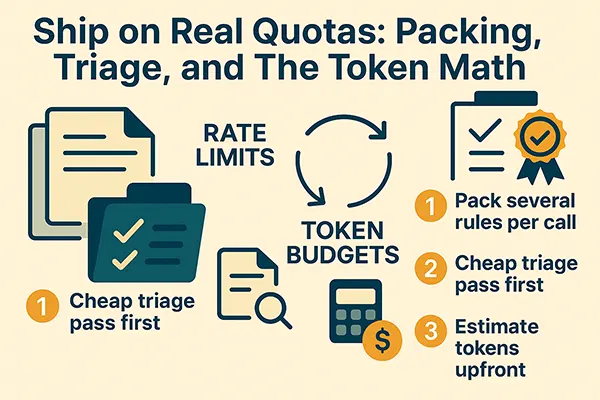
AI-Powered Processing of 500+ Page Bid Packs at Scale (3/4)
Big organizations drown in documents: 500-plus-page PDFs, scanned annexes, tables, and forms that arrive not once, but all the time. Shoving entire files into an LLM is slow, expensive, and hard to defend. This post shows a better way with AI: extract a small, testable catalog of requirements, index the documents locally, retrieve only the few passages that matter, and demand verbatim, page-linked evidence.
We use procurement as the running example, but the same pattern applies anywhere you process large volumes of pages: vendor risk and security due diligence, contract and policy review, healthcare and regulatory dossiers, M&A data rooms, insurance claims, ESG reports, and more.
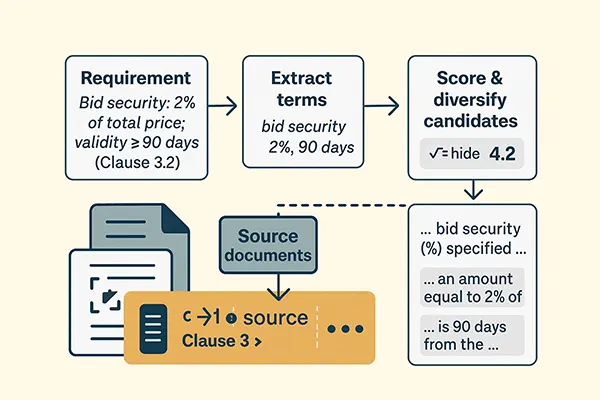
AI-Powered Processing of 500+ Page Bid Packs at Scale (2/4)
Big organizations drown in documents: 500-plus-page PDFs, scanned annexes, tables, and forms that arrive not once, but all the time. Shoving entire files into an LLM is slow, expensive, and hard to defend. This post shows a better way with AI: extract a small, testable catalog of requirements, index the documents locally, retrieve only the few passages that matter, and demand verbatim, page-linked evidence.
We use procurement as the running example, but the same pattern applies anywhere you process large volumes of pages: vendor risk and security due diligence, contract and policy review, healthcare and regulatory dossiers, M&A data rooms, insurance claims, ESG reports, and more.
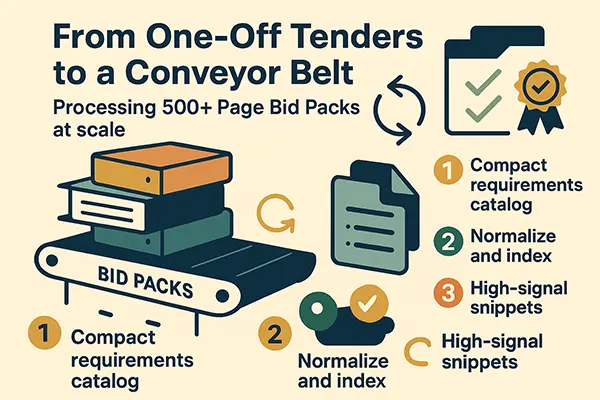
AI-Powered Processing of 500+ Page Bid Packs at Scale (1/4)
Big organizations drown in documents: 500-plus-page PDFs, scanned annexes, tables, and forms that arrive not once, but all the time. Shoving entire files into an LLM is slow, expensive, and hard to defend. This post shows a better way with AI: extract a small, testable catalog of requirements, index the documents locally, retrieve only the few passages that matter, and demand verbatim, page-linked evidence.
We use procurement as the running example, but the same pattern applies anywhere you process large volumes of pages: vendor risk and security due diligence, contract and policy review, healthcare and regulatory dossiers, M&A data rooms, insurance claims, ESG reports, and more.

Dal Codice Spaghetti all'Architettura Al Dente: Guida
“Spaghetti code” is almost never born that way. It starts as something small and pragmatic. A controller that “just hits the DB for now.” A static helper that “we’ll clean up later.” A feature that needed to go out yesterday.
Then the company grows, the product evolves, people leave, and suddenly your core system behaves like a haunted house: opening one door triggers five surprises somewhere else.
Here's how to save some real money.
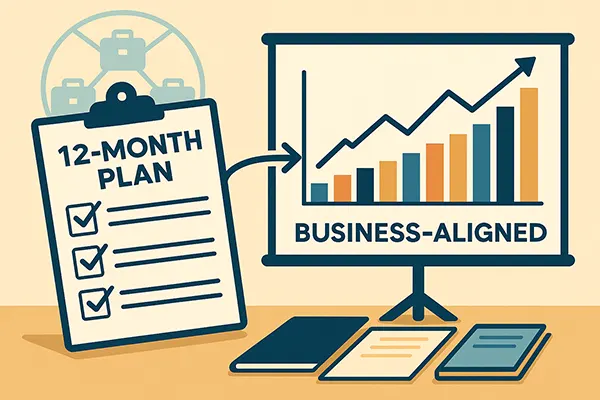
CTO Architecture Review to Roadmap (Part 3)
After all this, what do we actually walk away with? Not another 60-page PDF. Not a vague “you should probably refactor this.” You want something you can run the company with. This is where the review either becomes a tool for leadership or dies as a document in a shared folder.
Read Article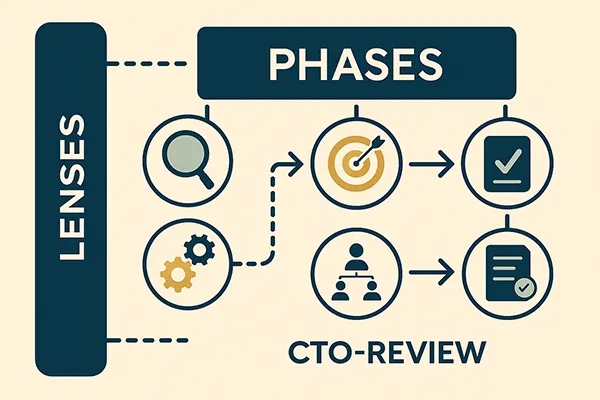
CTO Architecture Review to Roadmap (Part 2)
You might have clean diagrams, well-chosen patterns, and even a formal architecture review behind you: yet still be struggling with slow delivery, mounting technical debt, unreliable releases, or a platform that doesn’t match where the business is actually trying to go.
Read ArticleNeed a clearer view of a technology or operational problem?
Sharp Logica works with investors and operating companies on technical diligence, operational transformation, architecture, and technology leadership.
Subscribe to Our Newsletter
Stay current on the technology and operational decisions that affect business value. Technical diligence, operational transformation, architecture, AI, and technology leadership, without the hype.
We respect your privacy. Unsubscribe at any time.