

CTO Architecture Review to Roadmap (Part 1)
When companies reach out to a Fractional CTO, they almost never start with a blank slate. They’ve already built something. It mostly works. It’s creaking in a few places. People are nervous about scaling, security, costs, or that “big rewrite” someone keeps lobbying for. And quite often, they’ve already done some kind of architecture review.
From Architecture Review to Actionable Roadmap: What You Actually Get from a Fractional CTO (Part 1)
Why Traditional Architecture Reviews Aren’t Enough
When companies reach out to a Fractional CTO, they almost never start with a blank slate.
They’ve already built something. It mostly works. It’s creaking in a few places. People are nervous about scaling, security, costs, or that “big rewrite” someone keeps lobbying for. And quite often, they’ve already done some kind of architecture review.
Sometimes it’s a formal, structured architecture review methodology. Sometimes it’s a lighter internal assessment. Sometimes it’s a big consulting report that landed with a thud in everyone’s inbox.
You might even have gone through a formal approach like SARA or a similar framework that systematically evaluates your architecture against quality attributes, risks, and design principles.
All of that is useful.
But if you stop there, you’ve only answered one question:
Is this architecture technically sound?
But if you stop there, you’ve only answered one question:
Is this the right architecture for your business strategy, your team, and your runway?
This series is about that broader question.
In Part 1, we’ll look at why classic architecture reviews aren’t enough on their own. In Parts 2 and 3, we’ll walk through a practical Fractional CTO review framework and what you actually walk away with at the end.
What classic architecture reviews are good at
Let’s be fair: a solid architecture review is not a waste of time.
When done properly, a structured architecture review methodology will:
- Map out your current systems, integrations, and data flows
- Highlight structural risks: single points of failure, tight coupling, fragile dependencies
- Evaluate non-functional qualities: performance, scalability, reliability, security, operability
- Check alignment with agreed standards, patterns, and best practices
If your systems are a complete black box, this kind of review is invaluable. It creates a shared mental model. It gives everyone the same picture of “what we actually have” instead of ten conflicting versions.
The problem is not that these reviews are wrong. It’s that they quietly assume something that’s often false:
If the architecture is technically solid, we’re in good shape.
That’s simply not true.
You can have a beautifully designed system that is a terrible fit for your business reality.
The blind spot: business reality
A traditional architecture review usually doesn’t ask questions like:
- What are you trying to achieve in the next 12–24 months?
- How much runway do you have to get there?
- Where is the product heading, and how stable is that vision?
- What does your team actually look like – skills, seniority, turnover?
- How fast do you need to ship? How often can you safely change things?
- What markets are you entering, and what does that mean for compliance or data?
Without those answers, an architecture can look “clean” and still be completely wrong for your situation.
A few examples that come up again and again:
A startup with 18 months of runway and a highly modular, over-engineered platform that slows delivery to a crawl.
A growing SaaS that has clearly outgrown its original monolith, but is being pushed into a microservices migration without any serious investment in observability, testing, or platform capabilities.
A company expanding into new regions, still running on an architecture that assumes a single jurisdiction for data and compliance.
None of these are technical diagrams problems. They are context problems.
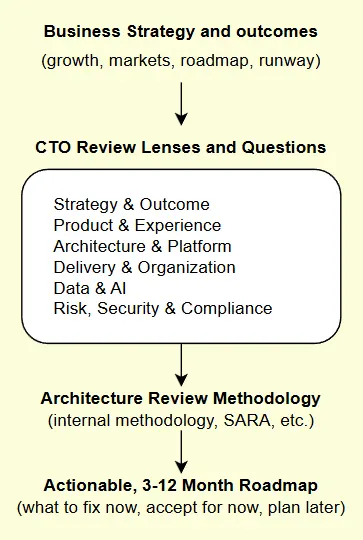
That’s where a Fractional CTO review starts: from the business outwards, not from the diagrams inwards.
CTO-level reviews start with outcomes, not diagrams
When you approach this from a CTO’s perspective, the first question is not:
Is this architecture pure enough?
It’s:
What must this architecture enable over the next 1–2 years?
That usually involves very concrete things:
- Revenue and growth targets
- New product lines or major features
- Market or region expansion
- Changes in pricing, packaging, or customer segments
- Plans to introduce AI, automation, or deeper analytics
- M&A scenarios or platform consolidation
Only once those are clear does it make sense to ask:
Can the current architecture support this?
Can the current team and processes operate it safely at that scale?
What will this cost to run if you hit your targets?
Where are the hard bottlenecks – technology, skills, process, or all of the above?
At that point, the structured architecture review methodology is still useful – but it’s one module inside a much wider review, not the whole story.
Architecture in isolation leads to the wrong decisions
A purely technical assessment can push you into decisions that look right on paper but fail in reality.
For example:
- A report concludes that the current monolith is “not scalable” and recommends a move to microservices. Technically valid. But:
- Your team has almost no experience with distributed systems.
- Your release process is already fragile.
- You have limited budget for platform, observability, and infra automation.
- You need to ship key features in the next 6–9 months.
From a pure architecture lens, the recommendation is fine. From a CTO lens, it might be disastrous right now.
A Fractional CTO would probably reframe the question:
- What’s the minimum structural change needed to survive the next growth phase?
- Where can we stabilize the current system (logging, monitoring, testing) before adding complexity?
- Can we extract a small set of services or modules that de-risk the future without betting the company on a big-bang rewrite?
- When is the right trigger point (revenue, usage, regions) to invest into a deeper platform change?
In other words: the architecture review becomes input, not destiny.
It’s not just systems – it’s people and delivery
A CTO-level review also has to deal with a harder, messier layer: how work actually gets done.
You can propose the cleanest architecture in the world. If the team cannot realistically build and operate it, it’s not a solution, it’s a fantasy.
So a Fractional CTO will look at things like:
- Team shape: are you organized by layers, by product, by capability?
- Ownership: who actually owns what in production? Who is on the hook when things break?
- Delivery: how often do you deploy, and how painful is it?
- Testing: what’s automated, what’s manual, what’s missing completely?
- Observability: do you know what’s happening in production, or do you guess?
These aren’t “soft topics” bolted onto a technical review. They are first-class constraints.
An architecture that requires a mature platform team, good observability, and robust automation is not inherently bad. It’s only bad if you don’t have those things and have no realistic plan to build them.
A Fractional CTO review hangs all of this together:
- Strategy: where you’re going
- Architecture: how systems are structured
- Delivery & Organisation: how change actually flows
- Risk & Cost: what could break and what it will cost to run
Traditional architecture reviews typically focus on the second bullet only.
Where architecture review methodologies still fit
None of this means you throw away formal architecture review methodologies. Quite the opposite: they become sharper when used in the right place.
In a CTO-level review, a structured architecture assessment is:
- A tool inside the broader Architecture & Platforms lens
- Mostly used in the Discover and Diagnose phases of the engagement
- Focused on areas that matter most given your strategy and constraints, not every system equally
If you already have the output of a previous architecture review, a Fractional CTO will usually treat it as input:
- Which risks identified back then are still real?
- Which recommendations were never implemented, and why?
- Do those recommendations still make sense in light of your current strategy?
- Is the “ideal target state” still ideal, or has the business moved on?
This shifts the conversation from “Did we pass the architecture exam?” to “What’s the next best step for the business given where we are?”
For an initial checkpoint before deeper review work, use the Architecture Scorecard.
Discussion Board Coming Soon
We're building a discussion board where you can share your thoughts and connect with other readers. Stay tuned!
Ready for CTO-level Leadership Without a Full-time Hire?
Let's discuss how Fractional CTO support can align your technology, roadmap, and team with the business, unblock delivery, and give you a clear path for the next 12 to 18 months.
Or reach us at: info@sharplogica.com