

The 30-Minute Task That Takes Three Days: Where Operational Time Actually Goes
A task that takes 30 minutes to complete can still take three days to reach an outcome. The difference is usually found in waiting, handoffs, missing information, rework, and exception handling across the wider business flow.
Sharp Logica helps companies examine one important business flow, map how it actually operates, and decide what should change before technology is introduced. Our Operational Transformation Assessment is a focused 2 to 4 week engagement that can lead to process changes, integration, automation, software, AI, or no technology investment at all.
Thirty minutes of work can produce three days of elapsed time
Leaders often hear that a business process is slow and reasonably ask which team needs to move faster. It is an understandable question, especially when the visible activity seems small: review a request, check an account, approve an exception, configure a record, or send a customer an answer. A person may complete that task in 30 minutes, yet from the moment the request arrives to the moment the customer receives an outcome, three days may pass.
The gap is not a rounding error, it is usually where capacity, customer confidence, and margin quietly disappear. The task may wait in an inbox until someone notices it, then move to another team that needs information that was not captured at the start, or it may be reviewed twice because the first reviewer lacks authority, returned for correction, or held while a specialist decides how to handle an exception. Each individual choice can appear sensible, but the overall flow can still be slow by design.
That is why operational time needs to be examined as end-to-end elapsed time, not merely as the effort recorded against one activity. A team can work hard and still deliver an outcome slowly when the process surrounding its work creates queues, unclear ownership, repeated handling, and avoidable dependencies.
Processing time and waiting time tell different stories
Consider a request to activate a new customer service. An operations analyst may need 30 minutes to confirm the information and create the required records. The request enters a shared mailbox on Monday morning, is picked up Tuesday afternoon, and is then sent to finance because a billing detail is missing. Finance asks the account team to clarify the detail, the customer responds the following day, and the analyst can finally complete the original task. The analyst was not the source of a three-day delay, although the customer experiences the whole period as one service process.
Processing time measures the time people or systems are actively working on an item. Elapsed time, often called lead time or cycle time, includes the queues, handoffs, corrections, and unresolved decisions around that work. Both measures are useful, although they address different management problems: processing time may point to a staffing or task-design issue, while elapsed time shows the experience delivered to the customer or downstream team. Improving the former without understanding the latter often produces little visible change.
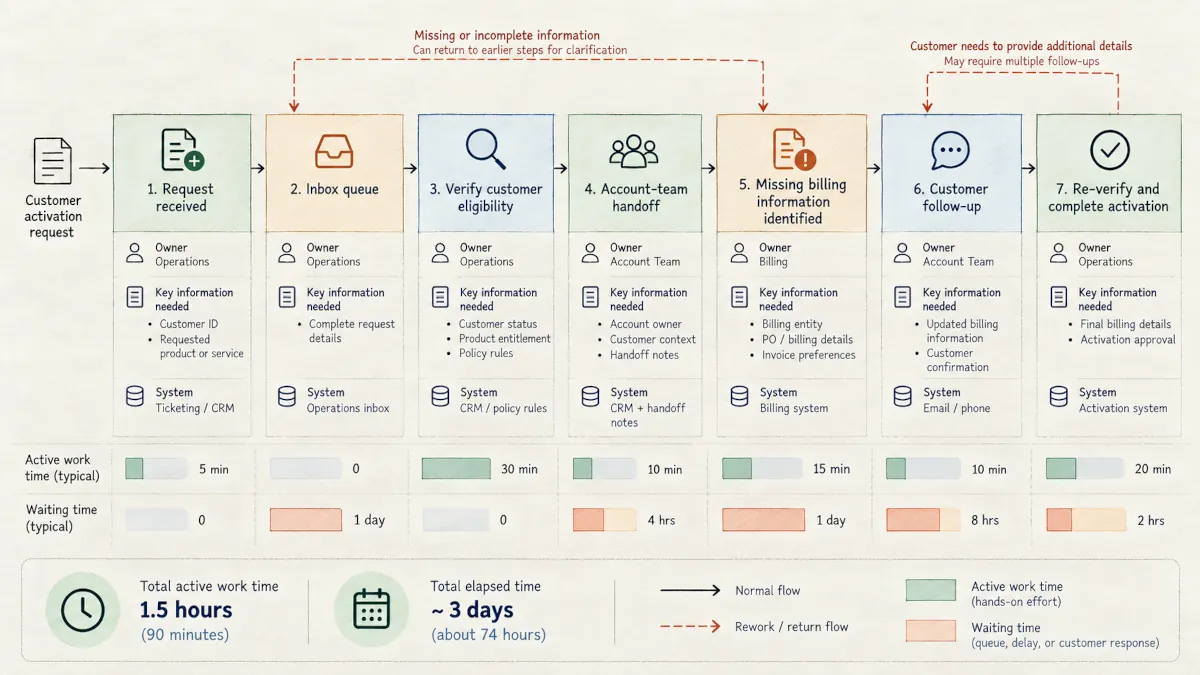
The diagram should make the hidden part of the experience visible. The active-work boxes are short, while the spaces between them carry most of the elapsed time. A good map also shows which team owns each step, what information is needed, which system holds it, and where the flow can return to an earlier stage. That turns a vague complaint about slowness into an observable operating problem.
Much of the delay sits between teams, systems, and decisions
Most organizations can produce a documented version of an important process in which a request is received, reviewed, approved, and completed. The work people actually perform is usually more involved, because a reviewer may need to search several systems to assemble a fragmented account history, or wait for an approval that exists because the policy does not distinguish routine cases from genuinely risky ones. A handoff that appears straightforward on the process diagram may happen through email because the workflow platform does not carry the information the next team requires. Once a customer has an unusual requirement, the formal route can give way to messages, meetings, and personal follow-up, leaving the people involved to coordinate the work as best they can.
These workarounds are not unusual, and in many cases they are what allow teams to keep the business moving despite gaps in the formal process. Their cost becomes difficult for leadership to see when performance is assessed only through department-level activity: sales may regard a handoff as complete while implementation is still waiting for commercial context, and finance may meet its invoice-accuracy target while operations waits for the account to be established. Each team can be performing well against its own measure while the customer is still waiting for the outcome that depends on all of them.
This is the reason value stream mapping is useful as a diagnostic tool. It follows the work from the trigger through the outcome, across the team and system boundaries where local reporting often stops. The map records steps, decisions, handoffs, systems, waits, manual work, rework loops, and exception paths, then validates that picture with the people who actually perform and manage the flow.
A queue can be a design problem in disguise
Although persistent excess demand can justify additional capacity, treating every queue as a resourcing problem overlooks the way the process itself may be creating the wait. Routine requests can sit until a weekly approval meeting because no lighter-touch route has been defined, while work that could be handled safely by several people is held for a single specialist because decision thresholds remain unclear. The same delay appears when a downstream team revalidates information already checked upstream, not because the check is inherently necessary, but because there is no trusted source or agreed accountability for data quality.
Although they can appear to be minor administrative details, these are operating-model choices, whether or not anyone originally designed them that way. Automating the flow before examining those choices may simply move more work into the same queue without improving the time to outcome. The better response may be to remove an approval, standardize the information required to begin work, clarify a decision threshold, or assign ownership of a recurring exception, none of which necessarily requires new technology.
The process redesign and automation work begins with this question: should this step exist at all, and if it does, what is the simplest reliable way to perform it? Stable rules, structured inputs, and predictable outcomes may justify workflow automation or system integration. Where the core issue is policy, ownership, or incomplete data, redesign needs to come first.
Rework restarts the clock around the task
Rework is rightly treated as a quality concern, but its operational cost is larger because each correction restarts the coordination around the work. When a field is missing, an analyst may need to ask an account manager for clarification, who contacts the customer, and the request joins the queue again when the answer eventually arrives. A mismatch between systems can create the same effect by requiring information to be checked and entered twice. The correction itself may take only five minutes, yet the back-and-forth it introduces can add days to the customer's elapsed time.
The cost rises sharply when the process treats routine work and genuine exceptions in the same way, because standard cases then consume the attention that should be reserved for decisions requiring judgment. Without a way to categorize recurring exceptions, different people continue solving the same issue without changing the rule, data requirement, or upstream handoff that created it.
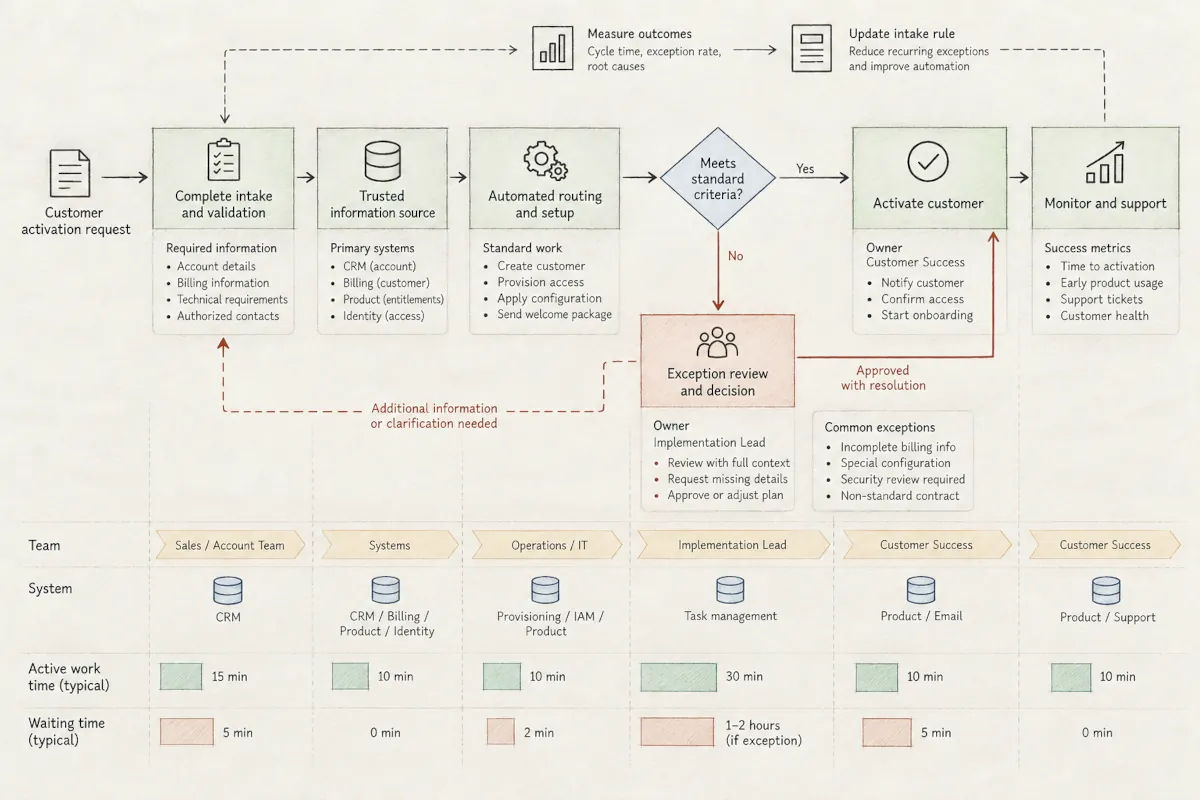
The future-state diagram should show that a faster flow is not simply a shorter list of boxes. It has clear entry criteria, a trusted information source, explicit decision rules, and a visible path for genuine exceptions. Standard work moves without unnecessary intervention, while higher-risk cases go to the right person with the context needed to decide. The feedback loop matters because recurring exceptions are evidence that the process needs adjustment, not merely a larger queue.
AI is useful only within a clear operating model
AI can be useful when delay comes from interpreting unstructured documents, classifying requests, extracting information, summarizing account history, or making a bounded recommendation. For example, it may help an operations team read an incoming customer request and identify the likely routing path, while deterministic workflow rules control permissions, approvals, and system updates.
That use case still depends on a process that is understood. The business needs to know what a good outcome looks like, what inputs are reliable, who remains accountable for material decisions, where a person must review the result, and how quality will be measured. Without those boundaries, an AI pilot risks adding a new layer of uncertainty to a flow that is already difficult to manage.
Our approach to AI-enabled workflows therefore places AI inside an operating model, where predictable work may be better handled through conventional automation or integration and AI can assist where interpretation is required. Many useful designs combine the two, retaining human review for decisions that carry material risk so the choice of mechanism continues to follow the work rather than dictate it.
Start with one flow that the business already feels
The practical response to a three-day task is not a company-wide transformation program. Choose one value stream that has visible business pain, such as quote-to-cash, customer onboarding, claims intake, billing, support escalation, or a recurring approval flow. Define where it begins, what outcome it must produce, and which people, systems, and measures are relevant. The scope should be broad enough to follow the outcome end to end, but contained enough that the evidence can be examined properly.
A focused Operational Transformation Assessment usually takes 2 to 4 weeks. It provides a current-state map, an evidence-based view of where time and value are being lost, a future-state design, and prioritized recommendations for what should be simplified, changed, automated, integrated, or evaluated for AI. Follow-on implementation is optional and scoped separately, because a decision-ready diagnosis is valuable in its own right.
The first question is not whether a 30-minute task can be made faster. It is whether the business can see everything that happens before and after those 30 minutes. Once that flow is visible, leadership has a much sounder basis for deciding where to invest effort, budget, and technology.
If a critical process appears to contain short tasks but long outcomes, start with the flow that is already under pressure. Sharp Logica can assess one defined value stream and provide a practical view of where time is going, why it is going there, and what should change next.
Discussion Board Coming Soon
We're building a discussion board where you can share your thoughts and connect with other readers. Stay tuned!
Ready for CTO-level Leadership Without a Full-time Hire?
Let's discuss how Fractional CTO support can align your technology, roadmap, and team with the business, unblock delivery, and give you a clear path for the next 12 to 18 months.
Or reach us at: info@sharplogica.com