
Operational Transformation Assessment
Value Stream Mapping for One Critical Business Flow
When quote-to-cash, onboarding, claims, support, billing, or another important flow is under pressure, leadership usually sees the symptoms before it sees the system causing them. We map the work as it is actually performed, across people, decisions, systems, queues, workarounds, and exceptions.
The first decision is deliberately small: is there one process painful enough to examine? The assessment turns that question into a shared picture of the current state and a clear view of what deserves attention.
The Operational Transformation Framework
01
Understand
Map the operating reality and make the sources of lost value visible.
02
Improve
Simplify the flow, clarify ownership, and remove avoidable work.
03
Automate
Apply rules, integration, and software where work is stable and repeatable.
04
Evolve
Use feedback, measures, and controlled AI where judgment and context matter.
The work product
A map of the work as it is actually done
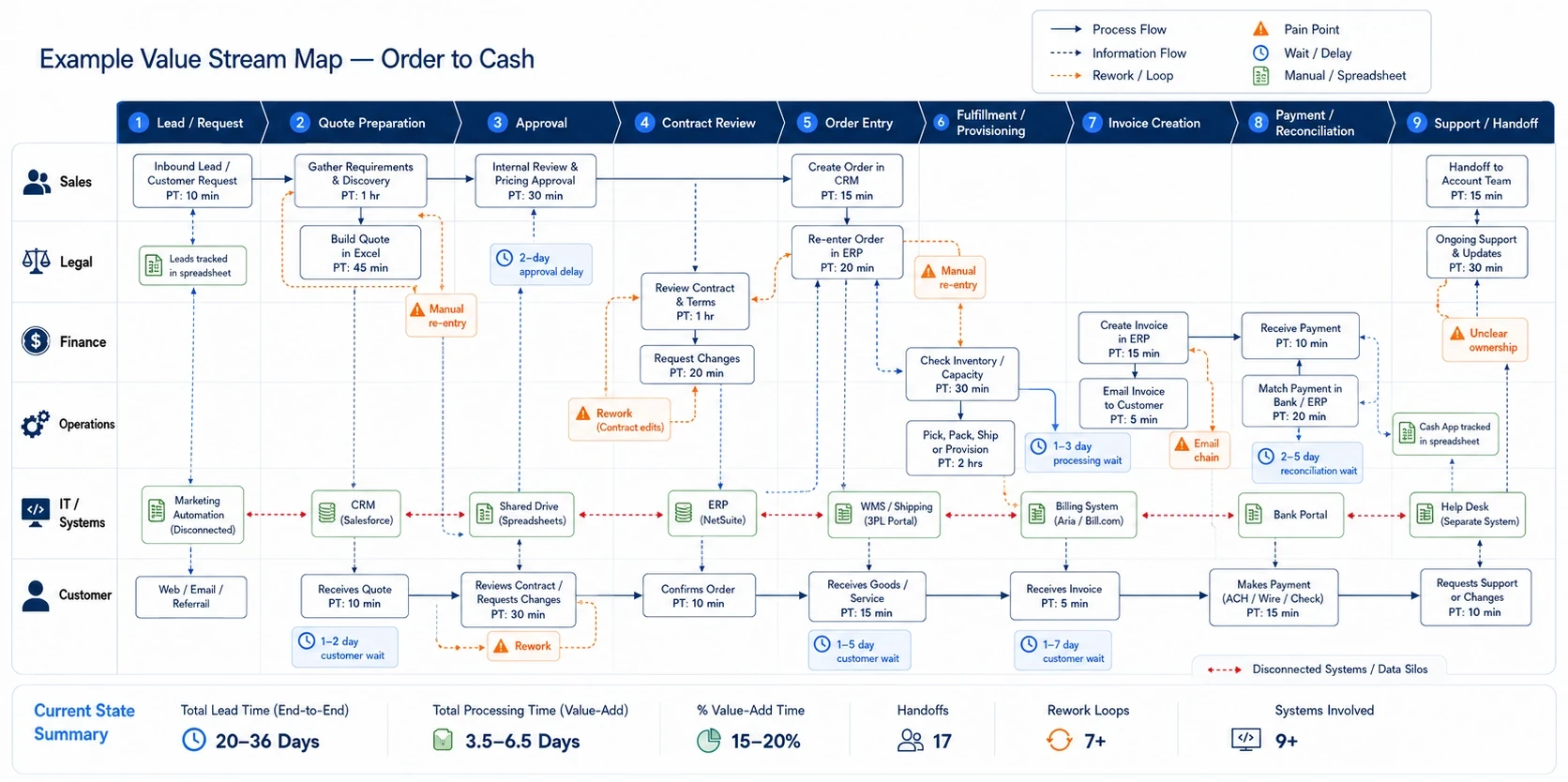
This is the kind of evidence-based map the assessment produces. It makes the relationship between flow, waiting, rework, handoffs, systems, and information visible enough for leaders to make a real decision.
What we study
One flow, from trigger to outcome
One defined value stream, from the event that starts the work through the outcome the customer, colleague, or partner receives.
A focused assessment typically runs for 2 to 4 weeks with the sponsor, process owner, operators, and the people responsible for supporting systems or data.
The readout gives leadership:
- Current-state value stream map showing steps, handoffs, systems, waits, rework, and exception paths
- Evidence-based view of where time, capacity, margin, quality, or customer experience are being lost
- Future-state design with ownership, process, data, and technology implications
- Prioritized recommendations and an executive readout
How the map is built
Choose the flow
We agree the value stream, boundary, outcome, and decision that makes the work worth doing. The scope stays narrow enough to examine properly.
Collect the operating evidence
Interviews, process artifacts, system views, operational measures, and live examples establish how work moves in practice, including the informal paths that do not appear in procedure documents.
Map and validate the current state
We make the handoffs, queues, data movement, rework loops, and decision points visible, then validate the map with the people who do and manage the work.
Design the next state
The final readout distinguishes changes to process, ownership, automation, integration, software, data, and AI so the organization can fund the right next move.
Questions leaders ask
Is value stream mapping just a workshop?
No. Workshops can help uncover the flow, but the assessment also uses operational evidence and validation. The output is a decision tool, not a wall poster.
How broad should the value stream be?
It should cover one meaningful end-to-end outcome, while remaining small enough to study in detail. Quote-to-cash, customer onboarding, claims intake, and support escalation are typical examples.
What if the issue spans several teams?
That is often the point. The assessment follows the work across team and system boundaries, then separates local symptoms from the end-to-end causes.