
Start with One Critical Business Process
We take one important value stream, map how it actually works, quantify where time and value are being lost, and design a practical future state.
You receive a decision-ready recommendation for what should change, be simplified, automated, integrated, or otherwise improved. Follow-on implementation is optional.
Not ready to discuss a live process? Take the free operational scorecard for a structured first-pass view of process visibility, operational friction, automation readiness, and AI opportunity.
Start with one process the business needs to improve
The Operational Transformation Assessment is the first engagement. We examine one critical value stream, make the operating reality visible, and give leadership a grounded basis for deciding what should happen next.
Value Stream Mapping
See how we map one end-to-end flow, identify friction, and turn evidence into a decision-ready diagnostic.
Explore the engagementProcess Redesign & Automation
Understand how findings become a simpler future state and a practical automation or integration plan.
Explore the engagementAI-Enabled Workflows
See where AI fits after the process, controls, data, and human review model are clear.
Explore the engagementStart with the flow that is creating pressure now
The assessment approach remains the same, but the operating problem is different in every flow. These pages focus on the symptoms, boundaries, and decisions that matter to a specific part of the business.
Quote-to-Cash Transformation
Reduce friction from quote through cash collection
Assess delays, rework, manual handoffs, and system friction across one clearly bounded quote-to-cash flow.
Explore quote-to-cashCustomer Onboarding Transformation
Improve time-to-value and the first customer experience
Assess missing information, handoff friction, manual coordination, and inconsistent activation across one onboarding flow.
Explore customer onboardingRevenue Cycle Transformation
Reduce friction from service delivery through payment
Assess denials, rework, manual reconciliation, system fragmentation, and weak visibility across one revenue cycle flow.
Explore revenue cycleTypically completed in 2 to 4 weeks for one clearly bounded business value stream.
The work includes focused discovery, stakeholder interviews, evidence review, mapping, validation, future-state design, and an executive readout.
$12,500
fixed fee for one clearly bounded value stream
More complex processes involving multiple business units, locations, or significant system dependencies are scoped separately.
The assessment is a standalone advisory engagement. Phase 2 implementation is scoped and priced separately based on the approved future state and roadmap, with no obligation to continue with Sharp Logica.
Do not start with AI. Start with how value flows.
Most organizations already know they have operating friction. The harder problem is seeing where it actually sits. Work moves across departments, inboxes, spreadsheets, approvals, legacy systems, SaaS tools, meetings, and informal workarounds. By the time the outcome reaches the customer, nobody has a clean picture of what happened.
Value stream mapping gives leadership a shared, evidence-based view of that flow. From there, the business can decide what needs process change, what needs automation, what needs software, and what may genuinely benefit from AI.
Start with one value stream the business already cares about
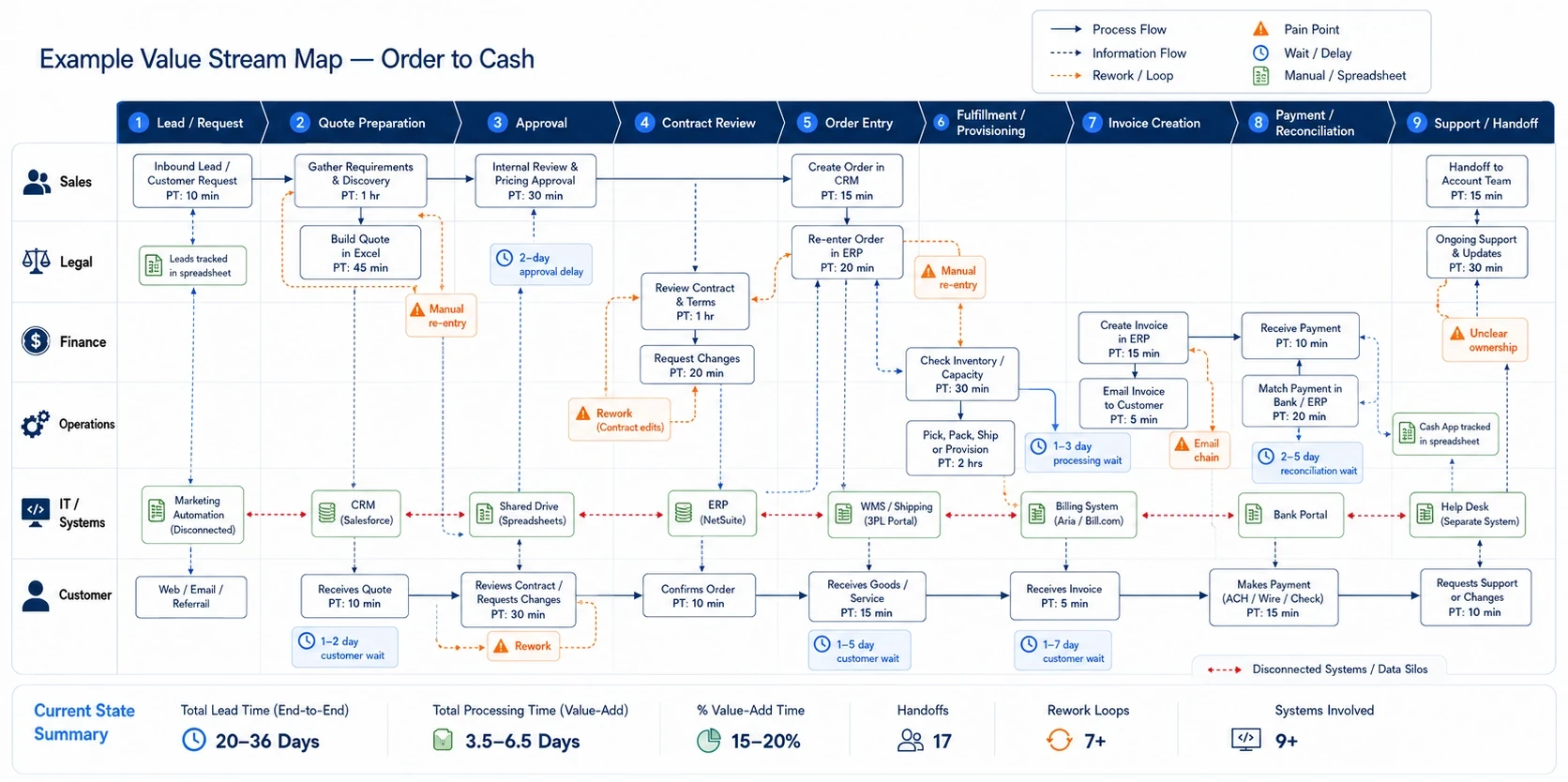
A value stream map makes the operating reality visible. It shows the steps, handoffs, systems, waits, rework loops, manual work, ownership gaps, and customer-visible delays that are usually scattered across meetings, spreadsheets, tickets, inboxes, and system logs.
The example below uses an order-to-cash flow, but the same approach applies to claims, onboarding, fulfillment, approvals, support escalation, billing, or any other flow where leadership needs to know what is slowing the business down before deciding what to improve or automate.
First
Understand and diagnose one business flow
Start with one important value stream. We map how work actually moves through the organization, across teams, systems, decisions, approvals, exceptions, and customer touchpoints.
The map helps identify delays, handoffs, rework, manual effort, ownership gaps, system fragmentation, poor data flow, and other sources of lost value. That gives leadership a shared current-state picture before anyone argues for a tool, workflow change, automation project, or AI initiative.
This diagnostic work produces the analysis and recommendations. For many organizations, it can be a complete engagement by itself because it gives the executive team the clarity needed to decide what to fund, stop, simplify, or investigate next.
The output is practical by design: a current-state map, a view of where value is being lost, the operational causes behind that loss, and a set of recommendations leadership can act on without first committing to a large transformation program.
This also creates a better starting point for later implementation work. Instead of debating symptoms, the team can discuss the actual flow, the evidence behind the bottlenecks, and the tradeoffs involved in changing how the work gets done.
Then
Improve the flow and choose the mechanism
Redesign the process first. The goal is to remove unnecessary complexity before adding more technology to a flow that may already be fragmented, unclear, or slow for non-technical reasons.
Automation is usually strongest when rules are explicit, inputs are structured, outcomes are predictable, exceptions are limited, and the same action should occur under the same conditions. A typical example is receiving an invoice, validating fields, routing it for approval, and posting it to the ERP.
AI becomes interesting when the work requires interpreting unstructured information, classification, document understanding, natural language, recommendations, or reasoning across context. A customer email, for example, may need intent detection, account context, next-action judgment, and a drafted response.
Frequently the best answer is hybrid: workflow automation, AI interpretation, then business rules and workflow again. Automation routes the work, AI extracts meaning, business rules decide the approval path, systems are updated, and AI may draft the communication.
This is where operational transformation becomes practical. The business is no longer buying a broad program. It is improving a specific flow: see the business, improve the business, automate what is predictable, and apply AI where judgment or interpretation is required.
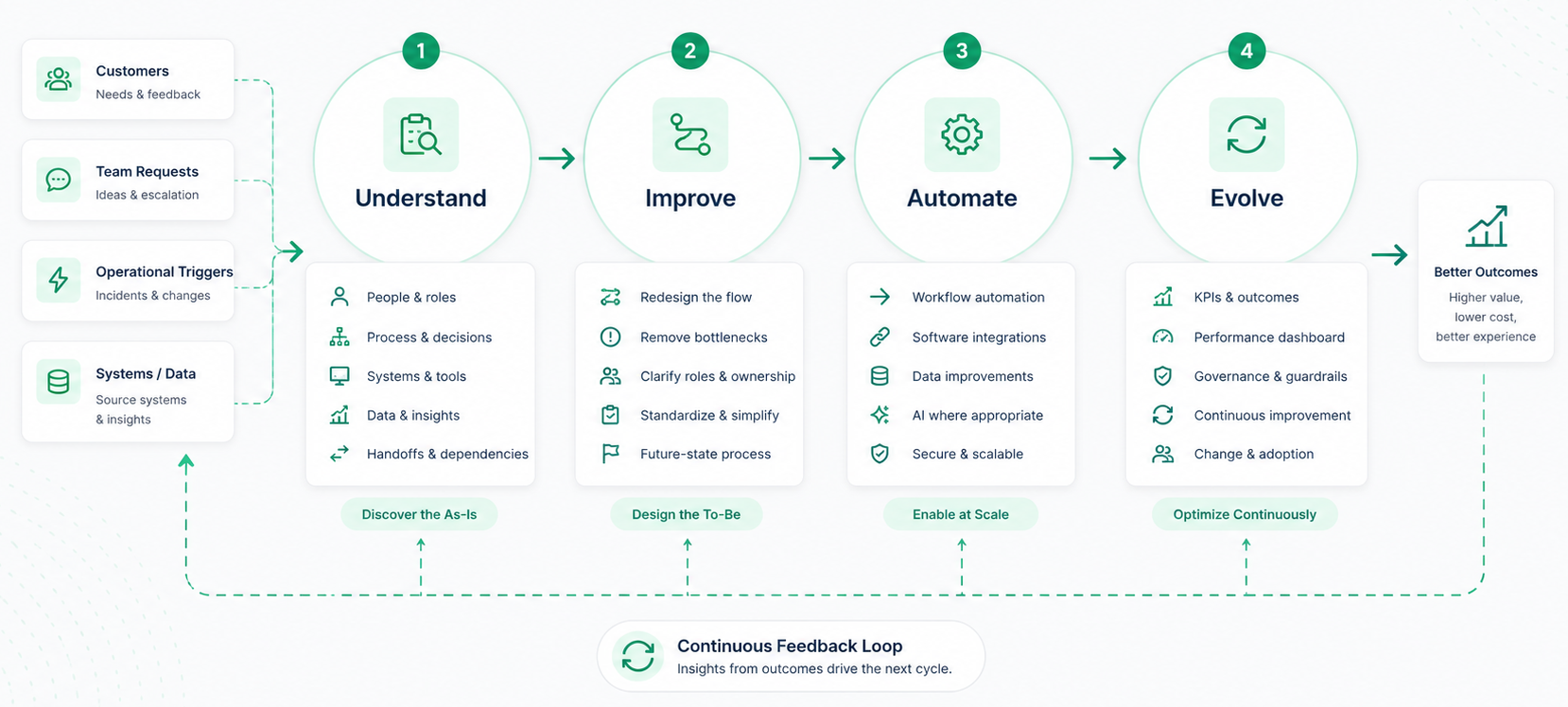
Understand, Improve, Automate, Evolve
The framework is designed to keep transformation grounded. It prevents the common mistake of choosing a technology first, then forcing the business to adapt around it.
Understand
We start by mapping the current state of one important value stream. The work is evidence-based: how requests enter the flow, who touches them, which systems are involved, where delays occur, where exceptions appear, and where customers or internal users feel the consequences.
Improve
Once the flow is visible, we redesign it before recommending automation. That means removing unnecessary handoffs, clarifying ownership, reducing rework, improving data quality, and separating problems that need operating-model change from problems that need technology.
Automate
Only then do we decide what kind of intervention fits. Automation is strongest when rules are explicit, inputs are structured, outcomes are predictable, and the same action should happen under the same conditions. AI becomes useful when the work requires interpretation, classification, document understanding, natural language, recommendations, or reasoning across context. Many good solutions combine both.
Evolve
Transformation does not end when a roadmap is written. The operating model needs measures, owners, feedback loops, and regular review so the business can see whether cycle time, quality, cost, capacity, risk, and customer experience are actually improving.
Two phases. Start with diagnosis. Execute only where it makes sense.
Operational transformation should not begin with a technology project. We first establish where value is being lost and what should change. The client can stop with that analysis and roadmap, or continue with Sharp Logica into implementation.
Phase 1
Operational Transformation Assessment
Understand where the business flow is breaking down and what should change.
We focus on one important value stream with visible business pain. We map the current state, identify delays, handoffs, rework, manual effort, ownership gaps, system constraints, and data issues, then design a better future state.
We also determine which problems should be solved through process redesign, conventional automation, system integration, software changes, AI, or no technology at all.
Typical outputs:
Phase 2
Transformation Execution
Implement the changes that create measurable business value.
Once the future state is agreed, Sharp Logica can help execute the transformation. The solution depends on the nature of the work.
Predictable, rules-driven activities are usually better suited to workflow automation, integration, or conventional software. Work involving interpretation, judgment, unstructured information, or variable inputs may benefit from AI. Many real processes require both.
Execution may include:
What does the process need?
Use automation where the process is predictable. Use AI where the work requires interpretation, judgment, or handling variability. Combine them where the process requires both.
Focused enough to move in weeks, detailed enough to support decisions
A focused assessment is normally measured in weeks, not months. We work with the people who own the outcome, perform the work, and understand the supporting systems and data.
The work typically combines:
Give leadership a clear view of what to change
The objective is not to deliver a process map. It is to give leadership a clear view of how the business operates today, what is preventing better performance, what the future state should look like, and which changes are worth funding.
See the flow
Current-state and future-state value stream maps.
Know where value is lost
Quantified friction, waiting, rework, manual effort, dependencies, and system gaps.
Know what to change
Clear recommendations across process, ownership, automation, software, data, and AI.
Know what to do next
A prioritized roadmap based on business value, effort, risk, and sequencing.
Practical material for leaders deciding what to change
Operational transformation usually starts with an uncomfortable question: do we understand the work well enough to change it? The knowledge platform gives leaders a way to examine that question before they commit to a program, a tool, or an AI initiative.
The material is built for executive and operating teams who need clear language, practical diagrams, and assessment tools they can use to discuss flow, friction, automation readiness, AI fit, and the business case for action.
Operational guidance
Practical writing on value stream mapping, automation judgment, AI readiness, and the operating issues that make transformation work difficult.
Executive discussion
Short-form observations and questions for leaders who are trying to separate useful transformation work from technology-driven activity.
Visual frameworks
Diagrams that make business flows, bottlenecks, handoffs, automation decisions, and AI opportunity quality easier to discuss.
Assessment tools
Lightweight tools for scoring process friction, automation readiness, AI opportunity quality, delivery risk, and the business case for change.
Common operational transformation questions
+What is Sharp Logica's operational transformation framework?
The framework is Understand, Improve, Automate, Evolve. It starts with value stream mapping so the organization can see how work actually gets done, then redesigns the flow, evaluates automation and AI opportunities, and keeps improving based on measurable outcomes.
+Where does AI fit in operational transformation?
AI is one possible intervention after the business flow is understood. Predictable work often belongs in workflow automation, system integration, or conventional software. AI becomes more useful when the work requires judgment, interpretation, classification, document understanding, natural language, recommendations, or reasoning across context.
+Is value stream mapping the service?
No. Value stream mapping is the diagnostic foundation of the Operational Transformation Assessment. The assessment turns the map into a future-state design, automation and AI decisions, and a prioritized roadmap. Sharp Logica can then remain involved to execute the transformation.
+What business outcomes should operational transformation improve?
The target outcomes usually include cycle time, cost, quality, capacity, customer experience, employee effort, risk, and management visibility. The right measures depend on the value stream being improved.
Need to understand where the business flow is breaking down?
Start with a conversation. The first question is not whether AI can be used. The first question is where value is being created, delayed, lost, duplicated, or hidden.
Or reach us at: info@sharplogica.com