
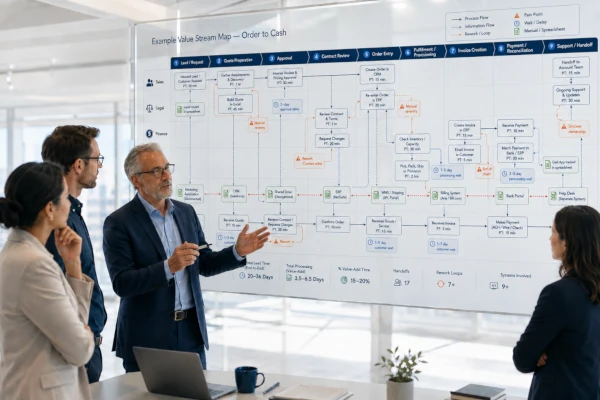
How We Approach Operational Transformation
Companies are under growing pressure to automate and adopt AI, but technology is rarely the best place to start.
The first step is understanding how work actually moves through the business, where time and value are being lost, and which parts of the process should change before any technology is introduced.
Sharp Logica helps companies understand how work actually flows through the business, identify where time and value are being lost, and determine what should be improved before introducing automation or AI. Our Operational Transformation practice starts with Value Stream Mapping and can continue through process redesign, automation, integration, and AI implementation where those approaches create measurable business value.
Before you automate a process, make sure you understand it
Most companies can identify at least a few processes that are clearly not working as well as they should, although the source of the problem is often harder to see. An order may take far too long to move from sales into fulfillment because information passes through several teams and systems along the way, while customer onboarding may depend on a mixture of email, approvals, spreadsheets, and manual coordination. Finance can find itself spending days reconciling information that already exists elsewhere in the organization, and employees may repeatedly move the same data between a CRM, an ERP platform, spreadsheets, and internal tools simply because those systems were introduced at different times and were never designed around the end-to-end flow of the business.
When problems like these become visible, the conversation naturally turns toward automation and, increasingly, toward AI as well. Both may eventually become part of the solution, but they are not the right starting point, because neither can tell you whether the underlying process should continue operating in its current form.
The process you think you have is rarely the process you actually have
Most business processes look reasonably clean when they are described at a high level. A request enters the organization, someone reviews it, an approval takes place, another team performs the work, and eventually the customer or internal user receives the expected outcome. Described this way, the process often appears logical and relatively straightforward.
The operating reality is usually much more complicated because the formal process is surrounded by informal practices that have accumulated over time. Once you speak with the people performing the work, you may discover spreadsheets being used because the primary system does not expose the information somebody needs, repeated data entry between applications, exceptions handled through email or chat, approvals that depend on people who are not formally part of the workflow, and departments maintaining different versions of the same information.
None of these issues may appear particularly serious when viewed independently, but together they can create a process where the actual work requires only a few hours while the end-to-end cycle takes several days or even weeks. The difference between those two numbers is often where a significant amount of operational waste, delay, and unnecessary effort becomes visible.
Start by understanding how value actually flows
At Sharp Logica, we use Value Stream Mapping as the diagnostic foundation for Operational Transformation engagements with companies that need to understand where operational friction, delay, rework, and manual effort are affecting business performance.
The objective is not simply to document a workflow or create another process diagram. The purpose is to build an evidence-based view of how value actually moves across teams, systems, decisions, approvals, exceptions, and customer touchpoints, so that leadership can understand the process as a whole rather than through the perspective of individual departments.
A useful value stream map therefore goes well beyond the official sequence of activities. It exposes processing time, waiting time, handoffs, rework, manual activity, disconnected systems, ownership gaps, and customer-visible delays, making it possible to distinguish between the time required to perform the work and the much larger amount of time that may be consumed by the process surrounding it.
This distinction matters because a task may require only 30 minutes of actual work while waiting two days for approval before anything else can happen. In that situation, optimizing the 30-minute task will have very little effect on the overall outcome because the real problem lies in the way the surrounding process operates.
A typical order-to-cash process might show the same pattern across several stages. Preparing a quote could require less than an hour of actual effort while approval takes two days, after which contract review may add another hour of productive work but introduce additional waiting and rework. Once the agreement is complete, the approved order may still need to be entered into one system and manually re-entered into another before fulfillment can begin.
The important question is therefore not simply “Can we automate this?” but “Why does this flow behave this way, where is value being lost, and what should change before we automate anything?”
Value Stream Mapping example
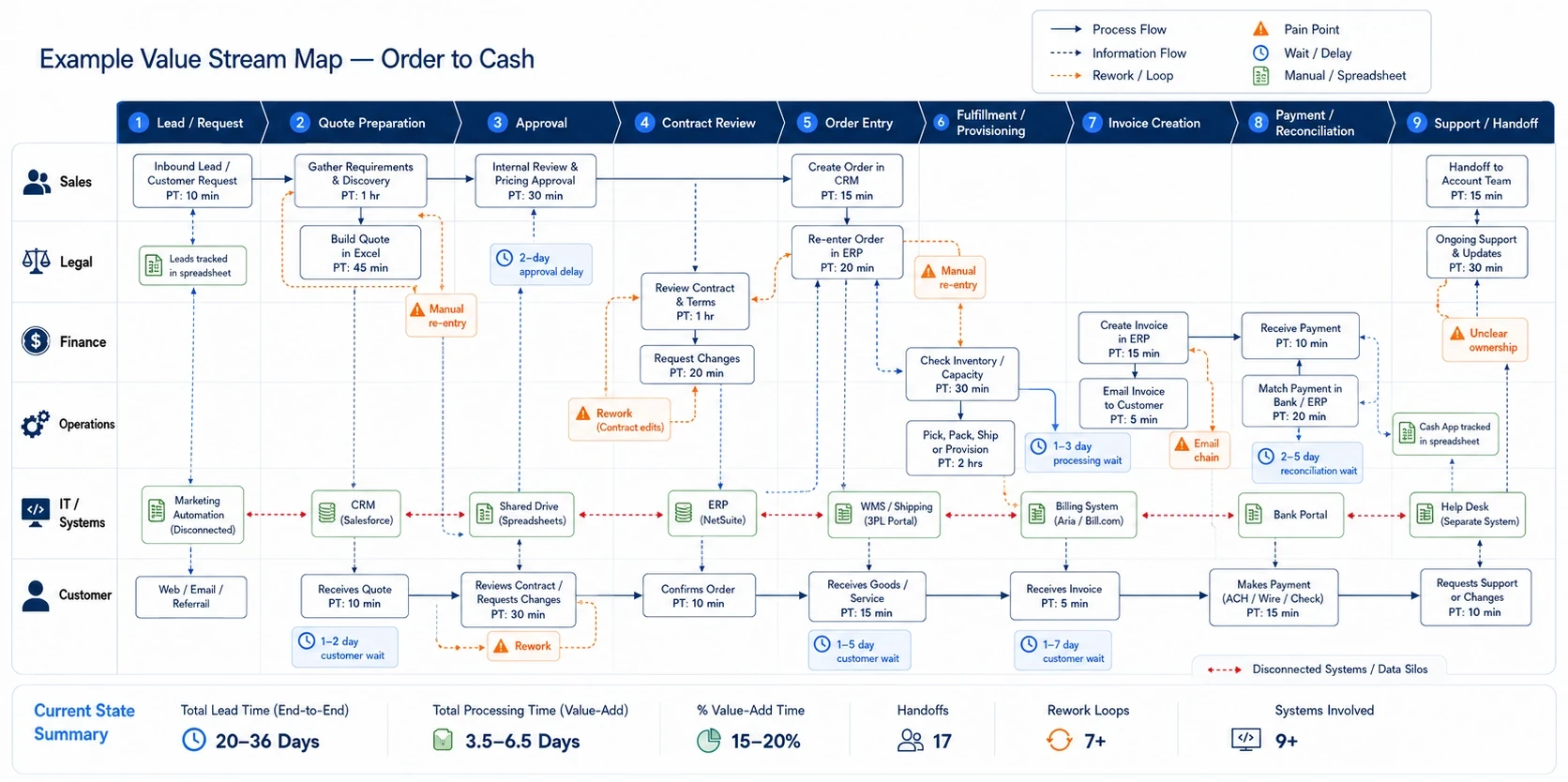
This diagram makes an important aspect of operational performance immediately visible: much of the waste in a business process often exists between the activities rather than inside them. Waiting for another department, moving information between systems, correcting errors, repeating work, resolving unclear ownership, and handling exceptions can consume far more time than the productive activities themselves.
This is why Value Stream Mapping gives leadership a much stronger starting point for transformation than selecting a technology first. Once the entire flow is visible, the organization can begin to distinguish between problems that require process redesign, problems caused by systems or data, activities that are appropriate for automation, and areas where AI may genuinely add value.
Our approach: Understand, Improve, Automate, Evolve
Once the business flow is visible, the transformation work becomes much more disciplined because decisions can be based on how the organization actually operates rather than on assumptions about where the problems might be.
Our approach follows four connected stages: Understand → Improve → Automate → Evolve
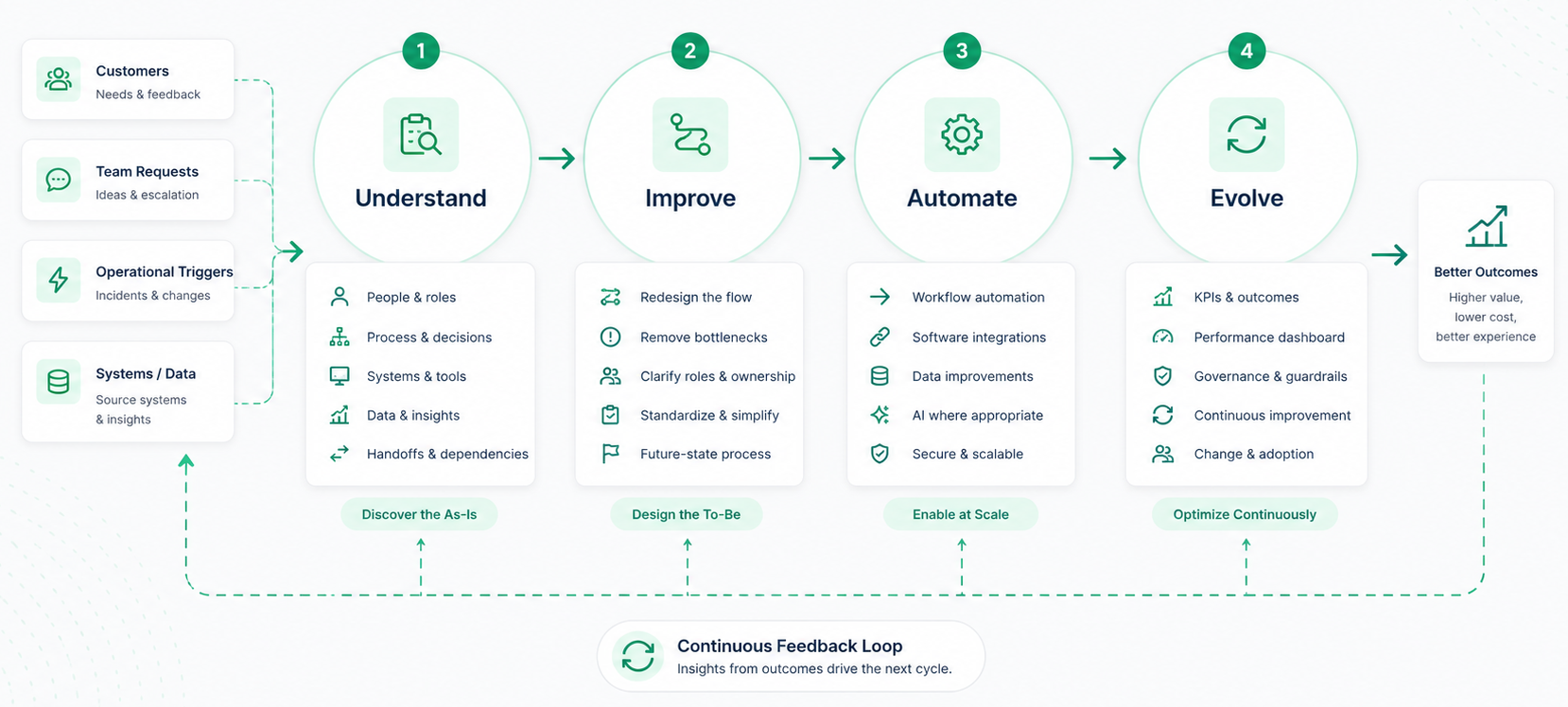
Understand
The first stage establishes what is actually happening today by mapping the current value stream, identifying who touches the work, which systems and data sources are involved, where delays occur, how exceptions are handled, and where customers or internal users experience the consequences.
The result is a shared current-state picture based on evidence rather than assumptions, giving business and technology leaders a common view of the process before decisions are made about how it should change.
Improve
Once the current state is understood, the next step is to redesign the flow before recommending technology. That may involve removing approvals that no longer serve a useful purpose, reducing unnecessary handoffs, clarifying ownership, eliminating duplicate work, improving data quality, or changing the way exceptions move through the organization.
This stage is important because automating a poorly designed process usually preserves the poor design. Technology may execute individual activities more quickly, but it cannot compensate for unnecessary complexity, weak ownership, or a process that was never designed around the outcome the business now needs.
Automate
Only after the process has been understood and improved do we decide what kind of technology belongs in it. Predictable, rules-driven activities are usually strong candidates for workflow automation, system integration, or conventional software, particularly when the inputs are structured and the expected action can be defined consistently.
AI becomes more useful when the work involves interpretation, classification, document understanding, natural language, recommendations, or reasoning across context, where the inputs and situations vary enough that conventional rules become difficult to maintain.
Many real business processes require both approaches. Automation may control the overall workflow while AI interprets an unstructured document or customer request, after which business rules determine the next action and traditional systems complete the transaction. The decision is therefore not simply automation versus AI; the more useful question is which mechanism is appropriate for each part of the business flow.
Evolve
Transformation should not end once the redesigned process has been implemented, because the organization still needs to determine whether the changes are producing the intended results. Measures such as cycle time, cost, quality, capacity, risk, and customer experience provide evidence of whether the new operating model is actually performing better.
Processes also continue to change as the business grows, systems evolve, regulations shift, and customer expectations develop, which means the operating model needs clear ownership, measurement, and feedback loops so that improvement becomes continuous rather than another one-time transformation initiative.
Automation and AI solve different kinds of problems
One of the reasons companies struggle with AI initiatives is that AI is often treated as a general-purpose answer rather than as one possible component of a broader operating model. The better approach is to understand the characteristics of the work first and then select the mechanism that is most appropriate for that part of the process.
Where the work is predictable and governed by explicit rules, deterministic automation is often simpler, cheaper, easier to control, and easier to maintain. A well-defined workflow, integration, or conventional software solution can often perform these activities more reliably than introducing AI into a problem that does not require interpretation.
Where the work involves unstructured information, variable inputs, interpreting intent, or applying contextual judgment, AI may provide capabilities that conventional automation cannot reproduce easily. Even then, AI rarely operates in isolation because the surrounding process will often continue to rely on deterministic systems, business rules, controls, and human decisions.
Many business processes therefore contain a mixture of different types of work, with one part being completely deterministic, another requiring interpretation, and another requiring human judgment. The practical objective is not to force the entire process into one technology category, but to understand the flow well enough to determine where process redesign, automation, integration, conventional software, AI, or human judgment belongs.
Operational Transformation can start with one important flow
Operational Transformation does not need to begin as a large enterprise-wide program. A more practical starting point is often one value stream where the business already sees measurable pain, whether that is quote-to-cash, onboarding, billing, claims handling, fulfillment, support escalation, internal approvals, or another process where delay, rework, manual effort, or poor visibility is affecting performance.
A focused first phase gives leadership a clear view of where value is being lost, why the process behaves the way it does, what the future state should look like, and which changes are worth funding. That assessment can stand on its own and provide the organization with a practical transformation roadmap, even if the company chooses to execute the recommendations internally.
Where execution support is needed, Sharp Logica can continue into the second phase and help implement the required changes across process design, system integration, automation, software, and AI-enabled workflows. The central principle remains consistent throughout the engagement: understand the business flow first, improve the process second, and introduce automation or AI only where they materially improve the outcome.
If your company has an important business process that is slow, fragmented, overly manual, difficult to scale, or being considered for automation or AI, Sharp Logica can help establish what is actually happening across the flow, identify where value is being lost, and determine which changes are most likely to improve business performance.
Discussion Board Coming Soon
We're building a discussion board where you can share your thoughts and connect with other readers. Stay tuned!
Ready for CTO-level Leadership Without a Full-time Hire?
Let's discuss how Fractional CTO support can align your technology, roadmap, and team with the business, unblock delivery, and give you a clear path for the next 12 to 18 months.
Or reach us at: info@sharplogica.com