
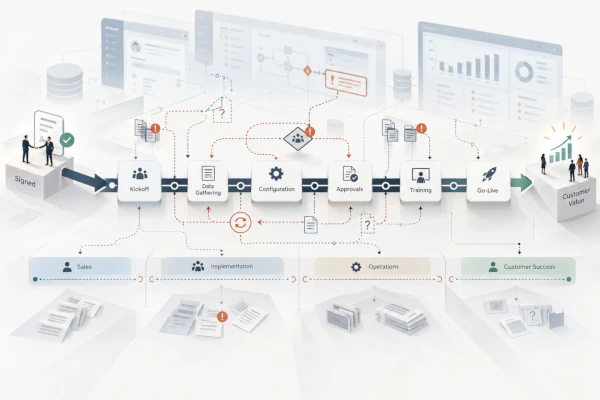
Customer Onboarding Is Usually a Process Problem Before It Is a Software Problem
When onboarding is slow or inconsistent, a new platform can look like the obvious answer. The underlying problem is more often the way work, information, ownership, and exceptions move from the commercial handoff to customer value.
Sharp Logica helps companies examine one important business flow, map how it actually operates, and decide what should change before technology is introduced. Our Operational Transformation Assessment is a focused 2 to 4 week engagement that can lead to process changes, integration, automation, software, AI, or no technology investment at all.
Customer onboarding is where a promise becomes an operating reality
Customer onboarding is often treated as a discrete implementation activity: a contract is signed, a project is opened, some configuration is completed, and the customer is handed to support or customer success. That description is tidy, but it usually misses the work that determines whether the customer reaches value quickly and with confidence. Sales may have made commitments that are not visible to the delivery team. Commercial information may be incomplete, scattered across a CRM, email threads, documents, and calls. Product, operations, finance, implementation, and customer success may each be waiting for a different prerequisite before they can proceed.
When onboarding begins to feel slow or inconsistent, the understandable response is to look for software. A project-management tool, customer portal, workflow platform, or AI assistant may all be useful later. None of them can establish a clear activation definition, resolve conflicting ownership, or decide which information needs to be complete at the commercial handoff. If those questions are unanswered, new software tends to become another place where people record the same uncertainty.
The better starting point is to understand the flow from the moment the customer commits to the point at which they are receiving the value they bought.
The visible delay is rarely where the problem starts
A customer may experience the issue as a delayed kickoff, an unclear request for information, or a period of silence after signing. Internally, teams may describe the same issue as incomplete requirements, difficult customers, a slow implementation group, or poor data in the CRM. Each explanation can contain some truth, but none is enough on its own because onboarding performance emerges from the connections between those activities.
A common pattern begins when sales closes an agreement and hands the account to implementation without a sufficiently complete picture of the scope, technical environment, customer contacts, or security requirements. Implementation then has to recover that context from sales, return to the customer for missing information, and wait for the right internal specialist to become available. At the same time, finance may be unable to establish billing until legal-entity and purchase-order details are confirmed, while customer success joins late and must reconstruct the original commitments before it can support adoption. None of these activities necessarily takes long in isolation, but together they create the waiting, repeated questions, and inconsistent communication the customer experiences.
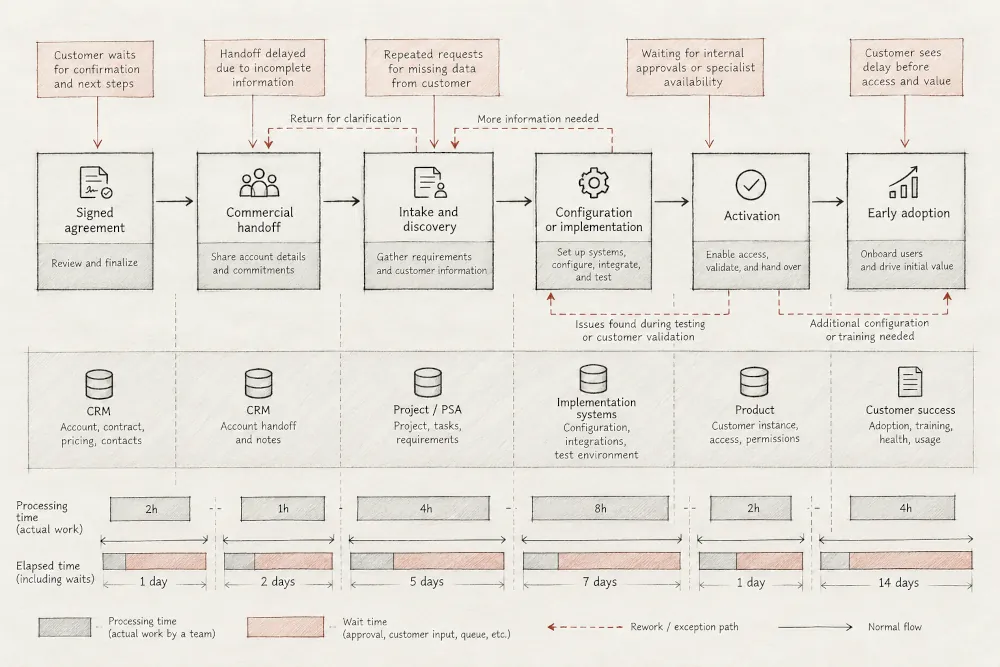
The diagram should make a distinction that is easy to miss in a project plan: processing time is not the same as elapsed time. A configuration task might take two hours, yet sit in a queue for three days because an approval, a customer input, or a specialist is unavailable. A value stream map puts those waits next to the work itself, alongside handoffs, duplicate entry, missing information, and exception paths. It gives leadership a way to see why the onboarding duration is what it is, rather than simply asking one team to work faster.
A handoff is an information contract, not an event on a calendar
The most expensive friction in onboarding frequently begins before the implementation team has received the account. Sales needs enough flexibility to pursue and close business, while delivery needs a reliable basis for staffing, planning, configuring, and communicating with the customer. The answer is not to burden every deal with a long checklist. It is to define, by customer type and offering, the information that must be known, who is accountable for it, and what happens when it is not available.
That information contract can include the commercial scope, intended outcome, customer contacts and decision-makers, technical dependencies, data or security requirements, billing prerequisites, implementation assumptions, and open risks. More importantly, it needs to be supported by an operating rule. If an essential item is missing, is the deal returned for clarification, accepted with an explicit risk, or routed to a specialist? Without that rule, people make reasonable but inconsistent choices under pressure, and the inconsistency becomes visible to the customer.
This is closely related to the issues found in quote-to-cash. The commercial flow does not end when a quote is accepted. The quality of information and decisions made before signature affects downstream activation, fulfilment, invoicing, and the customer’s confidence in the relationship.
Software can coordinate a good process, but it cannot invent one
An onboarding platform can centralize tasks, prompt customers for information, surface milestones, and create visibility for the teams involved. Integration can prevent people from retyping account details between CRM, billing, provisioning, and support systems. Workflow automation can route work consistently, while AI can help interpret customer documents, draft communications, or classify incoming requests. These are meaningful capabilities when they support a well-understood future state.
Technology becomes far less useful when the underlying process is still ambiguous, because automating an unclear handoff merely moves incomplete information faster and a portal can burden the customer with documents the business has not properly defined. An AI assistant may summarize account history effectively, but it cannot replace the accountable owner or operating policy required to make a decision.
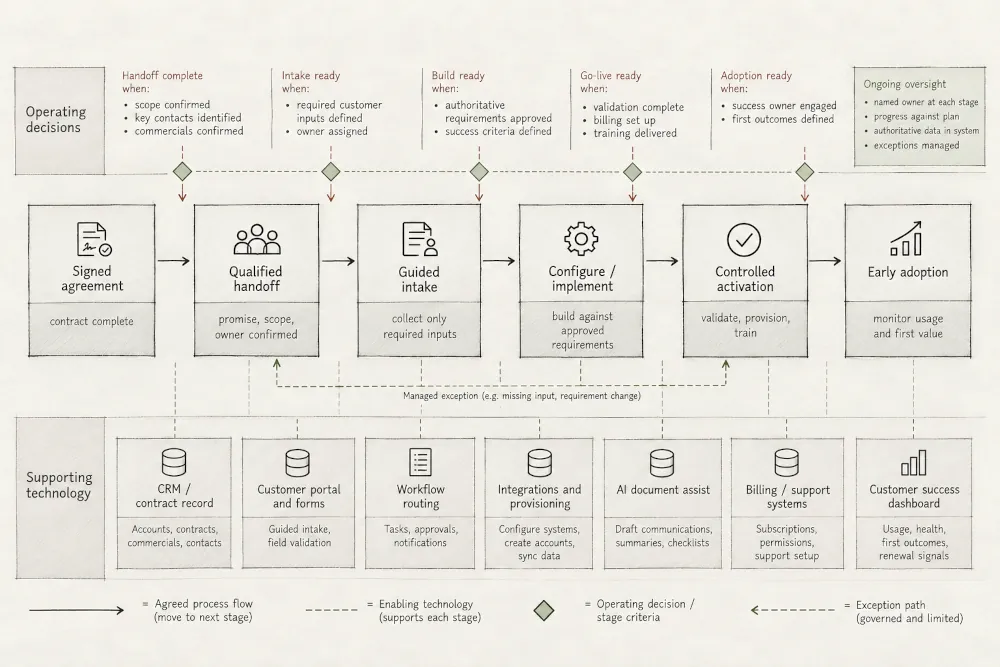
The future-state diagram should distinguish the operating decisions from the technologies that support them. Before selecting a tool, the team agrees what qualifies a customer to move into the next stage, who may make exceptions, what information is authoritative, and how progress will be measured. Technology is then applied to the stable, repetitive, and appropriately controlled parts of the flow. That order makes implementation simpler because the system is being configured around a decision that has already been made.
Start with one onboarding flow and evidence from the people doing the work
Customer onboarding varies materially by product and customer segment: an enterprise engagement may involve security review, integration work, data migration, training, and executive governance, while a lower-touch product may require only identity setup, a data import, and guided adoption. The practical starting point is to choose one meaningful flow, define its boundary clearly, and examine how it behaves in day-to-day operation.
That is the purpose of a focused Operational Transformation Assessment. Over 2 to 4 weeks, the work maps the current value stream, validates it with the people who sell, implement, configure, support, bill, and manage the customer, and connects the map to available measures. The practical output is not a generic process diagram. It is an evidence-based view of where time, capacity, margin, quality, and customer confidence are being lost, along with a future-state design and prioritized recommendations.
The recommendations may involve simplifying intake, changing responsibilities, improving data quality, reducing approvals, creating clearer exception paths, integrating systems, automating workflow steps, or using AI for a bounded interpretation task. They may also conclude that a proposed software purchase is premature. That is still a useful result, because it prevents the organization from spending money to preserve a process that needs to change first.
Measure the outcome the customer actually experiences
The most useful onboarding measures are anchored in the customer outcome rather than in internal activity. Time from signature to first value is usually more meaningful than the date a project was opened. Completion quality matters alongside speed, because a rushed activation that leaves the customer unable to use the product will create later support cost and avoidable churn. Teams should also understand how many times they ask for the same information, how often work is returned, which exceptions consume specialist time, and where customers go quiet or disengage.
These measures provide a baseline for improvement and show whether the redesigned process is producing a meaningful result, rather than merely confirming that a new workflow has been deployed. The real test of onboarding is whether the customer can reliably begin receiving the value they were promised, with time-to-value and customer effort improving as a result.
For a broader view of how we improve critical business flows, explore our Operational Transformation.
If onboarding is slow, fragmented, or difficult to scale, start with the flow that is already under pressure. Sharp Logica can assess one defined onboarding value stream, from customer commitment through activation and early value, and provide a practical view of what should change before a broader technology investment is made.
Discussion Board Coming Soon
We're building a discussion board where you can share your thoughts and connect with other readers. Stay tuned!
Ready for CTO-level Leadership Without a Full-time Hire?
Let's discuss how Fractional CTO support can align your technology, roadmap, and team with the business, unblock delivery, and give you a clear path for the next 12 to 18 months.
Or reach us at: info@sharplogica.com