
Why BidCompliance Exists: Because Manual RFP Compliance Review Breaks Down Fast
Reviewing one RFP is manageable. Reviewing the original RFP, multiple amendments, clarifications, and bid documents together is where manual compliance starts to break down. BidCompliance turns that complexity into a clear compliance matrix with Met, Partially Met, and Not Met.
If your team is managing competitive procurements where amendments are common and the requirement set tends to move between solicitation release and submission, BidCompliance is worth a closer look. You can try it for free, book a 30-minute demo, or email us directly at info@sharplogica.com if you have specific questions about how it fits your workflow.
Manual RFP Compliance Review Breaks Down Fast
The Document Pile That Never Stops Growing
You receive a 180-page RFP on a Tuesday. By Thursday, an amendment arrives correcting Section 4.2 and adding three new technical requirements. The following week brings another amendment, this one clarifying scoring weights and partially revising the mandatory certifications list. Somewhere in the middle of all that, the contracting officer releases a bidder clarification document that quietly rewrites what "demonstrated experience" means for the purposes of this particular procurement. Your team, meanwhile, has already been drafting the response since day two, working from the original document because that was the only one available when the work started.
Now someone has to figure out which version of each requirement is actually the governing one, whether the bid sections written two weeks ago still align to the requirement language that exists today, and whether anything in the clarification package changed the bar without anyone noticing. That reconciliation task falls to a person, usually a proposal manager with seventeen other things in motion, armed with a printed amendment summary and a spreadsheet that was last updated before the second amendment arrived. This is not an edge case in government contracting or complex commercial procurement. It is the ordinary shape of how competitive bids work, and the compliance review it demands is consistently one of the most fragile steps in the entire process.
The problem does not come from the documents being long. Experienced proposal teams handle length. The problem is that the requirement set and the bid package evolve simultaneously and in parallel, with no shared system tracking how changes on one side affect the validity of what has been written on the other. That gap, between what the RFP now requires and what the bid currently says, is where compliance failures live, not in the careless errors that are easy to catch but in the quiet misalignments that look fine until they do not.
What Manual Review Actually Asks of People
When proposal managers describe their compliance review process, the tools they mention are almost always the same: a requirements matrix in Excel, a printed or marked-up copy of the RFP, and a working knowledge of every amendment that arrived since solicitation release. The matrix is built early, usually from the original RFP, and then updated by hand as amendments come in - if there is time, if the person doing it is the same person who received each amendment, and if the update actually makes it into the master version rather than someone's local copy.
What this process requires, in practice, is that a human being hold in memory the correct precedence ordering of a document set that keeps changing, apply that ordering consistently across hundreds of individual requirements, and catch every instance where the bid language was written against a version of a requirement that no longer reflects the governing standard. That is a significant cognitive load to place on any individual, and it scales poorly as the amendment count rises. A single amendment changes the task from "compare this bid to this RFP" to "compare this bid to this RFP as modified by this amendment." Two amendments, and the task becomes "compare this bid to this RFP as modified by the first amendment and then further modified by the second amendment, in some cases overriding the first." Three amendments and a clarification document, and you are asking a person to maintain a mental model of requirement state that is genuinely difficult to keep accurate, especially while simultaneously managing the people writing the response.
The failures this produces are not always dramatic. A team does not usually submit a bid missing an entire section. What happens more often is subtler: a response addresses a requirement as it was written in the original RFP rather than as it was clarified or restated in Amendment 3, and no one catches it because the review was done against the matrix built from the original, and the matrix was not fully reconciled with the later files. The bid looks complete. It covers every line in the compliance checklist. And it still contains a misalignment that a sharper competitor, or a more careful evaluator, will notice before you do.
How BidCompliance Handles the Document Chain
The workflow inside BidCompliance is designed around a simple but consequential idea: that the requirement set is not a single document but a chain of documents, and that chain has a sequence that determines which language governs when sources conflict. You upload the original RFP. Then you add the amendments, clarification files, and any auxiliary solicitation documents in priority order, so the system understands which later files take precedence over earlier ones.
Then you upload the bid package - the technical volume, management approach, past performance, whatever the solicitation requires.
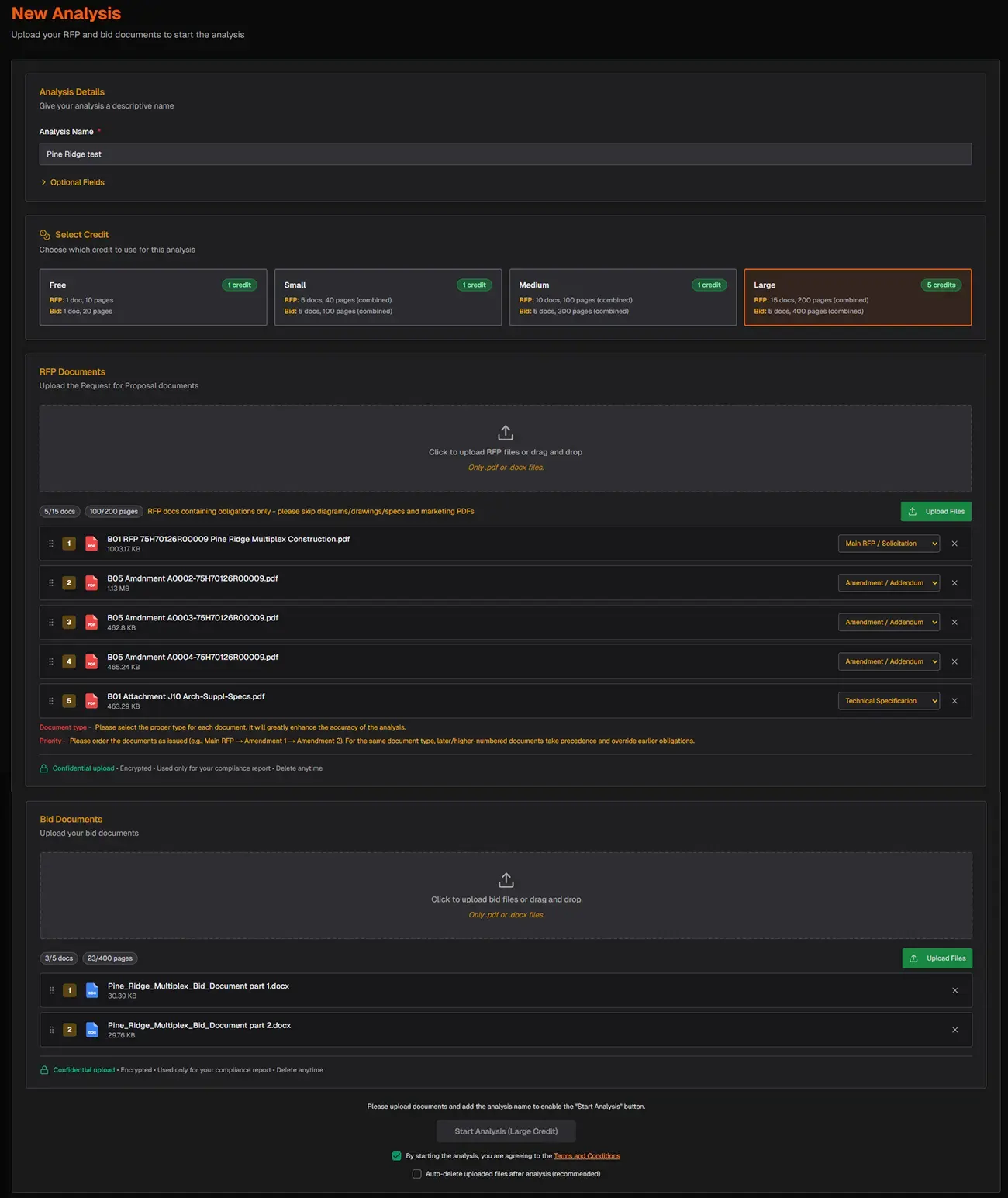
BidCompliance processes the requirement chain in sequence, allows newer stipulations to override earlier language where they conflict, constructs a unified picture of what the final requirement set actually demands, and then compares that picture systematically against the bid documents.
The output is a compliance matrix that reflects the requirement set as it stands at the time of submission - not as it stood when the team started writing, not as it was summarized in someone's amendment notes, but as the documents actually define it once precedence is applied. Each requirement is assessed against the bid, with a status indicating whether the requirement is met, partially addressed, or not covered, and with a traceable reference to where in the bid the relevant content appears. The proposal manager does not have to reconstruct the requirement hierarchy from a stack of files. They get a structured view of where the bid stands against the final requirement picture, and they can use that view to direct the revision work that matters rather than re-reading everything from scratch.
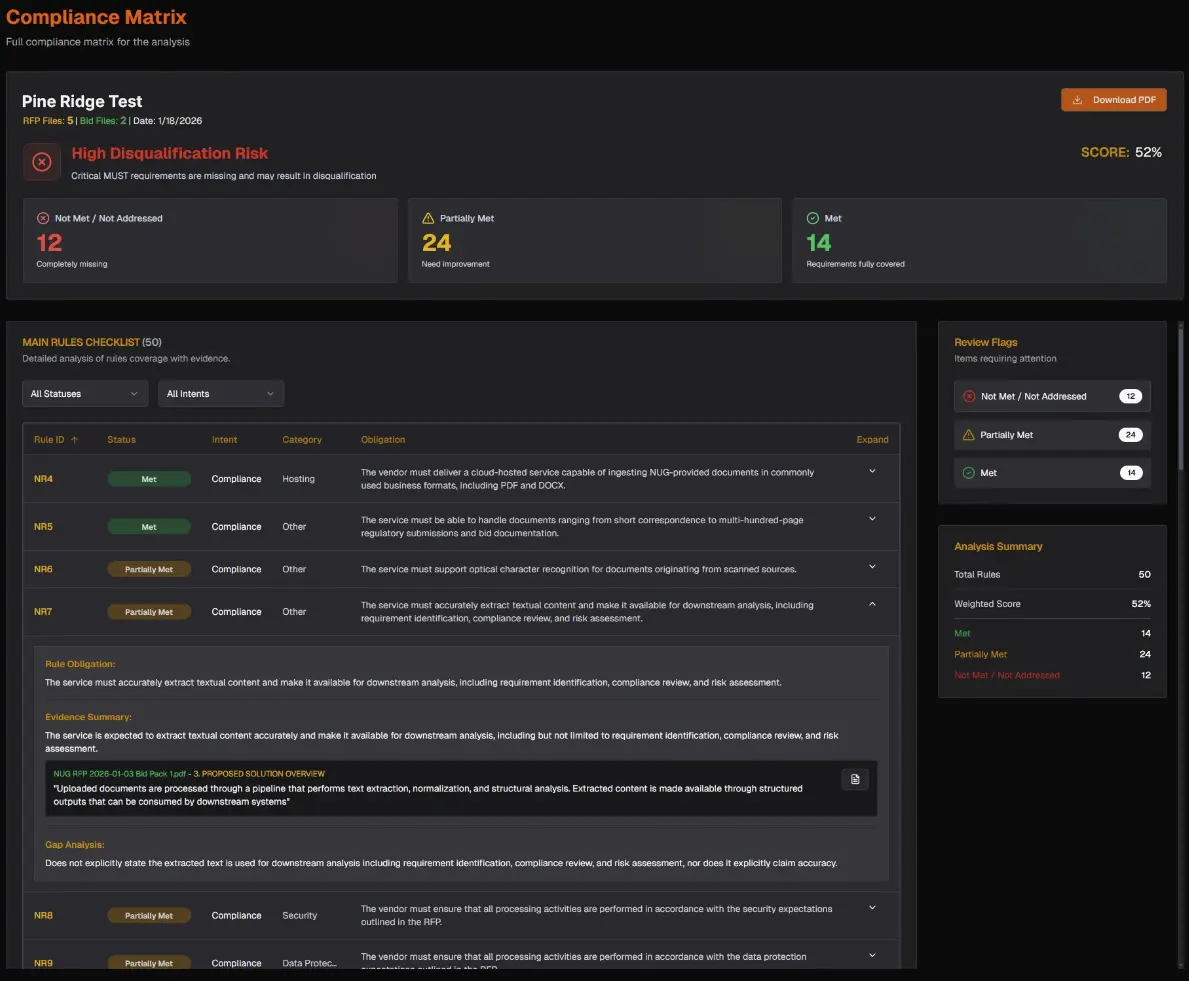
The compliance matrix reflects the requirement set as it stands after all amendments and clarifications have been applied - not as it was when the team started writing.
Each requirement is assessed against the bid, with a status indicating whether the requirement is met, partially addressed, or not covered, and with a traceable reference to where in the bid the relevant content appears. Equally important, every requirement carries a source citation - the specific section, paragraph, and document from which it originates, so the team knows whether they are looking at language from the original RFP, a superseding amendment, or a clarification filing, and can pull the exact passage if they need to verify the interpretation. Where the bid falls short, the matrix surfaces a gap analysis that identifies precisely what is missing or insufficiently addressed, giving the proposal manager a prioritized list of open items to resolve rather than a vague sense that something somewhere needs attention.
Why Amendment Priority Is the Differentiator That Actually Matters
Most proposal teams can imagine a tool that checks one bid document against one RFP. That is not a conceptually difficult problem, and it is not where the real risk lives. The genuinely hard part - the part that breaks manual review at scale - is checking a bid against an RFP that has been progressively redefined by several later documents, where some of those later documents partially modify sections of the original, some introduce new requirements entirely, and some clarify language in ways that change the practical interpretation of what compliance means without ever explicitly saying they are changing anything.
Amendment priority is not a feature in BidCompliance, it is the architecture. The system is built on the assumption that document order determines governing language, because that is how procurement actually works. A clarification issued after the amendment supersedes the amendment where they address the same point. An amendment that revised Section 3 takes precedence over the original Section 3 wording, but only for Section 3 - the rest of the original document still stands. Tracking that kind of layered precedence across a requirement set of hundreds of items is exactly the thing that manual review handles badly, not because proposal managers are not careful, but because the task is inherently difficult to do reliably in a spreadsheet managed by people who are also doing everything else.
What this means for a proposal team is that the compliance picture they get from BidCompliance reflects the document set they actually submitted against, not a simplified version of it. That distinction matters most in competitive procurements where evaluators are reading the RFP as it was finally issued, including every amendment and clarification, and assessing the bid against that complete picture. A compliance review that was done against an earlier version of the requirements is not really a compliance review of the bid that was submitted. It is a review of a bid against a requirement set that no longer governs the procurement.
What Proposal Teams Get Out of It
The practical value BidCompliance delivers is not just about speed, though the time savings are real (minutes instead of days). The value is about changing the nature of what proposal managers are asked to do during compliance review. Instead of spending hours reconciling amendment language, updating matrices by hand, and trying to hold the correct requirement precedence in working memory while also managing the response team, they start from a system-generated view of where the bid stands against the final requirement set. The work shifts from manual reconstruction to directed review - looking at the gaps the system surfaces, deciding which ones need to be closed before submission, and using the time saved on reconciliation to actually improve the bid.
For organizations that submit bids regularly, this also changes how compliance review fits into the broader production schedule. When the compliance check can be run against any version of the bid package at any point in the process, teams can catch alignment issues while there is still time to address them rather than discovering problems during the final read-through the day before submission. The compliance review becomes an ongoing checkpoint rather than a high-stakes final event, and the last-minute scramble that characterizes a lot of proposal shop review cycles becomes considerably less likely. That is not a minor operational improvement for teams running multiple simultaneous pursuits - it is a meaningful shift in how much of the submission timeline is actually controlled versus spent reacting.
There is also a quality dimension that matters beyond the immediate submission. A structured compliance matrix is a document. It can be reviewed by a second set of eyes, shared with a capture manager or a subject matter expert who needs to understand where the gaps are, filed as part of the pursuit record, and compared against evaluation feedback if the bid receives a debrief. The informal compliance review that lives in a proposal manager's head or in a spreadsheet known only to one person is not auditable in any useful sense. A system-generated matrix tied to the actual document chain is.
Why We Built It
BidCompliance exists because once an RFP has been modified by amendments, clarifications, and auxiliary stipulations, the gap between what the requirement set actually demands and what a manual review process can reliably track becomes difficult to manage without a system that understands document precedence. That is not a criticism of proposal teams. It is an observation about what manual review is structurally good at and where it runs out of road. People are good at writing compelling responses, managing pursuit teams, making judgment calls about what to bid and how, and reading evaluation criteria for strategic signal. They are less reliably good at maintaining a perfect mental model of a requirement set that has been revised three times while they were doing everything else.
And that is what increases a disqualification risk.
We built BidCompliance to handle the part of the process that benefits from a system: ingesting the document chain, applying precedence, comparing the result against the bid, and producing a matrix that gives the proposal team an accurate starting point for their final compliance review. The system does not replace the judgment of experienced proposal managers. It gives them better information to work from, and it frees their attention for the decisions that actually require it.
If your team is managing competitive procurements where amendments are common and the requirement set tends to move between solicitation release and submission, BidCompliance is worth a closer look.
You can learn more and request a demo at Try BidCompliance for free.
Discussion Board Coming Soon
We're building a discussion board where you can share your thoughts and connect with other readers. Stay tuned!
Ready for CTO-level Leadership Without a Full-time Hire?
Let's discuss how Fractional CTO support can align your technology, roadmap, and team with the business, unblock delivery, and give you a clear path for the next 12 to 18 months.
Or reach us at: info@sharplogica.com