
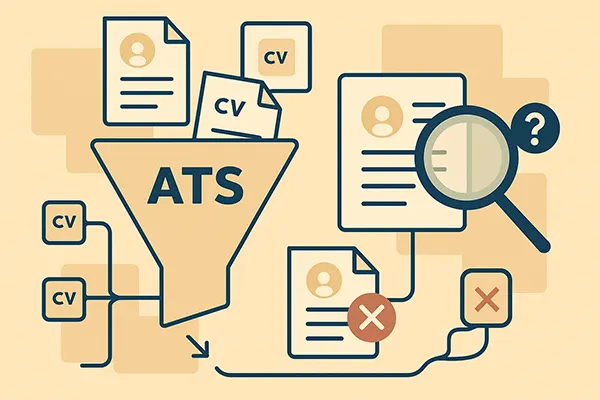
Why ATS Filters Aren't Enough for Hiring Decisions
Applicant Tracking Systems (ATS) were supposed to make hiring simpler. They collect resumes, store candidates, and apply keyword filters so overwhelmed HR teams can quickly shortlist people who “match” the job description. The problem is that matching keywords is not the same as making good hiring decisions.
Why ATS Filters Alone Are Not Enough for Good Hiring Decisions
Applicant Tracking Systems (ATS) were supposed to make hiring simpler. They collect resumes, store candidates, and apply keyword filters so overwhelmed HR teams can quickly shortlist people who “match” the job description.
The problem is that matching keywords is not the same as making good hiring decisions.
If you rely on ATS filters alone, you’ll miss strong candidates, waste time on weak ones, and gradually train your team to trust a black box that was never designed to understand people, only text.
Let’s unpack why that happens, and what a more balanced approach looks like.
ATS filters were built for volume, not judgment
Most ATS systems were created for a world where inboxes were exploding with applications and recruiters needed a way to avoid drowning.
So ATS filters optimized for one thing: reducing volume.
They scan resumes for specific keywords, titles, skills, or years of experience. If the right words are present, the candidate moves on. If not, they disappear into the “rejected” pile, often without a single human ever reading their CV.
That’s good for throughput. But hiring decisions aren’t made in a conveyor belt. Great hires come from understanding:
- How someone thinks and solves problems
- What kind of trajectory they’ve been on
- How well their experience maps to your specific context
None of this fits neatly into a handful of ATS rules.
Keyword matching creates false negatives and false positives
When ATS filters are treated as the main gatekeeper, two things start happening.
First, you get false negatives: strong candidates who never get seen because their wording doesn’t match the template in the job description.
Maybe they:
- Use a different job title for the same responsibilities
- Worked in a smaller company where roles were broader
- Describe outcomes rather than tools or frameworks
The system doesn’t care. No keyword, no shortlisting.
Second, you get false positives: weaker candidates who know how to play the ATS game.
They’ve learned to:
- Copy-paste keywords from the job description
- Stuff the CV with buzzwords
- Mirror titles and technologies even if the experience is shallow
On paper, they look like a match. In reality, they often disappoint in interviews.
The result? Your HR team spends time on the wrong people, while the best applicants might already have moved on.
Good hiring decisions require context, not just filters
A good hiring decision rarely comes from a single dimension like “X years of Y technology.”
Great hires emerge when you combine:
- Objective signals: skills, experience, achievements
- Context: how those skills were used, in what environment, with what constraints
- Trajectory: whether this person is leveling up, plateauing, or punching below their weight
None of that can be captured by simple “contains keyword” logic.
A CV might say “managed a team of 5,” but context answers:
- Were they actually leading, or just the most senior person on the team?
- Did they inherit a stable situation, or help build something from scratch?
- Were they driving results, or just attending meetings?
ATS filters don’t ask these questions. They cannot ask these questions. They just count matches.
Where AI helps: structured insight, not more noise
This is where AI-powered resume analysis can move you beyond “filtering” and closer to actual judgment.
The right AI assistant doesn’t just highlight keywords; it interprets the CV in the context of your job description. For example, it can help answer:
- How well does this candidate align with the core requirements of the role?
- Which parts of their experience are most relevant to this specific job, not just generically impressive?
- Are there any red flags or gaps that may warrant deeper questioning in an interview?
- How does this candidate compare to others on key dimensions (e.g., seniority, domain fit, leadership, adaptability)?
Instead of pushing more resumes into your ATS queue, AI can give HR a structured summary of each candidate: strengths, risks, and fit‐level, in plain language.
That’s the gap Screentico is designed to fill.
How Screentico complements your ATS (instead of replacing it)
Your ATS is useful. It stores candidates, tracks stages, and keeps your hiring process moving.
Where it struggles is in answering the “who should we actually invest time in?” question.
Screentico sits on top of your existing process:
- You keep using your ATS to collect and manage applicants.
- You define your job description and what you care about.
- Screentico analyzes your candidates’ resumes through that lens and gives you ranked, explainable insights.
Instead of skimming 50 resumes to find 5 decent ones, your team can:
- Start from a prioritized list, with reasoning attached
- See why a candidate is recommended (not just that they are)
- Quickly spot edge cases: candidates who don’t match perfectly on paper, but show strong potential
The ATS tells you: “these 120 people match your filters.” Screentico helps you answer: “who are the 8 we should actually talk to, and why?”
Reducing burnout and improving fairness at the same time
Over-reliance on ATS filters is not just a technical issue; it’s a human one.
When HR teams live inside keyword screens all day, work becomes:
- Repetitive
- Mentally draining
- Easy to second-guess (“did we miss someone good?”)
Adding an AI layer that surfaces clear, structured reasoning does two things:
- It reduces cognitive load. Recruiters don’t need to mentally parse every CV from scratch; they start from a summarized view and drill down where needed.
- It supports more consistent, fairer decisions. You get clearer criteria and more transparent comparisons, instead of gut feeling based solely on which CV happened to look “cleanest”.
You still need human judgment. AI doesn’t replace that. But it gives your team a better starting point than raw ATS output.
Moving beyond filters in a low-friction way
The good news: you don’t have to redesign your entire hiring stack to improve your decision quality.
You can start small:
- Take one open role
- Export or pull a set of candidates from your ATS
- Run them through Screentico with your real job description
- Compare the AI-ranked list and insights with how you would normally shortlist
You’ll quickly see the difference between “filtering by keywords” and “prioritizing by fit and potential”.
From there, you can decide where Screentico fits best: early screening, second-stage triage, or as a tool for hiring managers to prep for interviews.
Conclusion
In short: ATS filters are good at reducing noise, but bad at recognizing talent. They solve the volume problem, not the decision problem.
If you want better hires, less burnout, and a more transparent process, you need something that can actually read between the lines, not just count the words.
You can try Screentico on your next role and see the difference for yourself. Try Screentico for free
Discussion Board Coming Soon
We're building a discussion board where you can share your thoughts and connect with other readers. Stay tuned!
Ready for CTO-level Leadership Without a Full-time Hire?
Let's discuss how Fractional CTO support can align your technology, roadmap, and team with the business, unblock delivery, and give you a clear path for the next 12 to 18 months.
Or reach us at: info@sharplogica.com