
What We Look for During Technical Due Diligence of a Software-Enabled Business
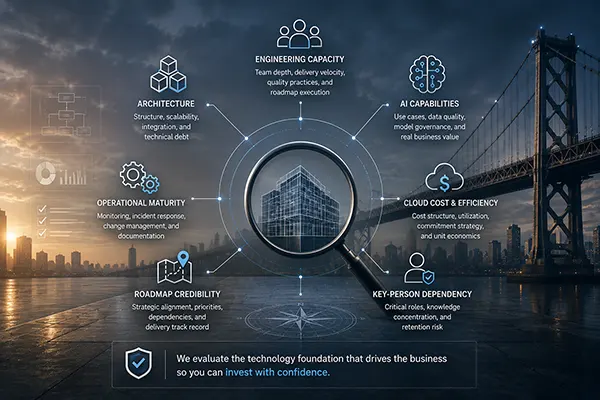
Many acquisition targets are not pure software companies, but their operations, growth plans, customer experience, compliance posture, and margins may still depend heavily on technology. Technical due diligence should uncover where the platform supports the investment thesis, where it creates risk, and what needs to be addressed after close. Sharp Logica evaluates architecture, engineering capacity, AI claims, operational maturity, cloud cost, roadmap credibility, and key-person dependency so investors can understand what they are really acquiring.
If your firm is evaluating a software company or software-enabled acquisition and needs to understand whether the platform can support the investment thesis, Sharp Logica can help with an executive-level Technical Due Diligence Assessment, including platform risk, scalability, engineering capacity, roadmap credibility, and post-close remediation priorities. You can book a 30-min free call, view the services, or email us at info@sharplogica.com with specific questions.
Introduction
Many acquisition targets are not pure software companies, but their business may still depend heavily on software. A healthcare services company may rely on a care-management platform, a logistics company may depend on scheduling and routing systems, a compliance business may be built around workflow automation, and a manufacturing or energy business may run important operations through custom applications, integrations, and reporting pipelines. In these situations, technology is not only a support function. It can affect revenue quality, margin, customer retention, regulatory exposure, and the credibility of the growth plan.
That is why technical due diligence needs to look beyond whether the application appears to work. A system can be stable for current operations while still being poorly prepared for new customers, higher transaction volume, enterprise integrations, acquisition integration, AI automation, or a more demanding compliance environment. The diligence question is not simply whether technology exists and functions today. The more useful question is whether the technology can support what the buyer is underwriting.
In real diligence work, the most important findings rarely appear as one obvious fatal flaw. They usually emerge from the way several smaller issues reinforce each other: the roadmap depends on a team that is already absorbed by support work, cloud costs are rising faster than revenue, customer onboarding still requires manual technical intervention, AI features look convincing in demonstrations but have weak evaluation controls, and critical system knowledge sits with a founder or senior engineer rather than in repeatable process. Each issue may be manageable on its own, but together they can change how the buyer thinks about execution risk after close.
Technical due diligence should turn scattered technical observations into deal judgment. That means separating ordinary technical debt from risk that affects the investment thesis, the first 100 days, the value-creation plan, or the budget required to make the platform fit for the next stage.
We start with the investment thesis
The same technical finding can mean different things in different deals. A fragile integration layer may be a minor issue if the company is expected to grow slowly within the same customer segment, but it may become a major concern if the buyer’s thesis depends on rapid enterprise expansion, new product packaging, or integration into a larger platform. A small engineering team may be reasonable for a stable niche business, but inadequate if the plan assumes faster roadmap delivery, stronger security controls, and more implementation capacity after close.
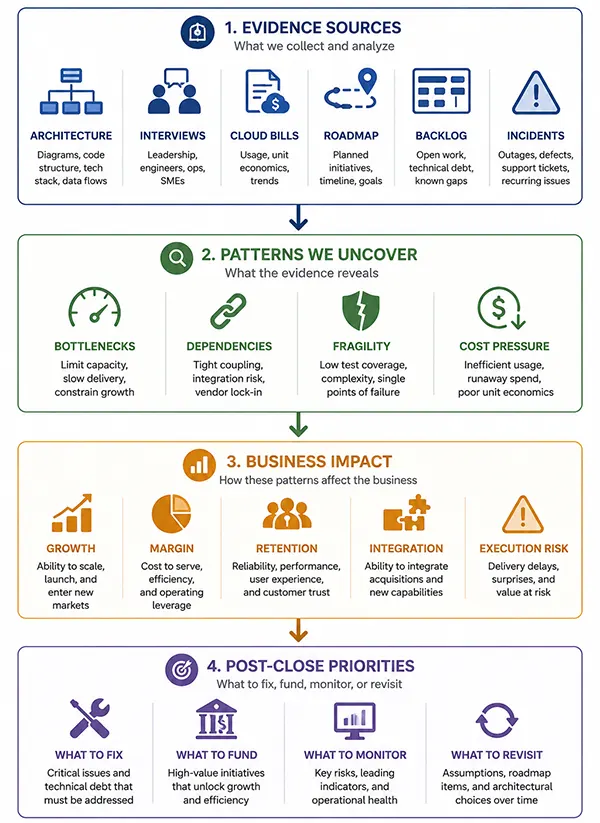
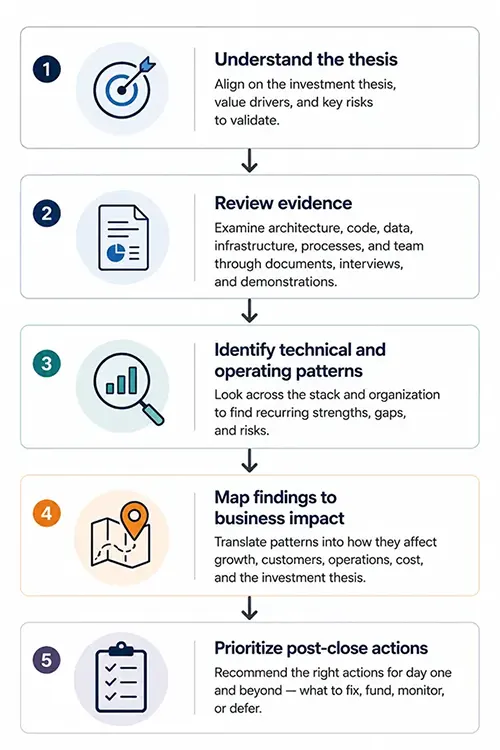
For that reason, a technical diligence review should begin with the buyer’s thesis and then follow the places where that thesis depends on technology. A growth thesis usually needs evidence around scalability, integration readiness, product extensibility, support burden, and engineering capacity, while a margin-expansion thesis may require a closer look at cloud cost, manual operations, customer-specific delivery effort, support load, and the technical debt that prevents the business from operating more efficiently. When AI or automation is part of the story, the review should test whether those capabilities are real, repeatable, cost-effective, and safe to operate, rather than treating them as proven because they appear in a roadmap or demo.
This does not mean that every diligence process becomes large or academic. It means the work has to be aimed at the risks that matter. A generic architecture review may describe the system, but technical due diligence has to explain how the system affects the deal.
We look for risk patterns, not isolated flaws
Most software-enabled businesses have technical debt, and that alone is not very informative. The real question is whether the debt is ordinary, manageable, and already understood by the team, or whether it constrains growth, hides operational risk, slows delivery, or requires material post-close investment.
A useful technical review looks for repeated patterns, because the same underlying constraint often appears in different parts of the business. Customer-specific implementation work may point to a productization problem, slow releases may reveal that testing still depends too heavily on manual effort, recurring reliance on the same senior engineer may expose key-person dependency, and cloud costs that cannot be explained by customer, feature, or workload may put pressure on the margin story. None of these observations is automatically decisive, but together they help show whether the company has a manageable technical backlog or a deeper operating constraint that will matter after close.
The point is not to make every technical issue sound severe, as many findings are normal and can be handled after close, but what matters is classification. Some issues belong in the first 100 days, some require budget, or can maybe the roadmap or influence deal terms, and some are simply part of operating a growing technology-enabled business.
Architecture tells us how the business can change
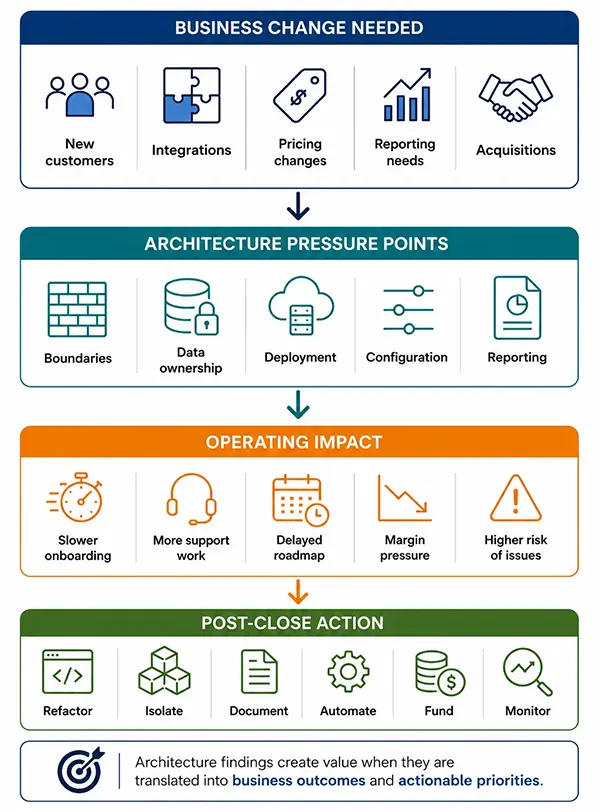
Architecture matters in technical due diligence because it shows how much room the business has to change without creating operational drag. The question is not whether the system follows a fashionable architectural pattern, or whether every component has the right name, but whether the current structure lets the company add customers, connect partners, introduce new product lines, serve larger accounts, absorb acquisitions, improve reporting, and change pricing or workflow behavior without every change becoming a small crisis.
In real reviews, architecture concerns often become visible through ordinary delivery stories rather than formal design discussions, because the pressure shows up in the work people struggle to complete. A feature that sounds small may end up touching billing, reporting, customer configuration, and older screens that were never meant to change together, while a routine integration request may depend on a developer who still understands a data export written years ago. When a product is described as configurable but implementation still requires custom scripts, database updates, or one-off operational steps, the issue is not necessarily that the architecture is bad; it is that past design decisions are still shaping how much effort the business needs to spend on change.
We look closely at system boundaries, data ownership, integration patterns, deployment flow, reporting architecture, tenant or customer isolation, and the places where business logic has accumulated over time. In a software-enabled business, the risky areas are often not hidden deep inside exotic code. They are in the practical seams between product, operations, support, finance, customer implementation, and reporting. When those seams are unclear, growth tends to create more coordination cost.
A useful architecture finding should be specific enough to affect action. Saying “the system has technical debt” does not help the buyer much. Saying that the current customer-configuration model will make enterprise onboarding slower, that reporting depends on production database queries, or that pricing changes require engineering involvement gives the buyer something they can plan around.
A platform can be stable for the current business and still be poorly prepared for the buyer’s next stage of ownership. That distinction is one of the main reasons architecture belongs in diligence.
Engineering capacity is often the constraint buyers underestimate
A capable engineering team can still be the bottleneck. This is common in lower-middle-market companies, founder-led businesses, vertical SaaS platforms, healthcare technology businesses, logistics platforms, compliance businesses, and services companies with important internal software. The team may be loyal, knowledgeable, and technically strong, but the post-close plan may expect more from them than they can realistically deliver.
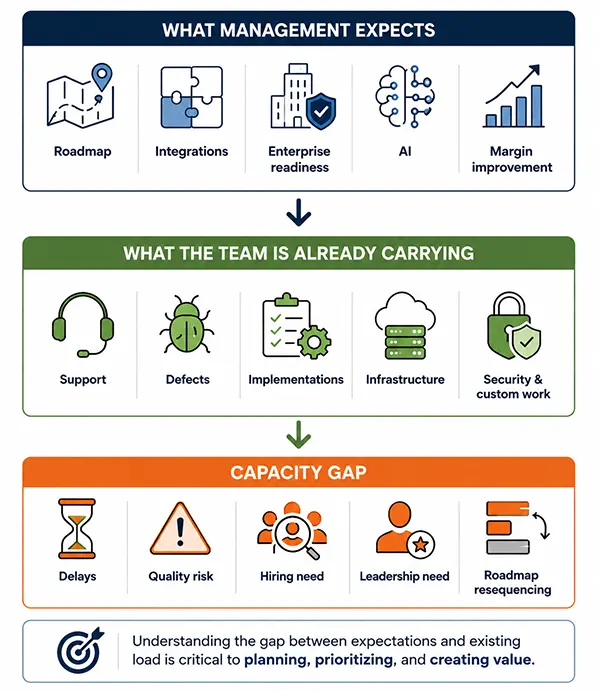
During diligence, we try to understand where engineering time actually goes. Management may describe an ambitious roadmap, but the backlog, interview pattern, support tickets, release history, and implementation process may show that much of the team’s capacity is already consumed by customer support, bug fixes, one-off implementation work, manual deployments, infrastructure maintenance, security requests, or urgent sales commitments. That does not make the team weak. It means the buyer needs to understand the difference between nominal headcount and usable product capacity.
This is where real diligence differs from a generic team-size comment. A ten-person team can be effective if the product is focused, the architecture is understandable, and releases are predictable. A larger team can still struggle if every customer implementation creates custom work, if testing is fragile, if one senior engineer reviews every important change, or if production support keeps interrupting planned development. The point is not to label the team as good or bad, but to understand whether the organization can support the growth plan.
We also look at knowledge distribution. If deployment, architecture, customer-specific behavior, security exceptions, reporting logic, and incident recovery all depend on one or two people, the buyer is not only acquiring software. The buyer is acquiring a knowledge concentration problem. Sometimes this can be fixed with documentation, runbooks, cross-training, better observability, and clearer ownership, and sometimes it requires additional leadership or a more deliberate post-close engineering plan.
Engineering capacity is not only a staffing question, it is a delivery-system question.
Roadmap credibility has to be tested against the system and the team
A roadmap often carries a large part of the investment story. It may support higher growth, larger customers, new modules, automation, better retention, margin expansion, or a more strategic exit. In diligence, the roadmap cannot be evaluated only by asking whether the ideas are sensible. Many roadmaps are sensible, but the harder question is whether the current system and team can deliver them in the time and budget the buyer is assuming.
We test the roadmap against the evidence, and if a company plans to move upmarket, we look for the architecture, security, auditability, integration capability, support model, and implementation maturity required by larger customers. If the roadmap depends on new analytics, automation, or AI, we look at the data model, data quality, evaluation controls, infrastructure cost, and team experience behind those plans. If management expects faster product velocity after close, we compare that expectation with the current release process, backlog pressure, defect patterns, support load, and technical debt.
In real situations, the issue is often not that the roadmap is unrealistic in every respect. More often, the sequencing is too optimistic. The company may be able to deliver the roadmap, but not while also improving security, reducing technical debt, supporting existing customers, handling new implementations, and hiring new engineers who need time to become productive. That matters because a buyer may be underwriting a growth plan that assumes the roadmap arrives before the operating model is ready.
A practical diligence output should make those tradeoffs visible by showing which parts of the roadmap are ready to execute, which ones depend on additional capacity or technical leadership, and which ones need enabling work before they can be delivered safely. Test automation, data cleanup, API stabilization, infrastructure changes, and clearer product boundaries may not be the most exciting parts of the plan, but they can determine whether the commercially attractive roadmap is actually achievable or only attractive on paper.
A roadmap is not credible because it is well described, it is credible when the system, team, data, and operating model can support it.
AI and automation claims need evidence, not enthusiasm
AI and automation claims now appear in many diligence processes, including for companies that are not pure software businesses. For instance, a healthcare services company may describe AI-supported care workflows, a compliance company may present document automation, a logistics company may discuss routing intelligence, and a vertical SaaS platform may show AI-assisted recommendations, summaries, classification, or workflow automation. Some of these capabilities are valuable and already operating in meaningful ways, while others are still early, manual behind the scenes, expensive to run, or not yet tied to measurable business impact.
We do not evaluate AI by the quality of the demo alone. We look at how the capability works in production or near-production use, what data it depends on, how outputs are evaluated, where human review is required, how exceptions are handled, how costs change with usage, and whether the company can explain failure modes. If the AI feature is based on external models, we also look at dependency, privacy, customer data handling, monitoring, and whether the company has a defensible workflow or mainly a thin layer over someone else’s model.
The practical issue is usually not whether AI can produce a useful result in one controlled example, but whether the company can operate that capability safely, repeatedly, and economically as usage grows. A workflow that still requires human review for every meaningful output may not reduce labor as much as the sales narrative suggests, and a feature whose inference cost rises with usage can put pressure on margins if pricing was not designed around that cost. Without a clear evaluation method, the company may also be relying on manual correction more than it realizes, which makes it difficult to know whether quality is actually improving or merely being cleaned up before customers see the result.
This is also where diligence has to separate product potential from current capability. A target may have a promising AI direction that deserves investment after close, but that is different from treating the current AI story as proven value. Buyers need that distinction before the narrative becomes part of price, growth expectations, or the first 100-day plan.
AI diligence warning: A strong demo can show that a capability is possible, but it does not prove that the capability is reliable, cost-effective, compliant, defensible, or ready to support the investment thesis.
Cloud cost can become a margin problem
Cloud cost often looks like an infrastructure detail until someone connects it to gross margin, customer profitability, or the economics of scaling the business. In many software-enabled companies, hosting, storage, data processing, observability, third-party APIs, AI inference, and customer-specific environments become part of the operating model. If those costs grow faster than revenue, or if no one can explain what drives them, the buyer needs to understand the margin implication.
In diligence, we look for basic cost visibility. Can the company explain cloud spend by product, customer segment, workload, environment, or major service? Does cost grow with customer count, transaction volume, data volume, implementation complexity, AI usage, or inefficient architecture? Are there obvious savings, or would meaningful reduction require engineering work that competes with roadmap delivery? Is the current pricing model aligned with the cost model, or are some customers quietly expensive to serve?
High cloud spend is not automatically bad. A growing company may have appropriate infrastructure cost, especially if the product processes large volumes of data or provides compute-heavy capabilities. The concern is when cost growth is poorly understood, structurally tied to manual or customer-specific work, or presented as easy to optimize without evidence. Cost optimization is real work, and it often requires tradeoffs between performance, reliability, engineering time, and product commitments.
For PE buyers, this matters because margin expansion is often part of the value-creation plan. If technical cost drivers are not understood before close, the first-year plan may overestimate how much margin can improve without additional investment.
Security and compliance need to match the market the company wants to serve
Security maturity should be judged against the company’s customers, regulatory exposure, and growth plan. A company serving smaller customers may have practices that are reasonable for its current stage, but if the buyer expects enterprise expansion, healthcare customers, financial services customers, government contracts, or more formal procurement, the required level of control may change quickly.
We look at how security works in practice. Access control, identity management, logging, vulnerability management, backup and recovery, incident response, deployment controls, data handling, vendor dependencies, and ownership all matter. Policies and checklists are useful, but they do not tell the whole story. A company may have documents that sound mature while day-to-day operations still depend on informal decisions, shared access, limited logging, or manual release steps.
Compliance works the same way. The question is not only whether the company knows which standard or customer requirement applies, it is whether it can produce evidence, operate controls, assign ownership, and keep those practices working as the business grows. A target may not need enterprise-grade controls today, but if the investment thesis depends on larger or more regulated customers, security and compliance readiness become commercial issues.
This part of diligence should stay practical rather than alarmist, because security and compliance gaps are not all equal. Some are normal for the company’s stage and can be handled after close with better ownership, documentation, controls, or tooling, while others may slow enterprise sales, create customer-retention risk, affect insurance, raise regulatory exposure, or complicate integration with an acquirer, so the buyer needs a clear view of which gaps are ordinary maturity issues and which ones could change the post-close plan.
Key-person dependency is easy to miss and expensive to discover later
Many software-enabled businesses rely on a small number of people who understand the systems, customers, integrations, deployment process, historical decisions, and recurring production issues. This can work for years in a founder-led or closely managed business, but the risk appears when ownership changes, growth expectations increase, or the buyer needs the business to operate with more repeatability than before.
Key-person dependency is easy to underestimate because it often looks like competence from the outside. A founder, architect, or senior engineer may know the deployment process, customer-specific behaviors, reporting logic, data corrections, security exceptions, old integration code, and incident recovery steps because they have been close to the system for years. That knowledge can keep the company moving, but it can also make the business look more scalable than it really is if the operating model depends on memory rather than shared ownership, documentation, runbooks, automation, and repeatable process.
This usually becomes visible during interviews and evidence review. The same person explains the architecture, answers the difficult customer-configuration questions, knows which production issues are risky, approves sensitive changes, and understands why older parts of the system behave the way they do. That person may be excellent, and their judgment may be one of the reasons the company has reached its current stage, but the diligence question is whether the organization can operate and grow safely if that knowledge remains concentrated.
The right response depends on severity, and in some cases the issue can be reduced through documentation, cross-training, clearer ownership, better observability, automated deployment, and practical runbooks. In other cases, the buyer may need to plan for engineering leadership, succession coverage, or a more formal operating model after close. The important thing is to identify the dependency before the growth plan assumes that the platform can scale without changing how critical knowledge is managed.
A company can have a strong technical leader and still have unhealthy technical dependency.
How we translate findings into priorities
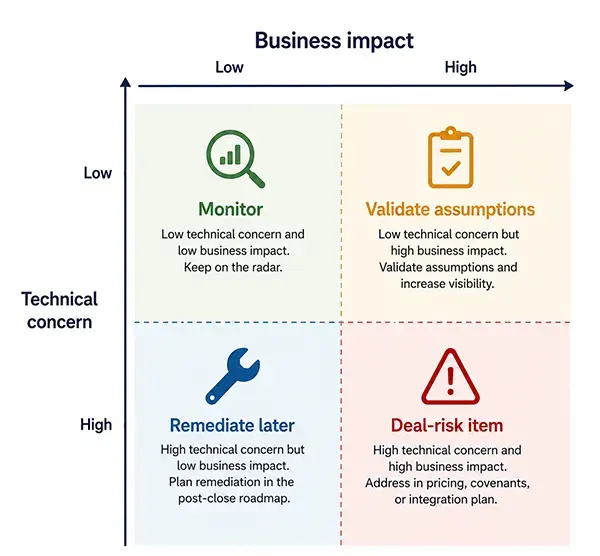
A useful diligence report should not leave the buyer with a long, flat list of technical concerns, because different findings require different decisions. One issue may need to be escalated before close because it affects the thesis, price, or terms, while another may simply belong in the first 100 days because it needs an owner, a budget, and a realistic timeline. Other findings may be ordinary operating improvements, items to monitor as the company grows, or technical imperfections that do not materially affect the deal.
Sharp Logica organizes findings around business relevance, where we look at whether a technical issue affects the investment thesis, customer growth, margin expansion, roadmap credibility, operational continuity, security exposure, integration plans, or post-close execution. This helps the buyer avoid two common mistakes: overreacting to ordinary technical debt, or underreacting to a technical constraint that quietly changes the deal economics.
| Finding type | What it means | Typical buyer action |
|---|---|---|
| Deal-risk item | Could affect the thesis, price, terms, or willingness to proceed | Escalate before close |
| First 100 days priority | Important enough to address soon after close | Assign owner, budget, and timeline |
| Budget item | Requires hiring, tools, remediation, or architecture work | Include in value-creation plan |
| Operating improvement | Useful but not urgent | Schedule after higher-risk items |
| Monitor | Known issue with limited current impact | Revisit as the business changes |
| Not material | Technical issue that does not affect the deal or plan | Do not overreact |
This classification is important because technical diligence can otherwise become too vague to guide action. A report that says “technical debt exists” does not help much unless it explains where that debt matters, how soon it matters, and what the buyer should do about it.
What a useful diligence output should give the buyer
A useful technical diligence output should give the buyer a practical view of technology as part of the acquisition. It should explain what is strong, what is fragile, what remains uncertain, what needs post-close action, and where the investment thesis depends on technical execution. The report should be clear enough for investors and operators to use, while still preserving the evidence behind the conclusions.
In many deals, the most valuable output is not the longest report, but a clear risk map, a prioritized set of findings, an executive readout, and enough technical detail to support the judgment. If the target has a serious platform risk, the buyer should understand it before close, and if the risk is manageable, the buyer should understand what budget, leadership, or sequencing will be needed to manage it.
Where Sharp Logica fits
Sharp Logica helps investors evaluate software-enabled businesses by assessing the platform, architecture, engineering capacity, roadmap credibility, AI claims, operational maturity, cloud cost, security posture, and post-close remediation priorities. The purpose is not to produce technical commentary for its own sake, but to help the buyer understand what the technology enables, what it constrains, and what it will require after close.
This work is especially useful when the target company depends on custom software, internal platforms, workflow automation, data pipelines, AI-enabled features, customer portals, integrations, or a meaningful IT organization that supports core operations. In those cases, technology may not be the whole business, but it can still be central to the investment thesis.
If your firm is evaluating a software-enabled acquisition and needs an independent view of platform risk, architecture, scalability, engineering capacity, AI maturity, cloud cost, security posture, roadmap credibility, or post-close remediation priorities, Sharp Logica can help with an executive-level Technical Due Diligence Assessment.
Discussion Board Coming Soon
We're building a discussion board where you can share your thoughts and connect with other readers. Stay tuned!
Ready for CTO-level Leadership Without a Full-time Hire?
Let's discuss how Fractional CTO support can align your technology, roadmap, and team with the business, unblock delivery, and give you a clear path for the next 12 to 18 months.
Or reach us at: info@sharplogica.com