
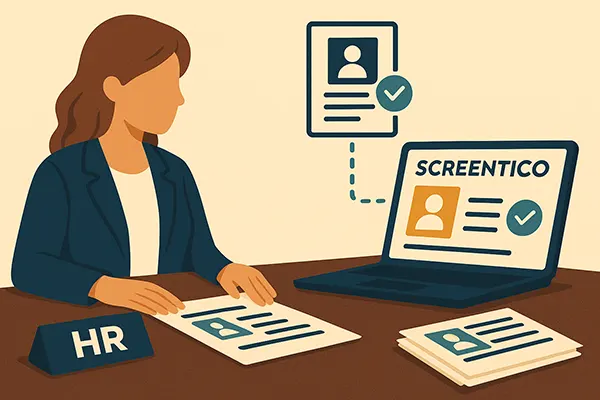
Stop Reading Every Resume: Focus on Right Candidates
You already have an ATS. You already use job boards. You already spend too many evenings skimming resumes that all start to look the same after a while. The real problem isn’t getting more candidates into the funnel. The real problem is deciding who deserves your attention without burning out.
Stop Reading Every Resume: How Screentico Helps HR Focus on the Right Candidates
If you work in HR or recruiting, you probably don’t need another tool telling you how “simple” hiring is.
You already have an ATS. You already use job boards. You already spend too many evenings skimming resumes that all start to look the same after a while.
The real problem isn’t getting more candidates into the funnel. The real problem is deciding who deserves your attention without burning out.
That’s exactly where Screentico comes in.
Instead of forcing you to read every Resume from scratch, or trusting blind keyword filters, Screentico acts like an AI analyst that sits between your job description and your candidate pool and says:
Here are the people who truly fit what you’re looking for, and here’s why.
Let’s unpack what that actually means in practice.
The hidden cost of “just quickly reviewing resumes”
Most teams underestimate how much time disappears into manual triage.
You open your ATS or mailbox “just to take a look,” and an hour later you’ve skimmed twenty resumes, shortlisted three, and still don’t feel entirely confident about any of it.
You repeat that across multiple roles, multiple weeks, and multiple people on the team. The result is predictable:
You get decision fatigue. You start relying on shortcuts: big-name companies, familiar universities, or whoever formatted their resume nicely. Not because you don’t care, but because your brain is overloaded.
The irony is that your best candidates might be the ones whose resumes aren’t polished, or whose titles don’t perfectly match your keywords, but whose actual experience would fit the role beautifully.
That is exactly the kind of nuance traditional ATS filters will never surface.
Why “more filters” won’t solve the problem
It’s tempting to think the answer is better filters: more conditions, more rules, more clever combinations inside the ATS.
But every time you add another filter, you’re playing a dangerous game:
You reduce volume, but you also reduce optionality. You silently remove people who might have been great, simply because their wording didn’t match your internal template.
Filters are blunt instruments. They were built to answer a simple question:
Does this resume contain these words?
What you actually care about is something more subtle:
Does this candidate make sense for this specific role, in this specific company, right now?
That requires interpretation, not just matching. It requires understanding the story behind the bullet points.
This is where AI-powered screening, done properly, starts to make sense.
What Screentico actually does with your job and resumes
Screentico doesn’t replace your ATS or your process. It plugs into the messy part: the bit where you stare at a list of candidates and wonder where to start.
The flow is simple and intentionally low-friction.
You start with the job description. Screentico reads it and identifies what really matters: core responsibilities, key skills, seniority expectations, domain context, and any explicit requirements you list.
Then you give it your candidates. That can mean exporting from your ATS, uploading PDF resumes, or forwarding resumes collected from different sources.
From there, Screentico does the kind of reading you wish you had time for:
It goes through each resume with the job in mind, not as a generic “good candidate” search. It evaluates how the person’s experience, achievements, and trajectory line up with what you’re hiring for. It looks at patterns across roles, industries, and responsibilities, not just one-off keyword hits.
And then it does the one thing that changes your day:
It ranks candidates and explains why.
Instead of a pile of unstructured resumes, you get a prioritized list with human-readable summaries. You don’t lose control of the decision. You gain a much better starting point.
From raw resumes to clear, explainable shortlists
The most important thing Screentico gives you is not a score. It’s context.
For each candidate, you don’t just see “Fit: 83%” and a mysterious green bar. You see why the AI thinks this person is worth your time.
You might read something like:
- This candidate has strong experience in similar roles, with direct ownership of X and Y.
- Their achievements show impact in areas that matter for your role, such as A and B.
- Their industry background partly overlaps with your domain, which may reduce onboarding time.
- Potential risks: limited exposure to Z, which you may want to explore in the interview.
Suddenly the conversation inside your team shifts.
Instead of “Who do we even invite?” you’re asking “Do we agree with this reasoning?” and “Who looks most promising given our constraints?”
Screentico doesn’t push you to trust a black box. It gives you structured arguments you can agree or disagree with. That’s a much healthier place to be.
Your HR team should spend time on people, not parsing PDFs
The best recruiters and HR professionals are not great because they read faster. They’re great because they:
- Ask the right questions in interviews
- Feel the cultural fit in a way no algorithm can
- Help hiring managers clarify what they actually need
- Build a good candidate experience, even for people who don’t get the job
All of that happens after the resume stage.
If your team is spending most of its energy on resume triage, you’re burning their time on the wrong part of the funnel.
Screentico’s job is to compress that front-loaded workload. It takes the avalanche of resumes, applies a focused, job-aware analysis, and surfaces the candidates that are actually worth investing human effort in.
You still make the decisions. You just don’t have to dig through fifty PDFs to get to the five people who deserve a conversation.
How Screentico handles your data securely
Whenever you bring AI into your hiring process, the first question from any serious HR or IT team is the right one: “What happens to our data?”
Screentico is designed with the assumption that resumes, job descriptions, and hiring notes are sensitive, and must be treated that way from day one, not as an afterthought.
In practice, that means:
- Encrypted in transit and at rest – All data moving between your browser, the Screentico backend, and the AI engine is protected with HTTPS/TLS. Stored data (where used) is encrypted at rest using industry-standard encryption.
- No data selling, no model training on your candidates – Your candidate data is not treated as training material for a public model. It’s used only to analyze and score resumes for your roles, then stored and retained according to the policies you agree to.
- Closed, enterprise-grade AI – Instead of sending resumes to random third-party APIs, Screentico is built to run on closed, enterprise platforms (such as Azure OpenAI in a controlled environment), so your data stays within a governed, compliance-focused cloud.
- Tenant isolation by design – Each customer’s data is logically isolated. One company’s candidates and jobs are never mixed with another’s, either for analysis or reporting.
- Built for compliance-minded organizations – The architecture is aligned with modern security and privacy practices (role-based access, least privilege, audit-friendly logging), so your legal and IT teams have something solid to review instead of hand-wavy claims.
The philosophy is simple: you own your data. Screentico processes it to help you make better hiring decisions, but it doesn’t turn your candidates into fuel for a generic AI model or a marketing database.
You get the benefits of modern AI while staying within guardrails your organization can live with.
The easiest way to test if this works for your team
You don’t have to reorganize your entire hiring process to see whether Screentico helps.
You can start with a single role.
Take a batch of candidates you’ve already collected. Run them through Screentico with your real job description. Compare:
- The shortlist you’d pick by skimming resumes manually
- The shortlist Screentico suggests, with the reasoning it provides
You’ll quickly notice where the AI spots people you might have missed, or where it surfaces patterns that your ATS will never see.
If it doesn’t help, you’ll know. If it does, you’ve just found a way to unlock more time for your team to do what they do best: talk to people, not chase keywords.
Conclusion
If you’re tired of staring at unending lists of resumes and wondering where to start, it might be time to add an AI assistant that is actually built for this part of the job.
Screentico won’t hire for you. But it will make sure the candidates who reach your calendar are there for good reasons, not just because they happened to use the right buzzwords.
Discussion Board Coming Soon
We're building a discussion board where you can share your thoughts and connect with other readers. Stay tuned!
Ready for CTO-level Leadership Without a Full-time Hire?
Let's discuss how Fractional CTO support can align your technology, roadmap, and team with the business, unblock delivery, and give you a clear path for the next 12 to 18 months.
Or reach us at: info@sharplogica.com