
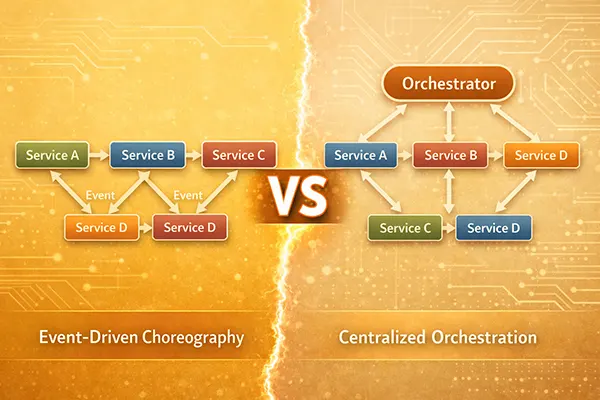
Orchestration vs Choreography: The Architecture Pattern Behind Scalable AI Systems
Distributed systems eventually face a coordination problem: should services react to events, or should a workflow orchestrate execution?
This architectural deep dive explores choreography vs orchestration across microservices, serverless platforms, and AI pipelines, explaining when event-driven systems scale better and when centralized workflows simplify complexity.
If you are already wrestling with this question in your own company, we offer a 2 week CTO Health Check and ongoing Fractional CTO support. You can book a 30-min free call or view the services whenever it is convenient, or simply email us at info@sharplogica.com if you have specific questions.
Orchestration vs Choreography: The Architecture Pattern Behind Scalable AI Systems
Modern distributed systems face a deceptively simple question:
Who coordinates the work?
When a system processes large volumes of data or executes complex workflows, tasks must be performed in the correct order, sometimes sequentially, sometimes in parallel, and often with dependencies between them.
For example, imagine a system that processes large document sets:
- upload documents
- extract text
- analyze rules
- process vendor responses
- compare results
- generate reports
Each document may trigger dozens of operations. Some tasks depend on others, some can run in parallel, some must wait until all other steps complete.
At this point every architect must answer a fundamental design question:
Should the system coordinate work through events, or through orchestration?
This decision is known as the choice between choreography and orchestration.
The pattern appears in many different domains:
- microservices architecture
- serverless workflows
- data pipelines
- AI agent systems
- distributed processing frameworks
And although the terminology changes, the underlying trade-off remains the same.
Understanding this distinction is essential when designing scalable AI systems and distributed platforms.
The Two Coordination Models
In distributed systems there are two primary ways to coordinate work.
Choreography relies on events. Orchestration relies on a central workflow controller.
Both approaches can be valid. Both appear in production systems.
But they produce very different architectures.
Choreography: Event-Driven Coordination
In a choreography model, each service reacts to events produced by other services. There is no central controller. Instead, the system evolves as events flow through it.
A simplified example might look like this:
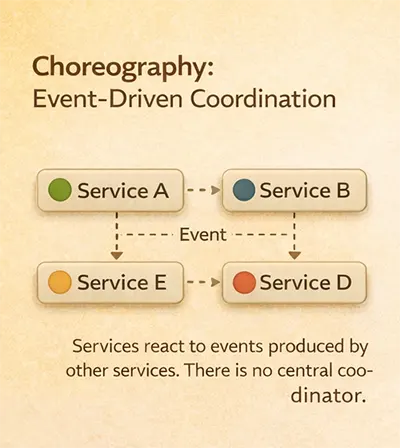
Each service performs a task and emits an event when it completes. The next service reacts to that event.
This model is often referred to as event-driven architecture.
Instead of a central workflow describing what must happen next, each component simply responds to the events it receives.
Why Choreography Became Popular
Choreography became widely adopted because it provides several powerful benefits.
First, it scales extremely well.
Each component operates independently. Workers can be added or removed without affecting the rest of the system. For example, a document pipeline may receive thousands of uploads. If extraction tasks increase, the platform can simply scale up the workers responsible for extraction. Other services remain unaffected.
Second, choreography produces loosely coupled systems. Services do not depend on each other directly. They communicate only through events. This reduces integration complexity and allows services to evolve independently.
Third, the system becomes resilient. If a service temporarily fails, the event remains in the queue. Once the service recovers, it continues processing.
This behavior emerges naturally when using message queues, event buses, or streaming platforms.
These advantages explain why choreography appears in many modern systems:
- microservices platforms built on Kafka
- cloud event pipelines
- large data processing systems
- AI processing pipelines
However, choreography introduces its own challenges.
The Hidden Complexity of Event-Driven Systems
Event-driven systems often appear simple at first. But complexity grows quickly when dependencies emerge.
Consider a document evaluation pipeline.
A single RFP document may produce multiple tasks:
- extract rules
- analyze vendor A
- analyze vendor B
- analyze vendor C
Once all vendors are analyzed, the system must merge the results and produce a report.
This creates a dependency graph:
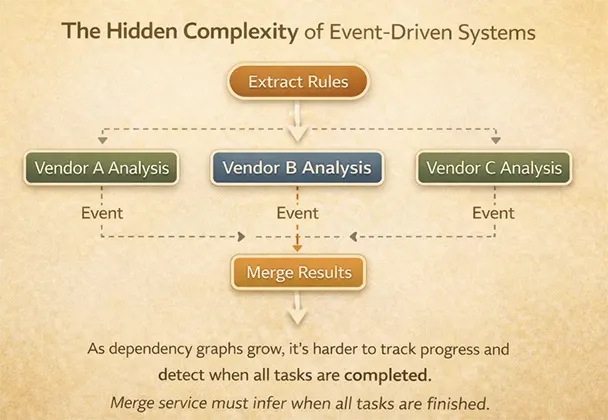
Now the system must answer several questions.
- How does the system know when all vendor analyses are complete?
- Where is that state stored?
- Who triggers the merge operation?
In an event-driven architecture this coordination logic becomes distributed across multiple services.
One service might store completion status in a database. Another service might poll for completion. A third service might listen for a specific number of completion events.
Over time the coordination logic spreads across the system. debugging becomes harder, and understanding the workflow becomes harder.
The system begins to resemble a complex dance where each participant reacts to signals from others.
This is precisely why the term choreography is used.
Each component follows its own steps, but there is no conductor guiding the performance.
Orchestration: Central Workflow Control
Orchestration takes a different approach.
Instead of distributing coordination logic across services, a single component defines the workflow.
This component is known as the orchestrator.
The orchestrator knows the sequence of tasks and coordinates their execution.
A simplified orchestration might look like this:
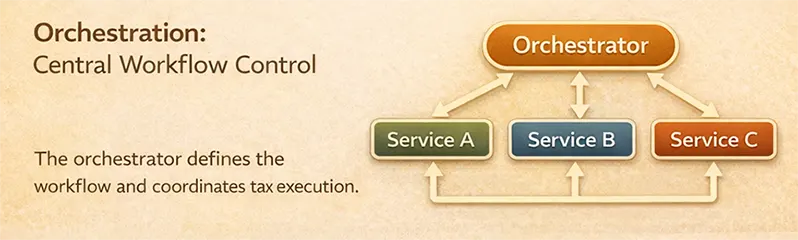
In code, this might appear as:
extractRules()

parallel:
   analyzeVendorA()
   analyzeVendorB()
   analyzeVendorC()

generateReport()
The orchestrator controls the execution order. It waits for tasks to complete, handles retries, and moves the workflow forward.
Frameworks such as Azure Durable Functions, Temporal, Cadence, and Apache Airflow implement this model.
They allow developers to define workflows while the platform manages execution and recovery.
Why Orchestration Is Appealing
Orchestration introduces several important advantages.
First, workflows become easier to reason about. Instead of reconstructing behavior from events across multiple services, the entire workflow exists in a single location. Architects can read the orchestration logic and immediately understand the system.
Second, dependency management becomes straightforward. Parallel tasks can be defined explicitly, sequential steps can be enforced naturally, and conditional branching becomes easier.
Third, orchestration simplifies failure handling. If a task fails, the orchestrator can retry it. If multiple tasks must complete before proceeding, the orchestrator simply waits.
This clarity explains why orchestration appears in many enterprise systems:
- financial transaction workflows
- order processing pipelines
- approval systems
- document processing pipelines
However, orchestration introduces trade-offs of its own.
The Limits of Central Orchestration
Central orchestration can become problematic when workloads grow extremely large. Consider a system processing thousands of documents simultaneously.
Each document might trigger dozens of tasks. If a central orchestrator must track every task and dependency, it becomes responsible for managing enormous amounts of workflow state.
This can introduce:
- storage overhead
- increased latency
- replay complexity
- coordination bottlenecks
Some orchestration frameworks mitigate these issues by checkpointing state and replaying workflow history. But even then, orchestrators must manage the lifecycle of thousands of tasks. For massive data pipelines this overhead can become unnecessary.
Many tasks in large pipelines are independent. They do not require central coordination. They simply need to be executed reliably and at scale.
In those situations choreography often remains the better choice.
Why AI Systems Often Favor Choreography
Modern AI pipelines tend to resemble large data processing systems.
Consider a system that analyzes thousands of résumés.
Each document may require:
- text extraction
- chunking
- embedding generation
- rule extraction
- scoring
- database storage
These tasks are largely independent. Each document can be processed in isolation, and ach step can be distributed across many workers. In such cases event pipelines scale naturally.
A typical architecture might look like this:
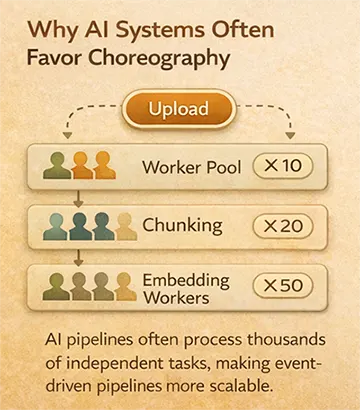
Each stage consumes events and produces new events.
There is little need for centralized coordination. The system scales horizontally by adding workers to each stage.
This architecture is common in AI systems because it supports massive parallelism.
Where Orchestration Still Matters in AI Systems
Even AI pipelines sometimes require orchestration.
Consider a compliance analysis system evaluating vendor proposals.
The workflow might include:
- extracting rules from an RFP
- analyzing multiple vendor responses
- comparing results
- generating a final evaluation report
In this scenario multiple analyses must complete before the final report can be produced.
This creates a coordination problem, and orchestrator can simplify this process. It can wait until all vendor analyses complete before triggering the final step.
This type of logic is easier to implement within a workflow engine than through distributed event coordination.
As a result many production systems combine both approaches.
The Hybrid Model: Orchestration and Choreography
In practice the most mature systems combine orchestration and choreography.
The orchestrator manages workflow logic, event pipelines handle data processing.
The architecture might look like this:
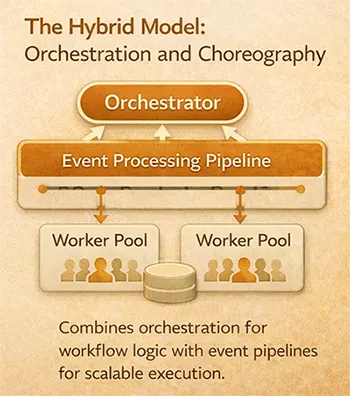
In this model the orchestrator decides what should happen next, while worker services perform the heavy processing. For example, an orchestrator might initiate document analysis tasks. Workers process documents in parallel through event pipelines.
When processing completes, the orchestrator aggregates results and triggers the final report generation.
This hybrid model combines the strengths of both patterns: orchestration provides clarity and dependency management, and choreography provides scalability and resilience.
Lessons for Microservices
The orchestration versus choreography debate originally emerged in the context of microservices.
In microservice choreography, services communicate through events:
- A payment service emits a payment event.
- An inventory service reacts to the event.
- A shipping service reacts to the inventory update.
No central service coordinates the process, and this approach can work well for loosely coupled systems.
However, complex workflows often reintroduce orchestration.
For example, an order processing workflow may require:
- payment authorization
- inventory reservation
- shipment scheduling
- notification delivery
When these steps involve dependencies, an orchestrator often emerges.
This is why many microservice platforms eventually introduce workflow engines. The need for orchestration reappears whenever systems must coordinate complex operations.
Lessons for AI Agents
The orchestration versus choreography discussion also appears in modern AI agent frameworks.
Many agent systems assume autonomous agents coordinating through tools and messages. In theory these agents plan tasks, call services, and collaborate dynamically. In practice production AI systems often rely on more structured coordination.
Instead of fully autonomous agents, many systems use orchestrators that control agent interactions.
For example, an AI pipeline may include:
- a planning component
- document analysis workers
- database services
- report generation
An orchestrator coordinates the sequence of operations. Agents provide specialized capabilities within the workflow.
The architecture resembles orchestration combined with event pipelines.
Once again, the same architectural patterns appear.
Choosing the Right Pattern
Neither choreography nor orchestration is universally superior, and the right approach depends on the nature of the system.
Choreography works best when tasks are independent and highly parallel.
Examples include:
- large document pipelines
- log processing systems
- data transformation workflows
- embedding generation pipelines
Orchestration works best when tasks involve complex dependencies.
Examples include:
- approval workflows
- multi-stage document analysis
- business transaction systems
- vendor evaluation pipelines
Hybrid architectures combine both approaches.
The orchestrator manages workflow logic while worker pools handle large-scale data processing.
This pattern appears in many production platforms.
The Real Architectural Insight
The most important lesson is that coordination patterns repeat across technologies.
The same architectural decision appears in:
- microservices choreography vs orchestration
- serverless workflows vs event pipelines
- AI agent coordination vs centralized planning
The tools change, the terminology changes, but the underlying problem remains constant. Architects who recognize this pattern can design systems more deliberately.
Instead of choosing tools first, they consider the coordination model their system requires.
Whether processing documents, executing microservices, or coordinating AI agents, systems must determine how tasks interact and when work can proceed.
Choreography distributes coordination across services through events, while orchestration centralizes workflow control.
Both patterns have strengths, and both patterns have weaknesses. The most effective architectures often combine them. Understanding when to apply each model is a critical skill for designing scalable systems.
And as AI platforms continue to grow in complexity, this architectural decision will become even more important.
Because regardless of whether the system processes financial transactions, vendor proposals, or millions of AI-generated embeddings, the same question will remain at the heart of the design:
Who coordinates the work?
If this mirrors your situation and you want concrete next steps, here is how we can work together:
CTO Health Check (2 weeks). A focused diagnostic of your architecture, delivery, and team. You get a clear view of risks, a 6 to 12 month technical roadmap, and specific, prioritized recommendations.
Fractional CTO services. Ongoing strategic and hands-on leadership. We work directly with your leadership team and engineers to unblock delivery, de-risk key decisions, and align technology with revenue.
30 minute FREE consultation. A short working session to discuss your current situation and see whether our support is the right fit for your company.
To explore these options, you can book a call, view the services, or email us at info@sharplogica.com with any specific questions.
Discussion Board Coming Soon
We're building a discussion board where you can share your thoughts and connect with other readers. Stay tuned!
Ready for CTO-level Leadership Without a Full-time Hire?
Let's discuss how Fractional CTO support can align your technology, roadmap, and team with the business, unblock delivery, and give you a clear path for the next 12 to 18 months.
Or reach us at: info@sharplogica.com