
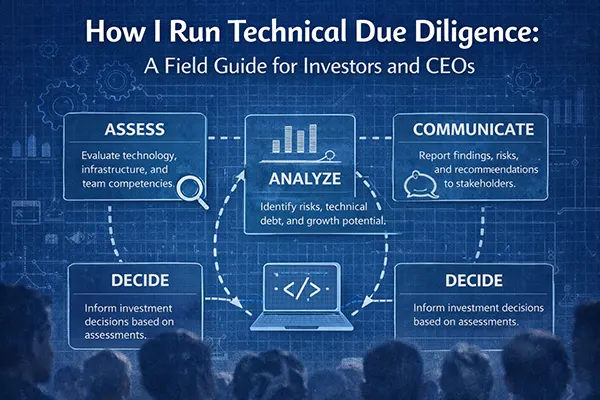
How I Run Technical Due Diligence: A Field Guide for Investors and CEOs
Technical due diligence is not a code review. It is a structured investigation into architectural risk, delivery predictability, cost behavior, and organizational resilience that directly impacts valuation.
If you are already wrestling with this question in your own company, we offer a 2 week CTO Health Check and ongoing Fractional CTO support. You can book a 30-min free call or view the services whenever it is convenient, or simply email us at info@sharplogica.com if you have specific questions.
How I Run Technical Due Diligence: A Field Guide for Investors and CEOs
Most technical due diligence fails because it looks at code instead of risk.
By the time I am brought into a transaction, the company usually has revenue, customers, and momentum. The codebase may not be elegant, but elegance is rarely what moves valuation. The real question is whether the system can sustain the growth assumptions embedded in the deal model without destabilizing delivery, margins, or operational control.
Valuation is forward looking. It prices future scalability, not present functionality. That gap between today’s architecture and tomorrow’s ambition is where diligence must focus.
Start With the Deal Thesis, Not the Diagram
Before I review architecture diagrams or repositories, I need to understand the commercial assumptions underlying the transaction. Every deal carries an implicit narrative about growth, margin expansion, integration, or platform consolidation. Those assumptions determine how much stress the system will face over the next two to three years.
If rapid expansion is expected, I examine whether the architecture can absorb complexity without increasing operational volatility. If EBITDA expansion is part of the valuation logic, cost behavior becomes central. If post close integration is planned, boundary clarity and data architecture maturity become critical. A system that functions adequately in isolation may prove fragile when evaluated against these strategic expectations.
Without this framing, technical observations remain abstract. With it, each finding can be translated into financial and operational impact, which is the only language that matters in serious transactions.
Map the System the Way Revenue Experiences It
Engineering teams usually maintain architecture diagrams, but they rarely reflect how revenue actually flows. My first tangible output is a simplified system map that highlights revenue critical components, major data stores, integration dependencies, and vendor exposure.
The objective is not technical completeness but executive clarity. A board member should be able to see which elements are essential for continuity, where operational fragility might exist, and which external dependencies introduce concentration risk.
This exercise often reveals structural realities that have accumulated gradually. Boundaries blur over time. Responsibilities overlap. Integrations multiply. None of this is malicious, but it creates latent fragility that becomes visible under scale or integration pressure.
Seeing the system clearly is the first step toward evaluating it honestly.
Where Risk Actually Lives
In most diligence engagements, valuation risk does not sit in syntax or framework choice. It tends to concentrate in four areas:
- Delivery predictability, which determines whether growth assumptions can be executed without operational chaos. If releases rely on heroics, undocumented steps, or implicit coordination, execution becomes personality driven rather than system driven.
- Cost behavior, particularly how infrastructure and third party services scale under load. Investors can tolerate high cost, but they struggle with unpredictable cost curves that undermine margin projections.
- Knowledge concentration, where architectural understanding resides with a small number of engineers. This creates key person dependency and increases integration risk during ownership transitions.
- Observability and resilience, which reveal whether the system fails in controlled, diagnosable ways or in opaque, customer visible breakdowns.
Notice that these drivers are structural rather than cosmetic. A modern stack does not compensate for delivery instability, and a fashionable architecture does not eliminate concentrated knowledge risk. What matters is whether the system behaves with discipline under stress.
How the Work Actually Gets Done
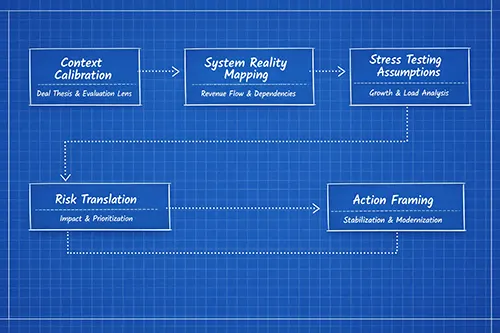
When I run technical due diligence, I do not start with a checklist. I start with a structured investigation loop that moves from context to evidence to impact.
The process typically unfolds in five deliberate stages, each feeding the next.
- Context Calibration
The first stage is alignment. I meet with deal sponsors and leadership to clarify what success looks like post close. This is where I gather growth targets, margin expectations, integration plans, and timeline constraints. I also identify non negotiables such as regulatory exposure or contractual obligations.
The output of this stage is a short written valuation lens document that defines how technical findings will be interpreted. This document anchors the entire diligence process. Without it, every later observation floats without reference.
- System Reality Mapping
Next comes structural discovery. I reconstruct the system from the perspective of revenue flow, not internal team structure. That means tracing a customer journey end to end and identifying every component, integration, and vendor dependency involved in generating and sustaining revenue.
I do not rely exclusively on documentation, but conduct focused architecture walkthroughs with senior engineers and validate assumptions by reviewing deployment pipelines, monitoring dashboards, and infrastructure configuration.
The output here is a simplified system map, plus a dependency matrix that highlights external services and concentration risk.
- Stress Testing the Assumptions
Once the system is mapped, I apply controlled pressure. This is where diligence becomes active rather than descriptive.
I test growth assumptions against infrastructure elasticity, examine whether release cadence can sustain projected feature velocity, evaluate whether incident response processes can handle increased scale, and model cost behavior under load scenarios.
This is not theoretical modeling alone. It includes reviewing historical incident data, cost curves, deployment frequency, rollback capability, and test coverage around revenue critical paths.
The question driving this stage is simple: if the company doubles in complexity, does instability double as well?
The output is a structured list of stress exposed risks, each linked to a specific scaling assumption.
- Risk Translation and Prioritization
Now the technical analysis is translated into economic language.
Each identified risk is evaluated along three dimensions: likelihood, operational impact, and financial consequence. Rather than labeling something as “bad”, I describe how it affects timeline certainty, margin behavior, or integration feasibility.
For example, a fragile deployment process is framed as a threat to predictable release velocity. A volatile cost curve is framed as margin uncertainty. Concentrated knowledge is framed as transition risk during ownership change.
The result is a prioritized risk matrix that executives can use directly in negotiation and planning.
5. Action Framing
The final stage prevents diligence from becoming academic.
For high priority risks, I outline what stabilization would require in the first ninety days and what structural modernization would look like over six months. This does not mean prescribing a rewrite, it means defining bounded actions that reduce uncertainty quickly.
Typical outputs include a stabilization sequence, hiring implications, and capital allocation estimates. The goal is to show whether risk is manageable within acceptable constraints.
This stage transforms diligence from diagnosis into controlled intervention planning.
The whole 5-step approach can be represented with the following diagram:
Translate Technical Findings Into Financial Language
The most common failure in diligence reports is abstraction. Stating that automated test coverage is low or documentation is incomplete may be technically accurate, but it does not influence valuation.
What influences valuation is explaining how low test coverage around revenue critical flows increases outage probability under projected growth. It is modeling how infrastructure volatility could compress margins if transaction volume doubles. It is outlining how knowledge concentration might delay integration or require additional post close investment.
Diligence becomes powerful when architectural observations are translated into deal relevant clarity. That means estimating impact on EBITDA, timeline, integration cost, and operational continuity. Not every variable can be quantified precisely, but most can be bounded realistically.
When risk is framed in economic terms, boards can decide whether to adjust multiples, negotiate holdbacks, or allocate capital for stabilization. That is where diligence shifts from commentary to valuation influence.
What a Strong Diligence Output Includes
A meaningful technical diligence process produces practical artifacts rather than theoretical commentary. At minimum, I expect the engagement to yield:
- A simplified architecture snapshot that executives can reuse for integration planning and strategic communication.
- A prioritized risk register with clear linkage between technical exposure and financial or operational impact.
- A ninety day stabilization outline describing how the highest risk areas can be bounded post close.
These deliverables demonstrate that risk is not merely identified but manageable within defined constraints. Investors do not require perfection, they require visibility and control. Ambiguous risk compresses valuation. Structured, bounded risk can be priced and managed.
The Real Purpose of Technical Due Diligence
Technology rarely kills a transaction outright. More often, it quietly reshapes the economics. It influences multiples, alters negotiation leverage, and determines how much capital must be deployed after closing.
At its core, technical due diligence is a disciplined examination of whether architecture, delivery processes, cost structure, and organizational design support the commercial ambition embedded in the deal. It is not a code review. It is an evaluation of enterprise durability.
When executed rigorously, it benefits all parties. Investors gain clarity about exposure. Founders gain a realistic roadmap for stabilization and modernization. Engineering leaders gain permission to address structural constraints that may have been tolerated internally.
In the end, diligence is about reducing uncertainty. Not eliminating risk, but making it visible, bounded, and governable.
That is the lens through which I run every engagement.
If this mirrors your situation and you want concrete next steps, here is how we can work together:
CTO Health Check (2 weeks). A focused diagnostic of your architecture, delivery, and team. You get a clear view of risks, a 6 to 12 month technical roadmap, and specific, prioritized recommendations.
Fractional CTO services. Ongoing strategic and hands-on leadership. We work directly with your leadership team and engineers to unblock delivery, de-risk key decisions, and align technology with revenue.
30 minute FREE consultation. A short working session to discuss your current situation and see whether our support is the right fit for your company.
If you want a quick first pass before a full diligence engagement, try the Due Diligence Risk Score Calculator.
To explore these options, you can book a call, view the services, or email us at info@sharplogica.com with any specific questions.
Discussion Board Coming Soon
We're building a discussion board where you can share your thoughts and connect with other readers. Stay tuned!
Ready for CTO-level Leadership Without a Full-time Hire?
Let's discuss how Fractional CTO support can align your technology, roadmap, and team with the business, unblock delivery, and give you a clear path for the next 12 to 18 months.
Or reach us at: info@sharplogica.com