
CTO Architecture Review to Roadmap (Part 3)
After all this, what do we actually walk away with? Not another 60-page PDF. Not a vague “you should probably refactor this.” You want something you can run the company with. This is where the review either becomes a tool for leadership or dies as a document in a shared folder.
From Architecture Review to Actionable Roadmap: What You Actually Get from a Fractional CTO (Part 3)
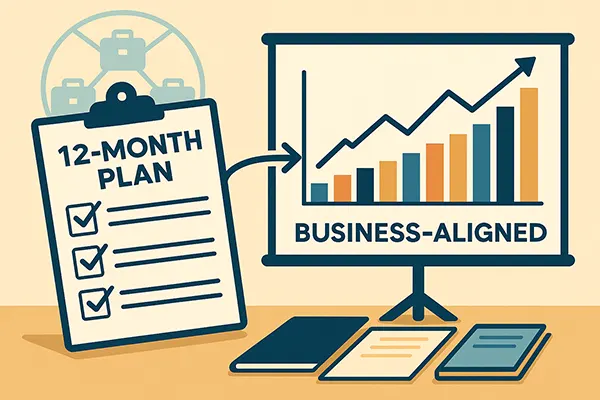
From Findings to a 12-Month, Business-Aligned Plan
By this point in the series, we’ve done a lot of thinking.
In Part 1, we looked at why a traditional architecture review – even one using a formal architecture review methodology like SARA – is too narrow if you care about growth, runway, and real-world constraints.
In Part 2, we unpacked how a Fractional CTO actually looks at your world: multiple lenses (strategy, product, architecture, delivery, data/AI, risk) and a clear sequence of phases (discover, diagnose, decide, design the roadmap).
This third part is about the thing that really matters to a founder, CEO, or VP of Engineering:
After all of this… what do we actually walk away with?
Not another 60-page PDF. Not a vague “you should probably refactor this.” You want something you can run the company with. This is where the review either becomes a tool for leadership or dies as a document in a shared folder.
Why traditional architecture reports stall
If you’ve been around long enough, you’ve probably seen the pattern.
Someone commissions an architecture review. Consultants interview people, collect diagrams, list risks, make recommendations. After a few weeks, a big report appears. It is thorough, technically sound, and full of detailed observations.
And then almost nothing changes.
The report gets a quick skim from leadership. Engineers argue about a couple of points. One or two items make it into a backlog. Six months later, most of the recommendations are either forgotten or overtaken by events.
The core problem is not the analysis. It’s the lack of translation from analysis to action.
A traditional report describes what is wrong and what “good” looks like in the abstract. It rarely answers the questions you actually need to run the business:
- What do we do first, given our constraints?
- What are we going to accept for now, even if it isn’t perfect?
- How much change can our team realistically absorb in the next year?
- Which recommendations are strategic, and which are just “nice to have”?
A Fractional CTO engagement lives or dies on that translation. If it doesn’t end in a roadmap you can actually execute and revisit, it hasn’t done its job.
What “actionable” really means in this context
“Actionable” is one of those words that shows up in every consulting deck, so it’s worth defining more concretely.
In the context of a Fractional CTO review, “actionable” means that the outcome gives you the ability to make and defend real decisions. You’re not just handed a list of issues; you have a working plan.
You should be able to look a founder, a board member, or your leadership team in the eye and say:
These are the trade-offs we’ve chosen. This is the order we’re going to tackle things in. This is what we’re deliberately living with for now, and this is why.
That’s a very different experience from “here are 47 findings and 23 recommendations.” The former is something you can use in steering meetings. The latter is just more noise.
The core deliverables you actually get
The exact shape depends on company size and maturity, but a good Fractional CTO engagement tends to produce a surprisingly consistent set of outputs.
First, there is a short executive narrative. This is usually just a few pages, written in plain language. It describes where you are today, what you’re trying to achieve in the next 12–24 months, and how your current technology, team, and delivery approach line up with that ambition. It highlights the main constraints and risks, and it offers a clear, high-level direction: how your architecture and operating model need to evolve to support the business.
This document is designed for conversation. It’s what you bring into a board meeting or a strategy offsite. There are no boxes-and-arrows diagrams on page one. Instead, it connects technology decisions directly to revenue, markets, and product bets.
Next, there is usually a current-state and constraints overview. This is not an exhaustive system inventory. It focuses on the few things that truly matter: the systems and patterns that are holding you back, the parts that are “good enough” for now, and the cross-cutting issues that keep appearing wherever you look: things like fragile deployments, weak observability, inconsistent data, or recurring security shortcuts.
Together, those two artifacts give everyone a shared, honest picture of what you have and what you’re trying to do with it.
The heart of the outcome is the 3–12 month roadmap. It normally has both a “zoomed-out” and a “zoomed-in” view. At the higher level, you see work grouped by quarters or phases, aligned with business milestones: what needs to be in place before a new product launches, before you enter a new region, or before you double customer volume. At the more detailed level, you see clusters of work with clear goals, rough scope, and the kinds of success criteria that can be used in planning: what we expect to be different once this cluster is complete.
Alongside that, there is often a decision log. It doesn’t have to be fancy, but it is crucial. This is where the big forks in the road are recorded: the choice not to replatform this year; the explicit decision to live with certain technical debt for a defined period; the commitment to fix a specific security or compliance gap before moving into a new market. The value of the decision log is that six months later, nobody has to guess why a particular path was taken, you can see the reasoning in black and white.
Finally, there is usually some form of risk and dependency map. Sometimes it is a simple diagram; sometimes a structured table. The goal is to make visible which pieces of work unlock others, which ones reduce the largest risks, and where you’re still exposed. It turns vague anxiety into something you can sequence and manage.
None of these artifacts are meant to sit on a shelf. They are designed to support ongoing leadership conversations about trade-offs, timing, and focus.
A startup story: choosing not to replatform
To see how this plays out, imagine a B2B SaaS startup with a small team, healthy early growth, and a codebase that has survived several pivots.
Internally, there is a growing sense of discomfort. Engineers complain about the “old monolith.” People talk about microservices and rewrites. The founders are caught between the fear of technical collapse and the fear of losing a year of product momentum.
The Fractional CTO review looks at the situation through the lenses from Part 2. It becomes clear that the next 12–18 months are about deepening one core product and proving repeatable sales, not about launching five new lines of business. Customers expect reliability and responsiveness, but they are still willing to tolerate occasional glitches if they are handled quickly and professionally. The architecture is not pretty, but most of the pain comes from a few overloaded modules and a fragile release process, not from some deep structural impossibility.
Delivery practices are rough but fixable. The team is small, smart, and motivated. There is interest in AI and more advanced features, but those are not the reason people buy the product today. Security is not perfect, but there are no immediate red flags that would prevent selling in the current market.
In this context, the roadmap does not say, “Rewrite everything into microservices.” Instead, it might recommend stabilizing releases over the next few months, cleaning up deployment scripts, adding basic monitoring, and shoring up the most painful edge cases, while carving out one or two problematic areas behind better boundaries. The message is that the company should build a safe landing zone for future evolution rather than jumping off a cliff now.
Most importantly, the roadmap records a very explicit choice: the organization agrees not to attempt a major replatform until it hits certain revenue or usage triggers. That single decision reduces a huge amount of background noise. People stop arguing about “when we’re going to rewrite everything” and focus on the work that moves the product and the business forward.
A scale-up story: turning products into a platform
Now consider a larger organization. There are several product teams, multiple codebases, customers in different regions, and a mix of older systems and newer services. The executive team is talking about “becoming a platform company,” but the reality on the ground feels more like a collection of loosely related tools.
The review reveals a familiar pattern. Each product has grown locally with its own architecture choices, its own copies of certain capabilities, and its own way of modeling data. Reliability is mostly acceptable, but integration between products is fragile, and simple cross-product features turn into multi-quarter efforts. Analytics is painful because nobody is quite sure which system holds the “real” data for a given concept. Meanwhile, regulatory obligations are getting more serious as the company enters new markets.
The roadmap in this case is very different from the startup story. It is not about carving out a couple of modules from a monolith. Instead, it focuses on defining a small set of shared platform capabilities, things like identity, billing, notifications, and core reference data: and assigning real ownership to them. It sketches how product teams will gradually migrate away from local implementations toward those shared services, without grinding new feature work to a halt.
At the same time, it outlines a phased approach to converging data models where it matters, so that AI and advanced analytics can be built on something more solid than a patchwork of exports and ad hoc transformations. The roadmap also makes compliance work part of the same story instead of a parallel panic: as you clean up data flows and centralize certain capabilities, you also close the most serious regulatory gaps.
Again, the value is not just in the technical recommendations. It’s in the way the roadmap ties those recommendations to strategy, team, and timing. Leaders can see how the company moves from “many products” toward “one coherent platform” without betting the entire year on a single, risky transformation program.
Keeping the roadmap alive
A roadmap that only lives in a slide deck is not a roadmap; it is a snapshot.
In a Fractional CTO engagement, the goal is to produce something that can actually be lived with. Markets shift. Hiring plans change. New opportunities appear. A good roadmap can flex with that reality without losing its core intent.
That usually means revisiting it regularly. In some organizations, that’s a quarterly review where leadership looks at what has been achieved, what has changed, and whether any decisions need to be updated. In others, the Fractional CTO stays involved on a part-time basis, helping to adjust priorities, support key technical decisions, and make sure the original reasoning doesn’t get lost in day-to-day noise.
What matters is that the roadmap remains a working tool. When someone proposes a new big initiative, you can ask, “Where does this sit relative to what we already agreed is critical?” When a new risk appears, you can see what it displaces or whether it fits into an existing stream of work.
How this differs from “just having a report”
In the end, the biggest difference between a traditional architecture review and a Fractional CTO engagement is not the set of diagrams or the vocabulary.
It’s the orientation.
A report tells you what is wrong and what an idealized future might look like. A Fractional CTO engagement tells you what you are going to do now, what you are going to delay on purpose, and how those choices support your strategy and respect your constraints.
When it’s done well, you don’t just have a nicer description of your systems. You have a set of deliberate, traceable decisions about your technology and the next 12–18 months of your business.
That is what “from architecture review to actionable roadmap” means in practice, and it’s the real value you should expect when you bring a Fractional CTO in to review your architecture and technology landscape.
If you need a quick baseline before committing to roadmap changes, use the Architecture Scorecard.
Discussion Board Coming Soon
We're building a discussion board where you can share your thoughts and connect with other readers. Stay tuned!
Ready for CTO-level Leadership Without a Full-time Hire?
Let's discuss how Fractional CTO support can align your technology, roadmap, and team with the business, unblock delivery, and give you a clear path for the next 12 to 18 months.
Or reach us at: info@sharplogica.com