
CTO Architecture Review to Roadmap (Part 2)
You might have clean diagrams, well-chosen patterns, and even a formal architecture review behind you: yet still be struggling with slow delivery, mounting technical debt, unreliable releases, or a platform that doesn’t match where the business is actually trying to go.
From Architecture Review to Actionable Roadmap: What You Actually Get from a Fractional CTO (Part 2)
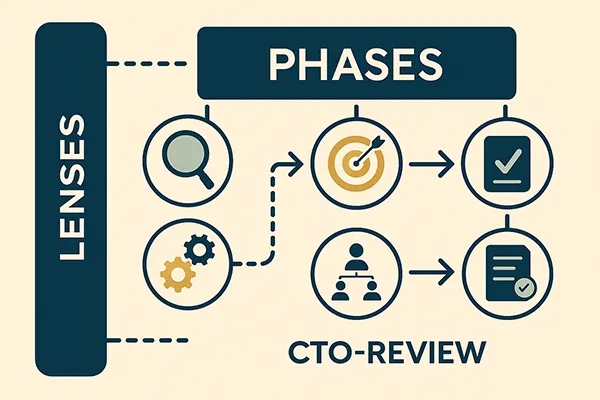
The Lenses and Phases of a CTO-Level Review
In Part 1, we looked at a simple truth: you can have a technically solid architecture and still be on the wrong path.
You might have clean diagrams, well-chosen patterns, and even a formal architecture review behind you: yet still be struggling with slow delivery, mounting technical debt, unreliable releases, or a platform that doesn’t match where the business is actually trying to go.
That’s usually not because the review was “bad.” It’s because it was narrow.
A typical architecture review focuses on the system itself: components, data flows, integrations, quality attributes. A Fractional CTO has to zoom out and ask a different set of questions:
- What is the business trying to achieve in the next 12–24 months?
- How does the product need to evolve to support that?
- Can the current architecture, team, and ways of working realistically get us there?
Answering those questions consistently requires more than experience and gut feeling. You need a repeatable way to look at the whole landscape, not just one slice of it.
That’s what this part of the series is about: the lenses a Fractional CTO uses to inspect your world, and the phases that turn that inspection into concrete decisions and, eventually, a roadmap.
The idea: multiple lenses, not a single spotlight
An architecture review methodology usually shines a very bright light on one question: the structure and quality of the system.
A CTO-level review is more like walking around a building and looking at it from different sides. Each lens reveals different problems and different opportunities.
A simple way to think about it:
CTO REVIEW LENSES
+ Strategy & Outcomes
+ Product & Experience
+ Architecture & Platforms
+ Delivery & Organization
+ Data & AI
+ Risk, Security & Compliance
You don’t necessarily dive equally deep into all six every time. But if you ignore any of them completely, your recommendations will be skewed.
Let’s walk through each lens in practical terms.
Lens 1: Strategy & Outcomes
This is where a Fractional CTO starts: with the question, “What are you actually trying to make happen in the next 12–24 months?”
Typical topics here:
- Revenue targets, growth plans, and markets you’re entering
- Key product bets and strategic projects
- M&A plans, consolidation, or spin-offs
- Constraints: runway, headcount growth, hiring market, budget
Without this context, everything else is guesswork. The same architecture can be an asset for one strategy and a liability for another.
For example:
- If your strategy is to experiment quickly and find traction, heavy upfront investments in a “perfect” platform may be the wrong call.
- If your strategy is to scale an already successful product into new regions, the same “good enough for now” architecture might suddenly be a legal or reliability time bomb.
This lens keeps the review honest. It forces every technical recommendation to answer, “How does this move us toward the outcomes we said we care about?”
Lens 2: Product & Experience
Next, a Fractional CTO looks at how the product behaves today and what kind of experience you’re promising.
Questions in this lens include:
- What does your product actually do for customers, and how critical is it to their business?
- What level of reliability and performance are customers expecting or paying for?
- How often do you need to release changes without breaking things?
- Are you a “move fast and iterate” tool, or a deeply embedded system where outages have serious consequences?
You can’t assess an architecture without understanding the experience contract you’re implicitly making with customers.
A design that is perfectly fine for an internal tool used once a week may be unacceptable for a product customers rely on to run payroll, manage medical workflows, or process sensitive financial data.
The Product & Experience lens ties the technical foundation to the real promises you’re making to users.
Lens 3: Architecture & Platforms
This is where the classic architecture review methodology lives.
Here, a Fractional CTO examines:
- How your systems are structured: monolith, modular monolith, microservices, event-driven, etc.
- How services and components talk to each other
- How data flows through the system and where it is stored
- Technical quality attributes: scalability, performance, reliability, security, observability
- Use of cloud services, platforms, and third-party dependencies
If needed, this is where you might use a formal architecture review methodology (such as SARA or a similar structured approach) to perform a deep assessment of critical systems.
The big difference in a CTO-level review is not the depth of this lens, but the context:
- A design that looks “clean” from a technical perspective might be overkill for the strategy and team you actually have.
- A design that looks “messy” might be the right compromise for your horizon and constraints, as long as it’s understood and managed.
The goal here is not to chase an abstract ideal, but to understand where the current architecture supports, constrains, or quietly contradicts your strategy.
Lens 4: Delivery & Organization
An architecture is only as good as the organization’s ability to change and operate it.
In this lens, the Fractional CTO looks at:
- How teams are structured: by product, by component, by layer
- How ownership is defined: who is responsible for which systems in production
- How work flows: planning, development, testing, deployment, incident management
- Release cadence and deployment pain: how often you ship, and how risky it feels
- Automation and tooling: CI/CD, testing, infrastructure as code, monitoring
Many “architecture problems” are actually delivery problems in disguise. For example:
- A design that would be fine with automated tests and mature CI/CD can be terrifying when everything is manual and fragile.
- A microservices setup without clear ownership and strong DevOps practices can easily turn into a distributed monolith that nobody fully understands.
A CTO-level review doesn’t just say, “This design is complex.” It asks, “Given your current team and delivery behavior, can you realistically operate this without burning people out or constantly firefighting?”
Lens 5: Data & AI
Today, most organizations are either using data and AI in some way, or planning to.
This lens looks at:
- How data is modeled, stored, and integrated across systems
- Where key data lives and how easy it is to get a reliable, unified view
- Whether analytics and reporting are bolted on or designed in
- How you are (or plan to be) using AI: internal automation, customer-facing features, decision support
- Whether your architecture and data practices support responsible AI use (governance, privacy, traceability)
A Fractional CTO is not just asking, “Can we add AI features?” but:
- Do we have the data foundation to make any AI work meaningful?
- Would adding AI on top of this architecture be real value, or just a demo?
- What risks do we introduce by plugging AI into existing workflows and data?
This lens often reveals that the limiting factor is not the model, but the plumbing and data discipline underneath.
Lens 6: Risk, Security & Compliance
Finally, there is the lens people often acknowledge and then quietly avoid: risk and compliance.
Here, the review covers:
- Security posture: authentication, authorization, data protection, secrets management
- Regulatory context: GDPR, HIPAA, industry-specific regulations
- Logging and auditability: can you explain who did what, and when?
- Business continuity: backup, recovery, disaster scenarios
- Vendor and dependency risk: what happens if a critical third-party service fails or changes terms?
From a CTO perspective, this isn’t about trying to eliminate risk completely. It’s about making risk explicit and intentional:
- What are we accepting for now, and why?
- Where are we one incident away from real damage?
- What security and compliance gaps are showstoppers for the strategy we described earlier?
This lens keeps the roadmap honest. It stops you from only investing in new features while ignoring risks that could derail the whole plan.
The four phases of a CTO-level review
If the lenses define what you look at, the phases define how you work.
A simple, repeatable pattern looks like this:
Phase 1: Discover
Phase 2: Diagnose
Phase 3: Decide & Prioritize
Phase 4: Design the Roadmap
Let’s unpack each of these.
Phase 1: Discover
In the Discover phase, the goal is to understand reality, not to judge it.
Typical activities:
- Short interviews with founders, executives, product, and tech leads
- Reviewing existing documentation, diagrams, and previous architecture reviews
- Walking through systems: staging or production demos from the team
- Looking at basic metrics: deployment frequency, incident history, cost patterns
If there is an existing architecture review methodology output (for example, a SARA-like assessment done in the past), this is where it gets pulled in as input.
The key in this phase is to see the whole picture: strategy, product, systems, delivery, and constraints.
Phase 2: Diagnose
In Diagnose, the Fractional CTO connects what they discovered to the outcomes you say you want.
This is where the lenses really come into play:
- Strategy & Outcomes vs. Product & Experience: is the product evolving in the right direction given the plan?
- Architecture & Platforms vs. Delivery & Organization: do the systems and the way you work fit each other, or are they at war?
- Data & AI vs. Risk, Security & Compliance: do your ambitions around AI and data match your governance and risk posture?
If needed, this is also where a deeper architecture assessment is focused on specific hot spots (for example, a critical system that’s clearly limiting growth).
By the end of Diagnose, you have a diagnosis, not just a list of observations:
- “These parts of the architecture are good enough for the next 12–18 months.”
- “These parts are blocking strategy and need attention sooner.”
- “These risks are acceptable for now; these ones are not.”
Phase 3: Decide & Prioritize
Here, the review turns from analysis into choices.
The Fractional CTO lays out options and trade-offs that connect directly to your context:
- What do we fix now?
- What do we stabilize or wrap and live with for a while?
- What do we schedule later, with clear triggers (e.g., when we reach X customers or Y regions)?
This is also where the constraints from Strategy, Delivery, and Risk lenses are brought into the same conversation:
- “We could replatform, but that would freeze feature delivery for 9–12 months. Is that acceptable given our market?”
- “We can live with this legacy system for now if we improve monitoring and isolation, and plan a replacement in phase two.”
- “We cannot enter this new region without addressing these compliance issues first.”
The output of this phase is a prioritized set of decisions, not an abstract list of “findings.”
Phase 4: Design the Roadmap
Finally, the review becomes a plan: a realistic roadmap for the next 3–12 months (and often a sketched view beyond that).
A CTO-level roadmap is not just a sequence of technical projects. It ties back to:
- Business milestones (“by the time we launch product X,” “before we open region Y”)
- Team capacity and hiring plans
- Risk reduction steps
- Platform and architecture investments that unlock future capabilities (like AI or multi-region support)
At this point, any formal architecture review methodology you’ve used has been fully absorbed into the bigger picture. The roadmap doesn’t say, “Refactor this because the review said so.” It says:
- “Do this work now because it unlocks these outcomes and removes these specific risks, and we’ve agreed it’s worth the cost.”
That is the moment where the review stops being a report and becomes a tool for running the business.
Before moving from diagnosis to execution, use the Architecture Scorecard to baseline risk in a structured way.
Discussion Board Coming Soon
We're building a discussion board where you can share your thoughts and connect with other readers. Stay tuned!
Ready for CTO-level Leadership Without a Full-time Hire?
Let's discuss how Fractional CTO support can align your technology, roadmap, and team with the business, unblock delivery, and give you a clear path for the next 12 to 18 months.
Or reach us at: info@sharplogica.com