
How to Evaluate COBOL Modernization Services Before Choosing a Vendor
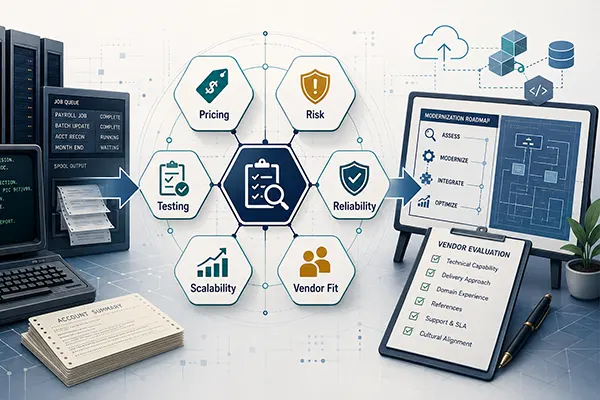
COBOL modernization services can mean very different things depending on the vendor. One provider may be selling rehosting, another may be selling automated conversion, while another may be offering assessment, roadmap, architecture governance, and delivery support. Before choosing a vendor, buyers need to understand pricing assumptions, delivery risk, testing discipline, business-rule validation, operational continuity, and whether the provider is prepared for the realities of business-critical systems.
If your organization is evaluating COBOL modernization options and needs an independent view of vendor proposals, modernization risk, pricing assumptions, and delivery approach, Sharp Logica can help with an architecture-led Legacy Systems Assessment and modernization roadmap. We can help you compare rehosting, replatforming, API enablement, refactoring, replacement, and phased execution options before committing to a large modernization program. You can book a 30-min free call, view the services, or email us at info@sharplogica.com with specific questions.
Introduction
Choosing a COBOL modernization provider is difficult because almost every vendor uses the same language, but they do not always mean the same thing. One provider may be selling a rehosting project, another may be selling automated code conversion, and someone else may focus on APIs around the existing system. A consulting firm may be selling assessment, architecture governance, roadmap planning, and execution support.
That difference matters. In a business-critical environment, especially in banking, payments, insurance, government, or logistics, COBOL modernization is rarely a simple technology replacement. The system may contain decades of business behavior, batch logic, exception handling, operational workarounds, reporting rules, regulatory obligations, and undocumented assumptions. A vendor can underestimate the real risk very early if they treat the work as a mechanical conversion from one language or platform to another.
The buyer's job is not to pick the provider with the most confident story. The buyer's job is to understand what the vendor is really proposing, what they have assumed, how they price uncertainty, how they reduce operational risk, and whether their approach fits the business system being modernized.
A simple way to think about vendor evaluation
Before looking at tools, platforms, and price, it helps to separate the decision into five questions.
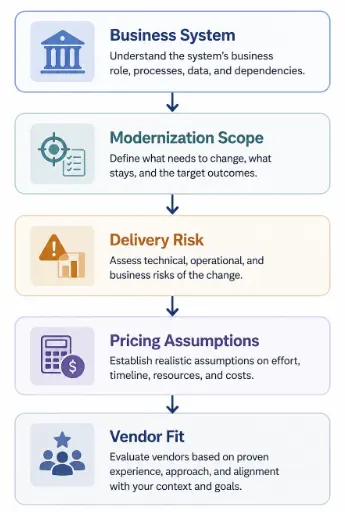
Most weak modernization proposals start too low in this chain. They begin with a target platform, a conversion tool, or a delivery package before there is enough understanding of the system. Stronger proposals usually start higher. They ask what the system does, who depends on it, where it can fail, how behavior will be validated, and which modernization path gives the organization a safe way to move forward.
First, clarify what the vendor means by modernization
"Modernization" can refer to several very different types of work. Some providers focus on moving the application to a different infrastructure environment while preserving most of the existing behavior. Others translate COBOL code into another language such as Java or C#. Some expose selected functions through APIs so newer systems can interact with the existing platform. Others start with assessment and roadmap work before recommending any specific migration path.
None of these approaches is automatically right or wrong. Rehosting may be reasonable when the main goal is cost reduction or platform flexibility. API enablement may be the right first move when the business needs integration but cannot tolerate disruption. Selective refactoring may make sense when certain parts of the system change frequently and slow down the rest of the organization. A full rewrite may be justified in some situations, but it usually requires the most discipline, business involvement, and delivery control.
The problem begins when a vendor presents one modernization pattern as the answer before enough discovery has been done. A preferred delivery model is not the same as the right modernization strategy.
Common modernization offers and what to check
| Vendor offer | What it usually means | What to check |
|---|---|---|
| Rehosting | Move the workload to a different runtime or infrastructure | Does it reduce business risk, or mainly infrastructure cost? |
| Replatforming | Move to a new technical platform with limited functional change | How will behavior be validated and reconciled? |
| Automated conversion | Translate COBOL into another language | What happens to structure, maintainability, and business-rule clarity? |
| API enablement | Expose selected capabilities while keeping the core system | Are the right boundaries understood? |
| Refactoring | Improve selected parts of the system | How will scope be contained? |
| Replacement | Replace part or all of the system | How will old behavior be rediscovered and tested? |
| Assessment and roadmap | Analyze the system before committing to execution | Does the assessment produce decisions, or only documentation? |
This table is useful because it forces the conversation to become more precise. If two vendors both say “modernization” but one means rehosting and the other means phased replacement, they are not offering the same thing.
Pricing should expose assumptions, not hide them
Pricing is one of the easiest areas to misunderstand. A simple fixed price may look attractive early in the buying process, but if the vendor has not examined the application landscape, batch jobs, data dependencies, integrations, reports, test coverage, operational constraints, and business criticality, the number may be based on broad assumptions rather than real understanding.
Good pricing is not necessarily low pricing. Good pricing explains what is known, what is unknown, and what could change the cost of the work. For a COBOL modernization effort, meaningful cost drivers often include the size of the codebase, the number of applications involved, batch complexity, external integrations, documentation quality, SME availability, test coverage, regulatory constraints, and downtime tolerance.
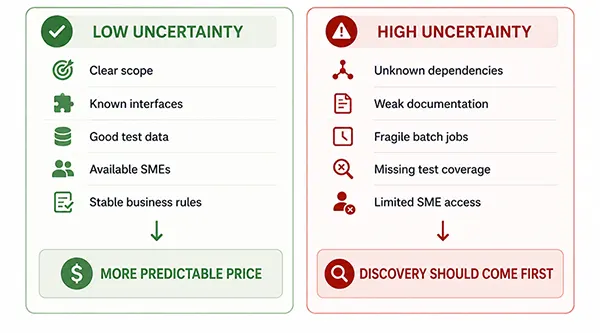
A provider should be able to explain whether discovery is priced separately from execution. This matters because modernization often becomes safer when the first engagement is not a commitment to a large migration program, but a structured assessment that reduces uncertainty and produces a realistic roadmap.
Be careful with pricing models that look simple by ignoring complexity. A vendor may quote a price per line of code, a price per application, or a broad migration package. Those models can be useful for early estimation, but they are not enough by themselves. Two applications with the same number of lines can carry very different business risk. A small program that controls settlement, interest calculation, eligibility, claims, or reconciliation may be more important than a much larger program that rarely changes and has limited business impact.
Pricing should also clarify responsibilities. Who extracts and validates business rules? Who provides test data? Who confirms expected behavior? Who owns reconciliation? Who handles production support during transition? Who decides whether a behavioral difference between the old and new system is acceptable?
If these responsibilities are vague, the proposal may be cheaper only because the risk has been left outside the document.
Risk management is the real test of the provider
Every COBOL modernization vendor says they manage risk. The useful question is how.
A credible provider should be able to explain how they identify high-risk parts of the system, validate behavior, protect production operations, and avoid forcing the organization into a single large cutover. They should ask about batch windows, upstream and downstream systems, manual workarounds, reconciliation processes, audit requirements, and operational calendars. If the system processes financial transactions, they should care about timing, exceptions, reversals, duplicate handling, rounding behavior, end-of-day processing, and end-of-month processing.
The safest path is often not the most dramatic one. It may begin with documentation, observability, test harnesses, interface isolation, or a small pilot around a contained business capability. That can feel slower than announcing a full replacement program, but it gives the organization a way to learn before committing the whole business to a high-risk path.
A useful vendor question:
What would make you slow down or recommend an assessment before execution?
A mature provider should be able to answer that question clearly. They might mention unavailable subject-matter experts, missing test data, unclear ownership, unstable upstream systems, weak operational documentation, regulatory constraints, or critical business rules that are only understood by a few people. If nothing seems to concern them, that is itself concerning.
Rollback is another important signal. If the provider cannot explain how a release can be reversed, how parallel operation would work, or how data consistency would be protected during transition, the plan may be depending too much on hope. Not every modernization step needs a complex rollback strategy, but every important production change needs a recovery path.
Reliability is proven through method, not claims
Many vendors describe their modernization services as reliable, but reliability is not something a buyer should accept as a statement on a slide. In legacy modernization, reliability comes from method: disciplined testing, business validation, operational awareness, release control, and a willingness to prove behavior before replacing it.
For a business-critical COBOL system, unit tests are not enough. The system’s behavior may depend on historical data, batch order, file formats, database state, scheduler behavior, external feeds, and exceptions that are poorly documented. A serious reliability approach usually includes regression testing, historical transaction replay, output comparison, reconciliation, parallel runs, and business validation.
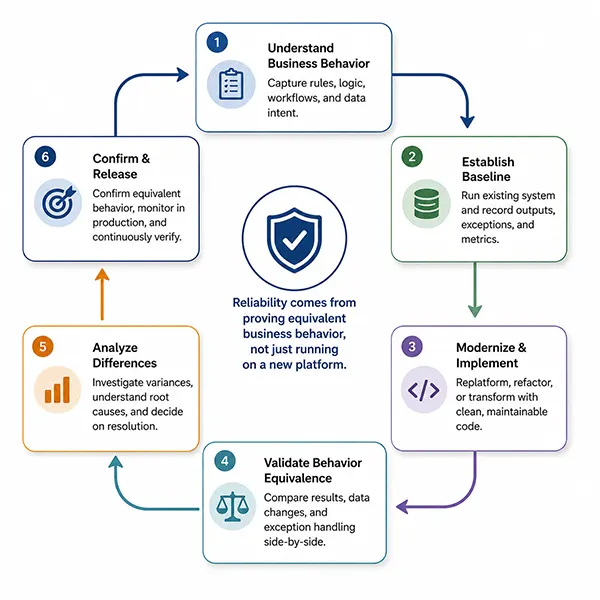
The details depend on the domain. A payment platform may require careful comparison of transaction outputs, settlement files, fees, reversals, and exception handling. An insurance system may require validation of policy calculations, claims logic, renewal rules, and regulatory reports. A government benefits system may require eligibility logic, notices, auditability, and batch timing to be preserved carefully.
The common theme is simple: correctness has to be demonstrated in business terms, not only technical terms.
A provider with a serious reliability story will also talk about production operations. They will ask how incidents are handled today, what monitoring exists, what reports operations teams rely on, and how support teams know whether the system is healthy. If modernization removes familiar operational signals without replacing them, the new platform may be technically cleaner but harder to run.
Scalability means more than infrastructure capacity
When modernization vendors discuss scalability, the conversation often turns quickly to cloud infrastructure, runtime performance, or database capacity. Those things matter, but they are not the whole question.
A legacy system may already process large volumes reliably. Its real problem may be that batch windows are too tight, integrations are difficult, release cycles are slow, or too few people understand how the system works. In that context, scalability includes operational scalability and change scalability, not only compute capacity.
For COBOL systems, useful scalability questions include:
- Can the system handle growing transaction volumes?
- Can overnight or month-end processing finish inside the required window?
- Can new integrations be added without risky changes to the core?
- Can the organization make changes without depending on a shrinking group of specialists?
- Can monitoring, support, and incident response scale with the modernized system?
This is especially important in financial systems, where peak periods, settlement cycles, regulatory deadlines, and reconciliation processes can matter as much as average load. A system that performs well during normal hours may still fail the business if it cannot complete required processing, produce reports, or recover cleanly after an upstream delay.
Customer feedback is part of delivery, not a survey at the end
Criteria such as customer feedback, stakeholder alignment, and adaptability can sound secondary during vendor selection, but they become very practical once the work starts. In legacy modernization, the provider is not only dealing with source code and infrastructure. They are trying to uncover how the business actually runs, including the parts that were never fully documented and the behaviors that people only notice when something breaks.
That knowledge is usually spread across the organization. Engineering may understand the structure of the code, while operations understands schedules, dependencies, and recurring failure patterns. Business users often know the exceptions, manual workarounds, and awkward cases that never appear in formal documentation. Compliance may care about audit trails and reporting obligations, while finance understands reconciliation, month-end behavior, and the places where a small difference in output can create a large problem. No single group has the whole system in its head.
A strong modernization provider creates feedback loops with these groups early, not as a formality but as part of the delivery method. They review assumptions, test findings with people who understand the domain, and adjust the roadmap when discovery changes the risk picture. A weaker provider can spend months working from code and documents alone, then return with a modernized system that looks complete but does not reflect how the business really operates.
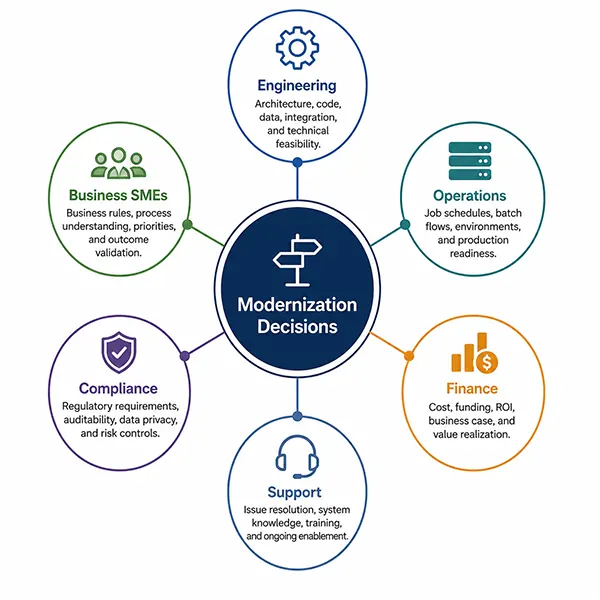
This is one of the reasons modernization governance matters. The project needs a way to make decisions when technical preferences, business constraints, and delivery pressure conflict. Without that decision structure, the vendor may keep moving, but the organization may not be learning fast enough to control the outcome.
Financial-services modernization needs a different level of discipline
COBOL systems in banking, payments, insurance, and other financial domains carry risks that are easy to underestimate from the outside. These systems often deal with money movement, account balances, fees, interest, settlements, claims, eligibility, regulatory reporting, audit trails, and customer-impacting decisions. A small behavioral difference can create financial, legal, or reputational consequences.
A provider does not need to have seen your exact system before, but they should understand the nature of business-critical transaction processing. They should be comfortable discussing reconciliation, auditability, exception handling, batch dependencies, data lineage, access controls, and production change discipline. If the vendor’s language is mostly about migrating code to a newer stack, that may not be enough.
The right question is not only whether the provider can modernize COBOL. The better question is whether they can modernize a system where correctness, continuity, and traceability matter.
Red flags in COBOL modernization proposals
Some warning signs are obvious. Others are subtle because they sound efficient at first.
A provider who says the whole system can be converted automatically without serious business validation is asking for a lot of trust. Automated tools may help, and in some situations they can reduce manual effort, but they do not remove the need to understand what the system does and how the organization depends on it.
Another red flag is a proposal that treats business subject-matter experts as optional. If the current system contains undocumented rules, exceptions, and operational knowledge, the modernization team will need access to people who understand those behaviors. Without them, the project may reproduce code while missing intent.
A big-bang cutover should also be questioned carefully. There are cases where a large cutover is unavoidable, but it should not be the default. A provider should be able to explain why a phased approach is or is not possible, what dependencies prevent it, and how the additional cutover risk would be controlled.
Testing language is another useful signal. If the proposal talks about unit testing but says little about regression behavior, parallel runs, reconciliation, historical data, or business acceptance, it may be treating modernization as a software construction problem rather than a business-continuity problem.
Finally, be cautious when the target architecture appears before the assessment. A vendor may have a preferred platform, tool, or architecture style, but the target architecture should be shaped by the business system, risk profile, integration needs, team capability, budget, and operating model.
A practical scorecard for comparing providers
A simple evaluation scorecard can help separate confident proposals from credible ones.
| Evaluation area | Strong signal | Weak signal |
|---|---|---|
| Pricing | Assumptions are clear, discovery is separated from execution, cost drivers are explained | Fixed price is presented before meaningful assessment |
| Risk management | Provider discusses specific risks, sequencing, rollback, and production continuity | Risk is described in generic project language |
| Testing | Plan includes regression testing, reconciliation, historical data, and business validation | Testing is mostly described as unit testing or code verification |
| Business rules | Provider explains how rules will be discovered and validated with SMEs | Assumes rules can be fully extracted from code or documentation |
| Scalability | Considers volume, batch windows, integrations, operations, and change capacity | Focuses mostly on infrastructure scaling |
| Governance | Includes regular reviews with business, operations, architecture, and delivery stakeholders | Vendor works mostly in isolation |
| Financial systems fit | Understands audit, settlement, reporting, exception handling, and transaction correctness | Uses generic application-modernization language |
| Delivery model | Starts with assessment, roadmap, and controlled execution phases | Pushes quickly toward a large migration commitment |
| Operational readiness | Considers monitoring, support, incident response, and runbooks | Focuses mainly on development and migration tasks |
The scorecard does not replace judgment, but it makes tradeoffs visible. A cheaper proposal may still be the right choice if the system is low-risk and the scope is narrow. For a high-risk financial platform, the cheapest proposal may simply be the one that has ignored the most uncertainty.
Questions to ask before choosing a COBOL modernization provider
A buyer does not need to become a COBOL expert to evaluate vendors well, but the questions should force the provider to expose their thinking.
A useful vendor conversation should make the provider’s thinking visible. Before accepting a recommended modernization path, ask what they would need to understand about the system first, where they expect the highest delivery risk to be, and how they would prove that the new behavior matches the old behavior where it matters. Their answer should cover more than code structure. It should include missing documentation, internal team involvement, test data, business-rule validation, production constraints, and the tradeoffs between rehosting, replatforming, refactoring, replacement, and API enablement.
The strongest providers will not treat those options as interchangeable labels. They will explain why one path fits the current system better than another, what assumptions would need to be tested, and what evidence could change the recommendation.
It is also worth asking what would make them slow down. A mature provider should be able to name conditions that increase risk: unavailable SMEs, weak test data, unclear ownership, unstable upstream systems, poor operational documentation, regulatory constraints, or a codebase that is technically small but business-critical.
If nothing seems to concern them, that is itself concerning.
Where Sharp Logica fits
Sharp Logica approaches COBOL modernization as an architecture and risk-management problem before it becomes a migration project. The first question is not which tool should convert the code or which platform should replace the mainframe. The first question is what the system does for the business, where the real risks are, and which modernization path gives the organization a safer way to change.
In practical terms, that usually starts with assessment. We look at the application landscape, business capabilities, batch processes, integrations, data dependencies, operational constraints, documentation quality, and the organization’s ability to validate behavior. From there, the work can move toward a modernization roadmap, architecture decisions, vendor evaluation, pilot planning, or delivery support.
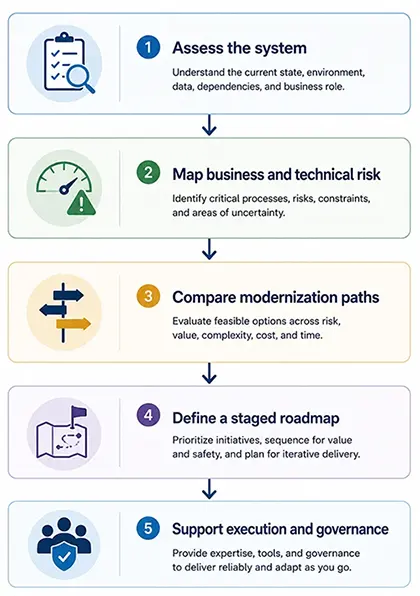
That approach is especially useful when the system is too important for guesswork. A company may eventually decide to rehost, replatform, expose APIs, refactor selected modules, replace part of the system, or retire components that no longer justify their cost. The right path depends on business risk, technical reality, and the organization’s capacity to execute.
Discussion Board Coming Soon
We're building a discussion board where you can share your thoughts and connect with other readers. Stay tuned!
Ready for CTO-level Leadership Without a Full-time Hire?
Let's discuss how Fractional CTO support can align your technology, roadmap, and team with the business, unblock delivery, and give you a clear path for the next 12 to 18 months.
Or reach us at: info@sharplogica.com