
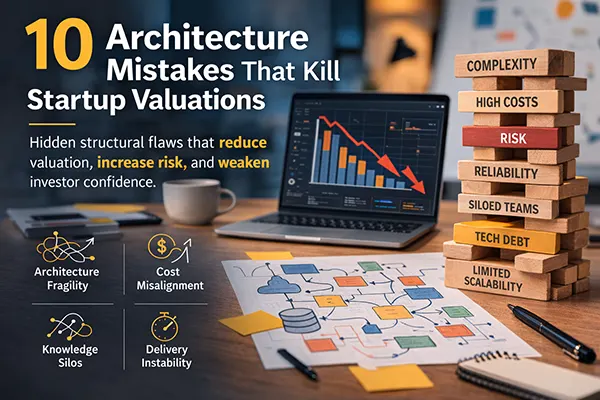
10 Architecture Mistakes That Kill Startup Valuations
Hidden architectural flaws silently reduce startup valuation during technical due diligence. Learn the structural mistakes that increase risk, compress margins, and weaken investor confidence.
Understand how disciplined architecture directly protects enterprise value before funding or exit.
If you are already wrestling with this question in your own company, we offer a 2 week CTO Health Check and ongoing Fractional CTO support. You can book a 30-min free call or view the services whenever it is convenient, or simply email us at info@sharplogica.com if you have specific questions.
10 Architecture Mistakes That Kill Startup Valuations
Most startup founders believe valuation is driven primarily by growth rate, revenue, and market potential. They are only partially right.
When a startup reaches meaningful scale and enters acquisition conversations, architecture suddenly becomes visible. What was once an internal engineering concern turns into a valuation variable.
In technical due diligence, investors are not impressed by clever engineering. They are evaluating whether the system supports durable growth or hides structural fragility. Certain architectural patterns consistently reduce confidence, and reduced confidence lowers multiples.
Over the years, I have seen the same mistakes surface repeatedly. Individually, they look technical. Collectively, they damage enterprise value.
Mistake 1: Designing for Complexity Before Earning It
Many startups adopt distributed systems too early. Microservices, complex orchestration layers, and heavy infrastructure are introduced before the organization has the scale or discipline to manage them.
The result is not flexibility. It is coordination overhead.
When boundaries are unclear and services are tightly coupled through informal contracts, the system becomes harder to reason about. Delivery slows, incident response becomes complicated, and knowledge becomes fragmented.
Investors interpret unnecessary complexity as risk. If the architecture requires senior engineers to constantly mediate between components, scaling the team becomes expensive.
Complexity without leverage is a liability.
Mistake 2: Treating Architecture as a Side Effect of Features
In early growth, product momentum dominates decision making. Features are prioritized based on customer pressure, and architectural considerations are postponed repeatedly.
Over time, this creates a platform that resembles a collection of patches rather than a cohesive system.
The issue is not speed, it is the absence of intentional design.
When architecture evolves accidentally, technical debt accumulates invisibly. Investors look for evidence that leadership understands structural constraints and has a plan to address them. When that awareness is missing, they assume future stabilization costs.
Architecture must be treated as a strategic asset, not as a byproduct of feature delivery.
Mistake 3: Building Without Observability
A surprising number of startups lack basic observability across critical workflows. Monitoring is partial, logging is inconsistent, and metrics are fragmented.
This creates blind spots.
Without visibility, performance issues surface through customer complaints. Capacity limits are discovered during traffic spikes. Failures are diagnosed through manual investigation rather than systematic insight.
From an investor’s perspective, lack of observability signals operational immaturity. Growth amplifies blind spots. If the system cannot be measured clearly, it cannot be governed reliably.
Architecture is not only about structure, it is about clarity.
Mistake 4: Ignoring Cost Architecture
Revenue growth often hides inefficient cost structure. Infrastructure scales organically and resources are provisioned defensively. Data accumulates without lifecycle management.
The absence of cost discipline becomes visible during diligence.
Buyers examine whether infrastructure cost behaves predictably relative to revenue. They assess whether margins are resilient or fragile under different usage scenarios.
When cost drivers are poorly understood, confidence in long term profitability decreases.
Strong architecture includes financial alignment. It treats cost as a first class design constraint rather than an afterthought.
Mistake 5: Concentrating Knowledge in Individuals
In many startups, one or two senior engineers hold critical architectural understanding. They know the fragile integrations, the undocumented assumptions, and the recovery procedures.
This creates dependency risk.
Investors evaluate whether the platform can survive team changes. If onboarding new engineers takes months because knowledge is tribal rather than documented, scalability is compromised.
Healthy architecture is reflected in documentation, ownership clarity, and shared understanding. When the system depends on heroics, valuation suffers.
Mistake 6: Overengineering Security Too Late
Some startups ignore security entirely until customers demand audits. Others implement controls hastily, layering compliance on top of fragile systems.
Both approaches create problems.
Security architecture must evolve with the product. It should be integrated into deployment processes, access control models, and data handling practices from early stages.
When security appears improvised, buyers assume regulatory exposure. In sectors such as healthcare, finance, or enterprise SaaS, this assumption materially affects valuation.
Security maturity is not optional, it is a trust signal.
Mistake 7: Failing to Define Clear Boundaries
Architectural boundaries define how components interact and how change propagates. When boundaries are unclear, small modifications produce unintended consequences.
In such systems, engineers hesitate to refactor. Fear of breaking unknown dependencies slows innovation.
Investors recognize this pattern quickly. They ask how modules are separated, how contracts are defined, and how dependencies are managed.
Clear boundaries enable controlled evolution. Blurred boundaries increase systemic fragility.
Mistake 8: Scaling Headcount Instead of Structure
As complexity increases, some startups respond by hiring more engineers rather than simplifying architecture.
This masks structural weakness temporarily.
More people coordinating around a fragile system increases cost without reducing risk. Delivery slows because communication overhead grows.
Architecture should reduce coordination load, not amplify it. If growth requires proportional increases in engineering headcount, operating leverage is weak.
Weak leverage reduces valuation.
Mistake 9: Integrating AI Without Architectural Containment
In recent years, many startups have layered AI capabilities onto existing systems without designing containment mechanisms.
LLM driven features introduce cost variability, latency unpredictability, and external dependency risk. Without clear boundaries, AI components can affect core workflows in unintended ways.
Investors will evaluate whether AI features are bounded and governed or loosely attached.
Innovation that increases systemic exposure without increasing defensibility does not improve valuation. It increases risk.
Mistake 10: Failing to Periodically Recalibrate Architecture
The final mistake is cultural. Many startups never pause to reassess whether their architecture still matches their scale.
The system that supported one million in revenue may not support twenty million efficiently. Yet leaders often assume incremental patches are sufficient.
Architecture requires periodic recalibration aligned with business trajectory. Without it, complexity accumulates silently until it becomes visible during diligence.
At that point, leverage is limited.
Why These Mistakes Matter Financially
Architecture is not evaluated in isolation during acquisitions. It is evaluated as a driver of risk, margin stability, and execution confidence.
If growth magnifies fragility, valuation decreases. If architecture supports predictable expansion, valuation increases.
The startups that negotiate from strength are rarely the ones with the most fashionable stacks. They are the ones with structural discipline, cost awareness, delivery predictability, and knowledge resilience.
Architecture is not a technical luxury. It is a valuation multiplier.
If this mirrors your situation and you want concrete next steps, here is how we can work together:
CTO Health Check (2 weeks). A focused diagnostic of your architecture, delivery, and team. You get a clear view of risks, a 6 to 12 month technical roadmap, and specific, prioritized recommendations.
Fractional CTO services. Ongoing strategic and hands-on leadership. We work directly with your leadership team and engineers to unblock delivery, de-risk key decisions, and align technology with revenue.
30 minute FREE consultation. A short working session to discuss your current situation and see whether our support is the right fit for your company.
If you want an early-stage architecture baseline before a formal review, start with the Architecture Scorecard.
To explore these options, you can book a call, view the services, or email us at info@sharplogica.com with any specific questions.
Discussion Board Coming Soon
We're building a discussion board where you can share your thoughts and connect with other readers. Stay tuned!
Ready for CTO-level Leadership Without a Full-time Hire?
Let's discuss how Fractional CTO support can align your technology, roadmap, and team with the business, unblock delivery, and give you a clear path for the next 12 to 18 months.
Or reach us at: info@sharplogica.com