
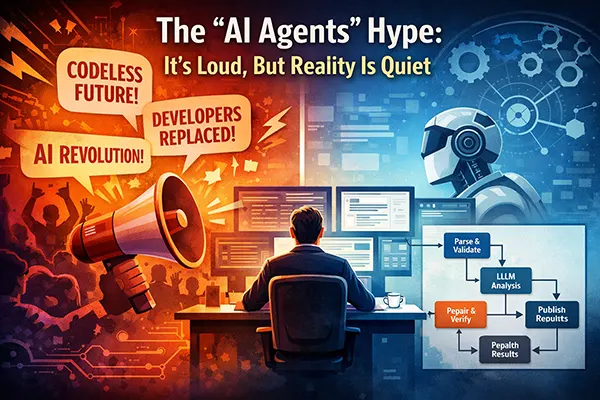
The AI Agents Hype: Loud Claims, Quiet Reality
The hype says AI agents will replace developers. Reality is much quieter: value comes from workflow-first systems with bounded, auditable LLM steps.
This is how you avoid demo-driven engineering and ship systems that you can actually operate.
A CTO-level view, backed by DORA, METR, McKinsey, and Goldman Sachs.
The "AI Agents" Hype: Loud Claims, Quiet Reality
If you spend time on LinkedIn or X, you've seen the same storyline repeated with increasing volume: "Humans will never write code again", "I used agents to do the job and laid off 15 developers", "One person with agents now replaces an entire team".
Then you try agent frameworks yourself and the experience is...well, underwhelming. Things fail in strange ways. Tool calls are flaky. The agent loops. The output looks plausible but breaks the moment you apply real constraints. And the most frustrating part is that, as an experienced engineer, you can already build the same thing with explicit orchestration and far more control.
So why are so many people screaming "AI agents" while many CTOs and senior engineers don't see a breakthrough?
This post is a CTO-level view of what "agents" really are, why the hype is so intense, what credible research and surveys suggest about real impact, and how to think about agentic systems in a production-grade way without turning your engineering organization into a demo factory.
AI is mostly evolution, and that is fine
AI is absolutely moving the industry forward. It reduces friction, accelerates certain tasks, and changes how work is done. But for most companies, it behaves more like an evolution of tooling than an overnight replacement of engineering.
That aligns with what we see in large enterprise surveys: adoption is rising, experimentation is widespread, but scaling repeatable value across an organization remains hard. McKinsey's reporting repeatedly emphasizes that many organizations have not yet converted gen AI excitement into enterprise-wide impact, largely because process, governance, and measurement lag behind tool adoption.
The most practical takeaway for leadership is simple: do not confuse "we can demo it" with "we can run it."
What people actually mean by "AI agents"
The word "agent" has become a marketing bucket. In most real implementations, an "agent" is simply:
- an LLM connected to tools (search, APIs, databases, internal systems),
- running in a loop,
- with some notion of state or memory.
This can be useful. It can also be dangerous. Because the definition does not automatically include reliability guarantees, auditability, deterministic behavior, or clear ownership.
If you already know how to run complex systems, you've seen this movie before. The "agent" is not magic. It's orchestration with an LLM acting as a policy function that proposes the next action.
The difference between a prototype and a product is what surrounds that proposal: constraints, validation, budgets, retries, and observability.
Why the loud "agents replaced developers" claims are not a reliable signal
The most viral claims are usually the least representative.
First, social platforms reward extremes. "We reduced cycle time by 10%" is boring. "Developers are finished" gets engagement.
Second, many stories quietly redefine "done". In a large portion of agent success posts, "done" means a prototype or a one-off output, not a long-lived product with quality gates, security posture, monitoring, and operational responsibility.
Third, layoffs are often multi-causal. It is easier to say "AI did it" than to explain a mix of overhiring, scope reduction, budget constraints, or shifts from build to buy.
Finally, credible data on developer productivity is more nuanced than the hype. One widely discussed randomized controlled trial by METR on experienced open-source developers working in their own repositories found that allowing AI tools made them about 19% slower on the assigned tasks, and that perceptions of speed did not reliably match measured outcomes.
For a CTO, this matters. It's a reminder that productivity claims must be measured in the context of real codebases, real constraints, and real accountability, not perceived speed or demo performance.
The system matters more than the tool (DORA's "amplifier" effect)
DORA's 2025 research is helpful because it reframes the debate. The core message is not "AI makes teams fast." It is that AI tends to amplify whatever system you already have.
If you have disciplined delivery, small batch sizes, clear ownership, strong testing, and strong observability, AI can accelerate meaningful parts of work.
If you have unclear priorities, large PRs, weak quality gates, and high coordination overhead, AI tends to increase output volume without improving outcomes. You can ship more, faster, and still lose, because the constraint is not output. It's correctness, alignment, and trust.
DORA's lens pushes leaders toward the right strategy: invest in the surrounding engineering system, then apply AI where it supports that system, rather than hoping AI replaces the need for discipline.
Macro reality: potential productivity, uneven transitions
At the macro level, there is credible analysis suggesting substantial productivity potential from generative AI, but not a clean "job wipeout."
Goldman Sachs, for instance, has published work arguing that broad adoption of generative AI could raise productivity meaningfully over time and lift GDP, while also acknowledging the transition could be disruptive and uneven.
This is the right mental model for leadership: AI can compress some tasks, shift skill premiums, and change hiring mixes, but it does not remove the need for engineering ownership. It increases the premium on the people and systems that can turn capability into reliable delivery.
The practical truth: most agents that work are bounded
Here is the difference between "agent hype" and "agent reality" in production environments:
In production, the successful pattern is rarely "let the agent run the show." It is workflow-first, with bounded agentic decisions.
Your workflow owns the guarantees:
- deterministic control flow where it matters
- idempotency, retries, and timeouts
- token and cost budgets
- policy enforcement and validation
- audit logs and observability
The LLM is used in confined places where it is genuinely strong:
- interpreting messy inputs into structured representations
- routing decisions when the decision tree is too large to hand-code
- drafting outputs that can be validated and revised
In other words, the useful part of "agents" is not autonomy. It is flexible judgment inside a constrained system. The "agent-like" behavior is best confined to narrow decision points and bounded repair loops.
Why Microsoft and the other ecosystems look "messy"
Many leaders point to the churn in frameworks as evidence that "agents aren't real." The ecosystem does look messy.
For instance, MS first started with Semantic Kernel and AutoGen, two completely different tracks from two different divisions. Developers had to choose between the innovation (AutoGen) and stability (Semantic Kernel). Both teams worked separately creating a fragmentation. That was in 2023 and 2024...in mid-2024 we've seen rapid, breaking changes, with only a version 0.2! Then a complete rewrite to 0.4 with incompatible architecture, and Semantic Kernel adding "Process Framework" for workflows. Then they drop it all together and announced converging to Microsoft Agent Framework, which only materialized in October 2025, just two months ago. GA is planned for Q1 2026, hopefully.
Does this look like a company that has a clear path and knows what they were doing? And this is Microsoft, not just some small company that started one or two years ago. If you have invested time to learn and use it, then you just get frustrated when they tell you: "Hey, now use this third thing". So, why is this all happening? Well, because of one simple truth: Microsoft also needs a coherent agent narrative for Azure, which is understandable. That's all there is to it. More focus on Azure and more usage, more revenue from it. And that's fine, Azure is certainly great.
The situation is not much better with other frameworks, like LangChain or Crew AI.
For a CTO, the correct response is pragmatic: avoid deep coupling to immature abstractions, and design your architecture so tools can be swapped as the market stabilizes. This is the smartest path forward.
Beware of hype cycles
This is generally true. We need to stay realistic and not give in to the hype. Let me quickly share a few anecdotal points, and take a short stroll down the memory lane:
- Agentic AI (2026): discussed in this article.
- Bitcoin/Blockchain (2017): everything will change, no more money, everything will be Bitcoins...all supply chains will be run on Blockchain, banks will not exist, everything will be decentralized, the whole world will be transformed. After the first wave of hype faded, maybe 80% of it disappeared and the remaining 20% became the real, durable thing: Blockchain. Fast-forward to 2026. I had to pay for a coffee the other day, but the POS terminal was down due to a communication issue. So I reached into my pocket, took out some cash, you know, a piece of paper with a picture on it that has no intrinsic value, but it works because the government says it does (finance people would also call it fiat currency), and I paid the bill. Go figure.
- IBM Watson (2011-2020): revolution in healthcare, legal and finance! It will diagnose cancer better than doctors, will completely replace junior lawyers (sounds familiar?), will transform customer service. Now the reality: project failed, never fully deployed, could not handle medical complexity, recommendations sometimes even dangerous...several high-profile efforts were scaled back or discontinued. Quote from doctor: "Was worse than a medical student".
- Low-code (2010): low-code tools are here, they will eliminate most of developers. (sounds familiar?)
- Second Life/Virtual Worlds (2006-2010): all commerce will move to virtual worlds, companies that do not have Second Life presence do not exist, real-estate investment in metaverse is a sound investment! The reality: 90% of Second Life was empty in 2 years, abandoned ghost cities, no one wanted to shop using a flying avatar, it was mostly people who were selling metaverse consulting.
- Outsourcing (2000): outsourcing will completely eliminate US developers. (sounds familiar?)
- 4GL (1980s-1990s): Fourth Generation Languages, that are: "So high level that business users can write applications! No programmers needed!". (sounds familiar?)
- CASE tools (1980s): CASE tools will eliminate programmers. (sounds familiar?)
- COBOL (1960s): COBOL will make programming so easy anyone will be able to do it, and it will lead to the saturation and consequent loss of jobs. (sounds familiar?)
and many many more....(2013-2015) Google Glass! (2010-2015) Big Data will replace analytics! (2000s) The Semantic Web! (2005-2010) SOA taken to religious extremes!
Don't we learn anything?
I can understand people who raise billions for building the AI infrastructure, they certainly need these hypes, however they are but a few...what I do not understand is why so many other people get swept up.
We have also seen these before:
- Everyone said cloud would eliminate ops teams -> Created DevOps as a discipline
- Everyone said Agile would eliminate project managers -> Created Scrum Master as a role
- Everyone said microservices would simplify architecture -> Created chaos, that needs what? More architects.
AI agents will create more need for people who understand systems, not less.
The difference is:
- Junior devs who just translate specs to code -> Threatened (the entry level bar is raised)
- Senior engineers who understand why systems are built the way they are -> More valuable
- Architects/CTOs who can see second-order effects -> Critical
How to recognize the hypes?
I have wasted many an hour tilting at that particular windmill, and believe it or not after a while the patterns start to emerge...it goes something like this:
PHASE ONE: The Vision (0-6 month)
- TED or similar talk with hockey-stick growth chart...very convincing. I mean it goes up almost ballistic, don't you see that chart?
- "This changed everything"
- Gartner adds it at "Peak of Inflated Expectations"
PHASE TWO: The Land Grab (6-18 month)
- Consultants emerge, offering expertise in 6-month-old tech!
- Conferences pop up ($2000/ticket)
- Executives get FOMO (Fear of Missing Out)
- "We need a [blockchain/microservices/AI agents/metaverse] strategy"
PHASE THREE: The Emperor's New Clothes (18-36 month)
- Quiet pilot projects that "aren't quite ready"
- Budgets balloon
- "We need more time/data/compute"
- Press releases about "promising results"
PHASE FOUR: The Reckoning (36-60 month)
- Projects quietly shelved
- "Pivoting to enterprise" (code for: consumers don't want it)
- Early adopters write blog posts about "lessons learned"
- Technology becomes niche tool instead of revolution
PHASE FIVE: The Next Hype Cycle
- Same vendors, same promises, new buzzword
- No one mentions the previous failure
- "This time it will be different"
It's the same cycle. Every. Single. Time.
Why? Consultants bill by hour (complexity=revenue), vendors need growth stories for investors, executives need to look visionary, media needs clicks, no one ever gets punished for failures.
Psychology? Sunk cost fallacy (after the money has been spent), confirmation bias (or simply: ignoring evidence it is failing), fear of missing out and being left behind (stems from the personal insecurities), tendency to believe in magical solutions.
Meanwhile, billions of dollars in technical debt accumulate every day across existing systems.
When somebody tells you "AI agents will replace developers"
When someone says "AI agents will replace developers," my response is:
"Great! Which specific decision-making capabilities have you automated? Because in my experience, 80% of software engineering is figuring out what NOT to build, understanding context that's not in the spec, and making tradeoffs between options that are all technically viable. If you've solved that, I'd love to see the architecture."
This usually ends the conversation quickly.
The Uncomfortable Truth About "Agent Productivity"
I think we've addressed the "replacing developers with AI agents" claims. Now let's move on to the other big promise: "dramatically increased productivity with AI agents".
When companies claim "10x productivity gains", here's what's actually happening:
Before AI agents
Junior dev writes code -> Senior reviews -> QA tests -> Ships
Time: 2 weeks, Quality: High
After AI agents
AI generates code -> Developer reviews/fixes/rewrites -> QA finds edge cases -> Developer fixes AI mistakes -> QA tests again -> Ships
Time: 1.5 weeks, Quality: Medium, Technical debt: Accumulating
The problem is that these claims measure only "the first draft faster", and ignore:
- Code review time increased
- Bug fix cycles increased
- System complexity creeping up
- The senior dev who actually understands the domain is now buried in reviewing AI input
This quickly becomes the problem. Don't get me wrong. I am saying this out of professional honesty, because I am trying to give a realistic view, and the situation seems to be getting worse day by day.
And in all sincerity, I probably shouldn't even care, because this trend actually creates more work for me as a fractional CTO. Why? Because when a company tries to "replace developers with AI agents", the net result usually looks like this:
- Codebase becomes unmaintainable spaghetti,
- No one understands the system architecture,
- Simple changes take weeks because everything's coupled,
- They get desperate for someone who can actually think about systems
Then they call me. Or somebody like me, who does the same job.
Closing: the future is quieter than the hype
The online noise makes it sound like the future is "agents replacing developers."
A more accurate future is quieter and more boring, in the best way:
- better tools
- more automation in narrow tasks
- stronger workflows
- stronger engineering discipline
- higher premium on ownership and system design
If you don't see the magic of agents in production contexts, you're not behind. You're applying the right bar. And in the long run, that bar is what separates companies that demo from companies that ship.
A handful of players can afford the hype cycle because it helps them raise billions. The rest of us are sitting on billions in accumulated technical debt, legacy systems, brittle integrations, and operational risk. That's what moves the business. That's what burns budget and slows delivery. And that's what we need to roll up our sleeves and fix, with or without agents.
mirano@sharplogica.com
Discussion Board Coming Soon
We're building a discussion board where you can share your thoughts and connect with other readers. Stay tuned!
Ready for CTO-level Leadership Without a Full-time Hire?
Let's discuss how Fractional CTO support can align your technology, roadmap, and team with the business, unblock delivery, and give you a clear path for the next 12 to 18 months.
Or reach us at: info@sharplogica.com