
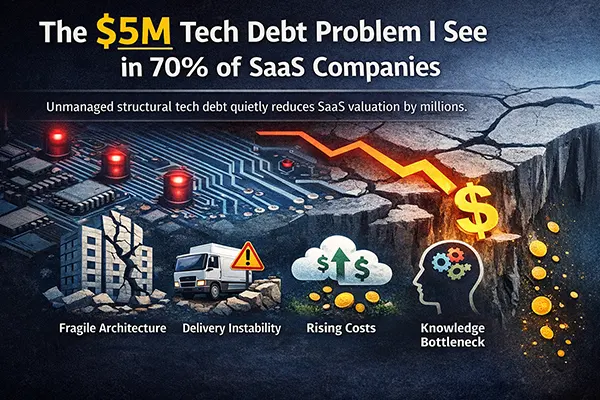
The $5M Tech Debt Problem I See in 70% of SaaS Companies
Unmanaged structural tech debt quietly reduces SaaS valuation by millions. Discover how architecture fragility, delivery instability, cost drift, and knowledge concentration create hidden acquisition risk.
The five million dollar problem rarely arises from incompetence.
If you are already wrestling with this question in your own company, we offer a 2 week CTO Health Check and ongoing Fractional CTO support. You can book a 30-min free call or view the services whenever it is convenient, or simply email us at info@sharplogica.com if you have specific questions.
The $5M Tech Debt Problem I See in 70% of SaaS Companies
There is a structural issue I repeatedly encounter in SaaS companies between roughly three and twenty five million in annual revenue. It is rarely visible in board decks, almost never quantified in financial models, and frequently underestimated by founders who are focused on growth. Yet in acquisition scenarios, it quietly reduces valuation by millions.
I refer to it as the five million dollar tech debt problem.
The number is symbolic, not precise. But in mid market transactions, unmanaged technical exposure often translates into several million dollars in price adjustments, additional escrow terms, or post acquisition stabilization investments. What makes this especially concerning is that most companies carrying this burden do not see it as a systemic issue. They experience it as operational friction rather than enterprise risk.
The problem is not messy code, it is not outdated frameworks, it is not even the existence of technical debt in the traditional sense. The real issue is a lack of structural control over the technology that generates revenue.
Debt That Lives in Architecture, Not in Backlogs
When most leaders hear the phrase tech debt, they think of refactoring tasks or legacy modules that need cleanup. That view is too narrow. The kind of debt that damages valuation is architectural and operational. It lives in the way systems are connected, in how changes move into production, and in how knowledge is distributed across the organization.
In early growth, speed is rational. Features are shipped quickly to secure customers, integrations are added under commercial pressure, and infrastructure decisions are made with urgency rather than long term elegance in mind. None of that is inherently wrong.
The difficulty emerges when revenue scales but the underlying structure does not mature alongside it. Over time, I see a consistent pattern in companies that later struggle during diligence:
- Components become tightly coupled, so small changes ripple unpredictably across the system.
- Deployment processes depend on senior engineers coordinating manually rather than on disciplined automation.
- Monitoring is reactive, meaning issues are discovered by customers before they are detected internally.
Individually, each of these seems manageable. Collectively, they form a system that functions through experience and effort rather than through design and control.
During due diligence, experienced investors sense this quickly. They look for evidence that leadership understands where the platform is constrained and where risk accumulates. When those signals are weak or inconsistent, uncertainty increases, and uncertainty directly reduces valuation.
How Valuation Is Quietly Reduced
Private Equity models are built on projected future cash flows. Technology influences those projections in three major ways: through capital requirements, margin stability, and execution reliability.
If a platform requires significant stabilization after acquisition, that represents future capital the buyer must invest. If infrastructure costs scale unpredictably with usage, margin projections become fragile. If delivery processes are inconsistent, product roadmaps lose credibility.
Even without a visible crisis, structural weakness alters the perceived risk profile of the business. Buyers respond by adjusting price, tightening deal terms, or demanding additional protections. In mid market SaaS transactions, that adjustment can easily reach several million dollars.
The critical insight is that this discount rarely comes from dramatic technical failure. It comes from a pattern of limited visibility and limited control. Investors are more tolerant of known weaknesses than of ambiguous ones. When leadership cannot articulate where constraints lie or how they are managed, confidence erodes quickly.
The Illusion of Modernity
One of the most persistent misconceptions I encounter is the belief that modern tooling equates to maturity. Companies may run containerized services, maintain CI pipelines, and integrate AI features into their products. These choices are not negative, but they are not sufficient.
Modern infrastructure does not guarantee disciplined architecture. In some cases, premature complexity increases exposure. Distributed systems introduce coordination overhead. Microservices without strong boundaries create more integration points to fail. AI components add cost variability and operational unpredictability if they are not carefully bounded.
Investors are not impressed by architectural fashion. They are evaluating whether the system is understandable, observable, and economically aligned with the business model. A well governed modular monolith can be more attractive than a loosely controlled distributed system. What matters is clarity, predictability, and cost discipline.
The companies that protect valuation are not necessarily the most ambitious technically. They are the most deliberate.
Delivery Stability as a Financial Signal
Release behavior is one of the clearest indicators of hidden structural debt. In many SaaS companies, deployments carry an undercurrent of stress. Minor changes occasionally produce unexpected side effects. Rollbacks, while not constant, are not rare.
These are not merely operational annoyances. They are financial signals.
Investors want to understand how reliably the organization can execute over the next several years. They look at:
- Frequency and severity of production incidents.
- Time required to detect and recover from failures.
- The degree to which deployments can occur without disrupting customers.
If the answers suggest fragility, growth appears risky. A platform that struggles at current scale will struggle more at larger scale. Conversely, a system that demonstrates calm, predictable delivery builds confidence that revenue expansion will not introduce chaos.
Delivery predictability is not just an engineering virtue. It is an economic asset.
Cost Structure as a Proxy for Governance
Cloud infrastructure has made scaling easier, but it has also made inefficiency easier to conceal. I regularly see environments where spending has increased steadily without systematic review. Resources remain over provisioned. Data accumulates without lifecycle management. Environments proliferate without clear ownership.
The issue is not that costs grow. The issue is whether growth is intentional and understood.
A mature SaaS organization can explain how infrastructure expense relates to revenue and how margins behave under different usage scenarios. It understands its cost drivers and treats architecture as a financial lever rather than a technical afterthought.
When cost behavior appears accidental rather than controlled, investors assume margins are vulnerable. Vulnerable margins reduce confidence in long term profitability. Even if current earnings are healthy, uncertainty about cost trajectory lowers the multiple buyers are willing to pay.
Knowledge Concentration and Organizational Fragility
Technology risk also resides in people. In many companies, a small number of engineers hold disproportionate architectural knowledge. They understand the fragile integrations, the historical tradeoffs, and the unwritten recovery procedures.
As long as those individuals remain, the system functions. From an investor’s perspective, however, this creates dependency risk. If key contributors leave after acquisition, the platform may become slower to evolve and more expensive to maintain.
Strong organizations mitigate this risk deliberately. They document core systems, clarify ownership, and reduce reliance on heroics. They build processes that survive personnel changes. When buyers see evidence of this discipline, confidence increases. When they see reliance on a few indispensable individuals, they factor in transition risk into the deal structure.
Avoiding the Five Million Dollar Discount
Avoiding this valuation erosion does not require a complete rewrite. It requires visibility and alignment.
Leadership must develop a clear architectural view that connects technology directly to revenue flows. Risks should be identified explicitly and prioritized by business impact. Delivery stability and cost behavior should be measured consistently, not as vanity metrics but as governance tools.
Most importantly, technology leadership must frame architectural decisions in financial language. When engineering tradeoffs are discussed alongside margin implications and risk exposure, the organization aligns around enterprise value rather than technical preference.
The five million dollar problem rarely arises from incompetence. It arises from growth without structural recalibration. Companies that periodically realign architecture, operations, and governance with their revenue trajectory protect their valuation long before entering a transaction.
In competitive acquisition environments, that discipline is often the difference between negotiating from strength and accepting a discount.
Technology does not merely enable revenue, it shapes the risk profile of the entire business. When that profile is controlled, valuation follows.
If this mirrors your situation and you want concrete next steps, here is how we can work together:
CTO Health Check (2 weeks). A focused diagnostic of your architecture, delivery, and team. You get a clear view of risks, a 6 to 12 month technical roadmap, and specific, prioritized recommendations.
Fractional CTO services. Ongoing strategic and hands-on leadership. We work directly with your leadership team and engineers to unblock delivery, de-risk key decisions, and align technology with revenue.
30 minute FREE consultation. A short working session to discuss your current situation and see whether our support is the right fit for your company.
If you need a quick estimate of debt exposure before a deeper review, use the Technical Debt Calculator.
To explore these options, you can book a call, view the services, or email us at info@sharplogica.com with any specific questions.
Discussion Board Coming Soon
We're building a discussion board where you can share your thoughts and connect with other readers. Stay tuned!
Ready for CTO-level Leadership Without a Full-time Hire?
Let's discuss how Fractional CTO support can align your technology, roadmap, and team with the business, unblock delivery, and give you a clear path for the next 12 to 18 months.
Or reach us at: info@sharplogica.com